 English
 Español
 Português
 Deutsch
 Français
 Italiano
 Nederlands
 العربية
 日本語
 한국어
 ไทย
Quick Answer
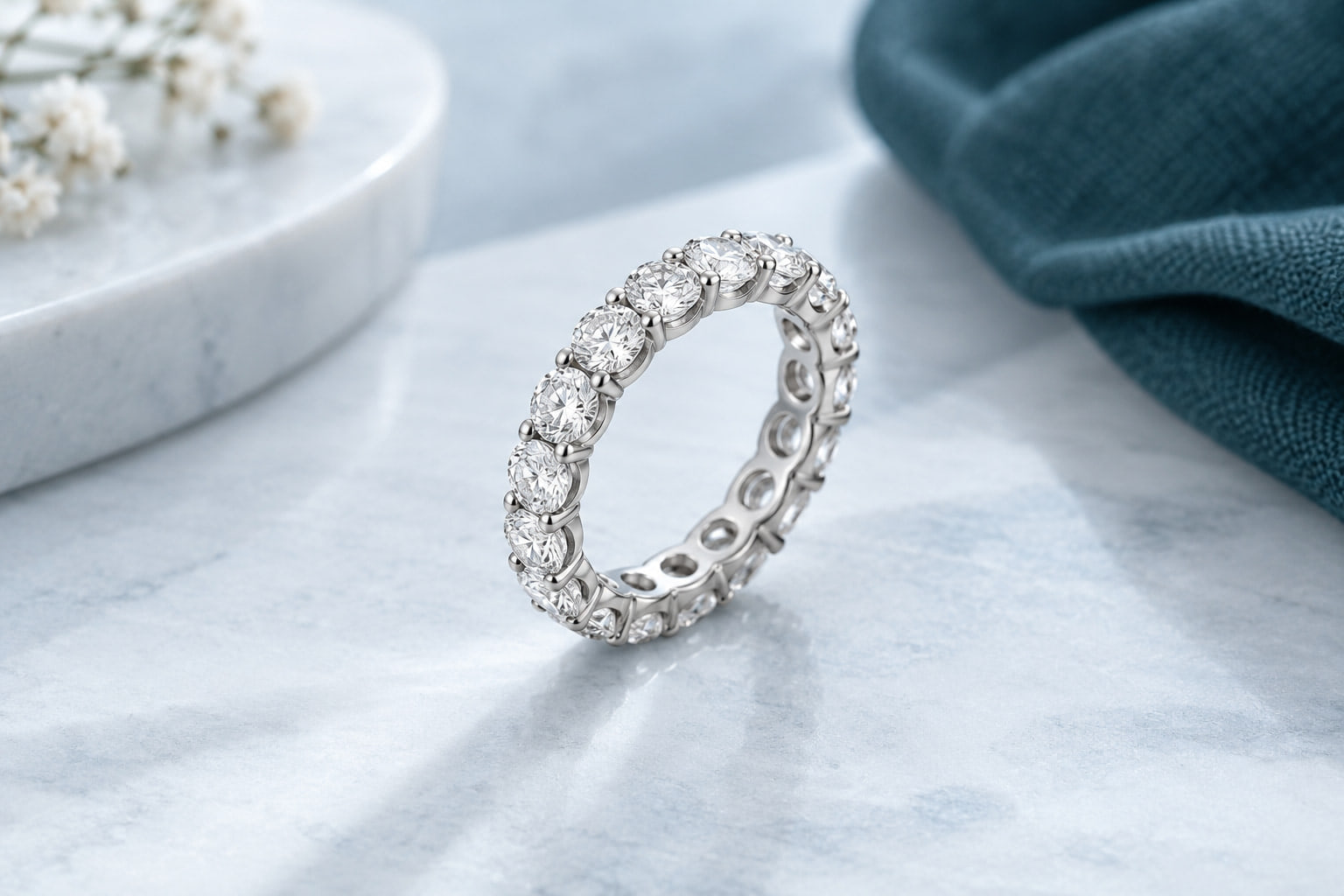
A lab grown diamond eternity ring with diamonds around its full circumference must be planned by ring size, stone count and setting geometry together. Do not assume one diamond count serves every size or that a finished full-eternity band can be resized like a plain metal ring. Ask the jewelry maker for a size-specific drawing and a written service approach, then approve physical samples at the relevant size boundaries. Select stones against the accepted seat windows and preserve a matching reference for replacements. Distinguish full eternity from half eternity and finite five- or seven-stone bands. For procurement, a continuous appearance is the design goal; a controlled count, fit and service record makes that goal reproducible.
Why Does a Full-Circle Stone Row Need Size-Specific Counts?
A continuous row has to close at a seam in its pattern, even when that seam is visually unobtrusive. The producer must reconcile the ring's geometry, stone dimensions, spacing and setting structure. A size change alters that relationship. The maker may use a different count, a revised seat schedule or another explicitly approved design approach. None should be inferred from the phrase eternity ring.
Specify the sizing system and the producer's measurement method. Record the finished size, width and profile on the accepted sample. A broad retail size label without the corresponding production reference invites confusion when different workshops or markets use different conventions. Avoid creating your own conversion chart from memory; have the producer identify the exact size being supplied.
Ask where the row's closure is reviewed and how the last positions match the repeating pattern. A buyer should not discover after setting that the final interval differs conspicuously from the rest. Inspect the full circumference in sequence, with a reference mark that makes the orientation reproducible in photographs.
Use calibrated diamond parcels when the design repeats one seat family. Calibration supports repeatability, but it does not determine the maker's ring circumference or authorize a different stone count.
Exchange VS Remake VS Assessed Alteration: What Service Route Is Agreed?
| Service question | Exchange | Remake | Assessed alteration |
|---|---|---|---|
| Object supplied | Another accepted finished ring in the requested size | A newly produced ring against an approved size-specific drawing | The original ring after work the producer considers feasible |
| Evidence needed | Replacement size, condition and technical version | New count and seat schedule, materials scope and sample approval | Actual ring inspection and a written construction-specific proposal |
| Stone identity | Do not imply the replacement contains the original stones | State whether original stones are reused or a new parcel is supplied | Record what is removed, replaced or retained |
| Commercial responsibility | Define return eligibility and replacement charges | Define recovery, labor and new-material charges | Define assessment, work and rejection terms |
| Limit | Available accepted stock and policy conditions | Feasible approved design and production scope | May be declined after inspection |
These are routes to agree, not claims that all three are available for every full-eternity ring. The producer must assess its construction. A retailer should publish only the actual agreed options, keeping technical feasibility distinct from its own return policy. Full circumference coverage makes the disposition of the original ring and its stones especially important.
Distinguish this problem from general stacking-range planning. The present brief concerns continuity at the row closure and what happens when the accepted closed circle needs service. A finite anniversary row has a different endpoint and should not inherit this service schedule.
How Should an Eternity Ring Size Run Be Approved?
Build a size matrix before selecting the bulk parcel. For each offered size, list the producer's count, measured stone window, ring width, profile and component revision. Identify which sizes share the same stone family and which need a different selection. A common retail style number can still contain several technical versions.
Ask the maker which boundary samples are needed. For example, a count change between two adjacent sizes deserves direct review because the visual rhythm or gap pattern may change. Do not assume the sample in the middle of the range represents the smallest and largest versions. The buyer should understand where the design changes, rather than receiving only an average size.
For each sample, inspect the whole circumference from the side and top. Note consistent table presentation, spacing and any visibly different interval near the pattern closure. Have the producer explain the setting contacts and its final verification. The buyer's visual checklist complements that process; it is not a substitute for the producer's technical responsibility.
The melee buying guide can structure dimensional and condition fields. Add the size matrix so a new supplier understands how many accepted stones are needed for each finished version, not simply how many carats the whole launch might consume.
Decide how the collection handles made-to-order sizes outside the stocked range. A buyer may offer a limited initial size run, request a separate sample for an additional size, or defer that size until the producer confirms a workable schedule. Do not publish an unlimited size selector while the supplier has approved only a few versions. The product-data team should receive the exact supported range and any distinct lead-time arrangements.
Also distinguish nominal stone count from actual mounted weight. If a larger size uses one additional stone, its combined weight can differ even when the face-up stone family is unchanged. Give the commercial team a verified disclosure basis for each version rather than copying one headline total across all sizes. Do not invent a single fixed weight from the count matrix alone.
Make the closure location traceable even if the final jewelry has no visible mark there. The maker can identify it through a drawing coordinate and a controlled inspection photograph. Without that reference, two reviewers may inspect different intervals and talk past one another. The closure record should travel with the accepted sample and the producer's final inspection instructions.
Hypothetical Example: A Closure Seam That Breaks the Pattern
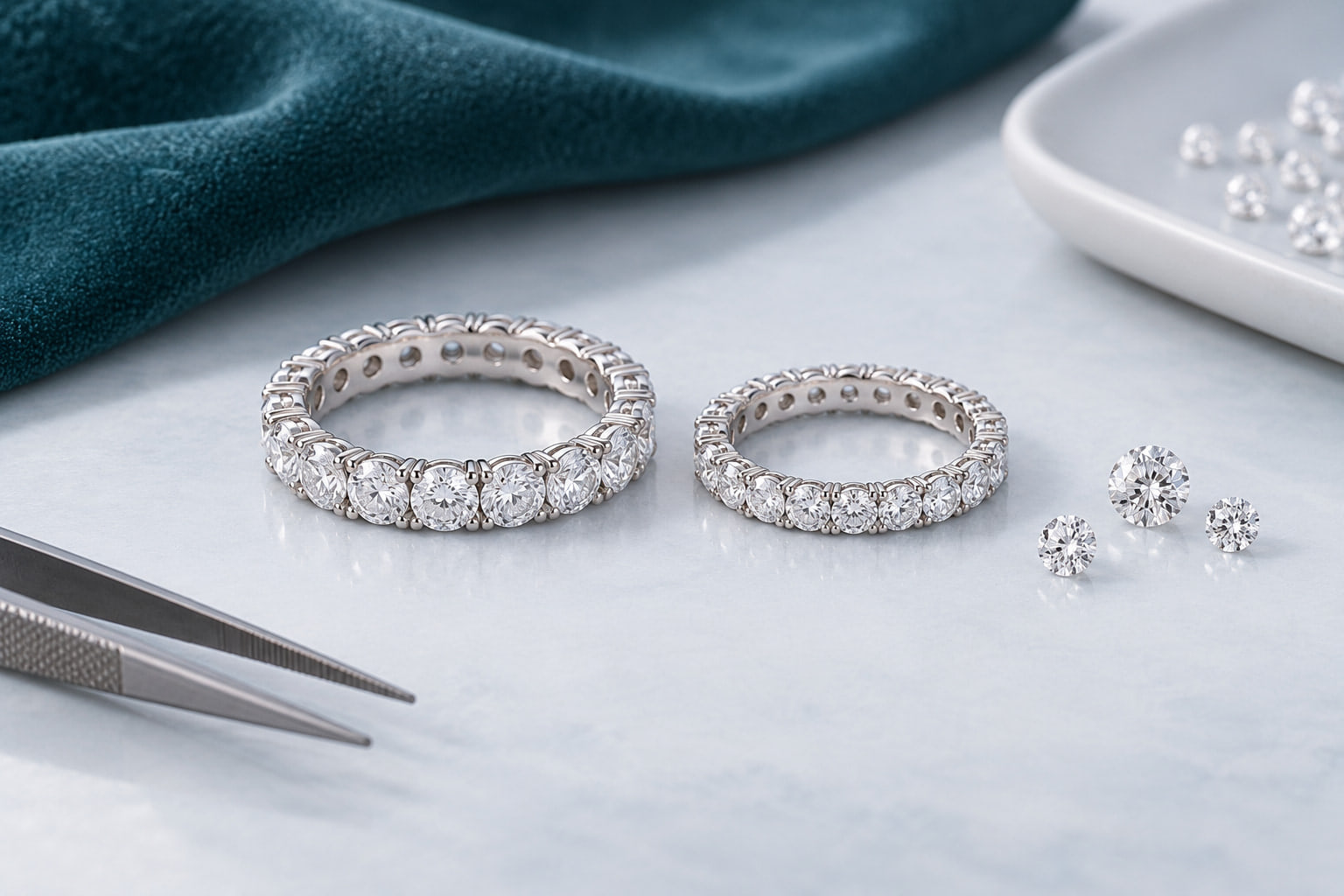
Consider an invented full-eternity prototype with 24 repeating positions. The buyer marks the pattern closure as position 24-to-1 and photographs the entire circumference in six overlapping views. Most visible intervals appear consistent, but the closure view shows a conspicuously wider gap. The count is correct; the visual pattern is not. A bulk count check would miss the problem entirely.
The buyer compares the seam photograph with the accepted drawing and asks the producer to investigate. The producer identifies two possible remedies for review: redistribute the seat locations while retaining the accepted stone family, or revise the closing positions with a different measured selection. Neither is approved merely because it closes the circle numerically. The buyer needs to see how the transition reads beside the repeating positions.
For the revised sample, the producer retains the 24-position family and adjusts its layout. The buyer repeats the six-view record, locating the same seam. This time the closure no longer presents the obvious interruption under the agreed viewing conditions. The approval records that observation and the drawing revision; it does not invent a maximum universal gap or claim a certified tolerance.
Later, a returned ring needs a size the retailer does not stock. The service agreement offers a remake after assessment. Before authorizing it, the buyer asks whether the original stones can be used in the new approved schedule, which must be separately confirmed. The quotation identifies any additional stones, recovery work and new materials. Stone identity is preserved in the service record rather than implying that the remade ring necessarily contains every original diamond.
Which Channel Can Preserve Full-Eternity Size Schedules?
Ask every channel whether it is quoting loose stones, completed bands or a service arrangement. The evidence needed for a continuous ring is a controlled size matrix and an accepted sample, not a general claim that the supplier sells wedding jewelry.
USA / Size exchange and service scope
What Should a US Retailer Resolve Before Offering Full Eternity?
Stuller is an example of a US loose lab-grown channel. Access to replacement stones does not establish that a completed full-eternity ring can be resized. The retailer should obtain the actual maker's service approach before publishing size-change terms.
Ask a local bench to assess the precise construction rather than a generic product name. If the proposed remedy is an exchange or remake, identify how the original ring, replacement size and customer approval are recorded. Keep technical feasibility separate from the retailer's commercial return policy, which may impose its own conditions.
For a stocked size run, compare the supplier's available counts and dimension windows with the producer's matrix. A repair parcel may support one size version but not another. Retain the accepted boundary samples so staff can identify the correct technical reference when a customer requests a different size. This reduces the temptation to promise a simple alteration before the producer has reviewed the ring.
CHINA / Size-mix translation
How Should a Chinese Coordinator Allocate Full-Circle Parcels?
For China-facing sourcing, give the coordinator the finished-ring size mix and the producer's stone consumption by version. MEITUO in Qingdao can coordinate loose selection, but it needs that matrix to translate a commercial ring order into accepted stone counts. Sixty rings is not a complete diamond requirement when the sizes use different schedules.
Mark which stone families can be pooled and which must remain separate. If the retail team shifts quantities toward larger sizes, send a revised allocation rather than asking the workshop to borrow stones from another version. Ask the coordinator to confirm whether the available parcel still meets the revised requirement after dimensional selection.
For packing, use labels tied to the technical versions or the receiving workshop's approved common groups. Keep any service stock clearly outside production consumption. At the first repeat order, check that the maker has not altered the count or seat spacing. A familiar retail style code can conceal a changed closed-circle schedule unless the revision is identified explicitly.
INDIA / Usable counts by seat family
What Should an Indian Parcel Offer Show for Eternity Sizing?
Greenlab lists Surat manufacturing and Mumbai corporate contacts. For an Indian parcel inquiry, ask how the offered stones will be selected into your ring maker's actual seat families. A broad commercial sieve category may still need sorting before its usable count is known.
Request accepted count and actual weight for each family, and identify whether the quote includes that selection work. Where adjacent ring sizes change count, preserve the relevant reference samples so a later shipment can be compared with the correct version. The supplier should not be asked to infer a ring size from stone weight.
Before export, confirm how rejected dimensions and shortages will be replaced. A substitute parcel may match a written color range while changing the apparent rhythm of a full circle. Keep the final selection reference and the size matrix together, then have the receiving workshop approve fit before the stones are committed to setting. This keeps the loose offer connected to the closed-circle design.
What Should the Service and Replacement Record Say?
Before launch, obtain the producer's written approach to size changes for the actual construction. Record whether the proposed remedy is an exchange, a remake or a specifically assessed alteration. Explain who bears which costs under the commercial agreement. Do not market a universal resizing promise merely because a different ring in the collection can be adjusted.
For replacement stones, retain the accepted dimension window and visual reference. If a missing stone's seat has changed through wear or damage, the jewelry producer should inspect it before the buyer orders a replacement. A paper match to the original color description does not establish that the repaired seat can accept the same dimensions without further work.
At receiving, reconcile the parcel by technical version. After setting, ask for a full-circumference inspection record and the agreed retention checks. GIA notes that loose diamonds can wear setting metal. That supports prompt professional attention to movement, rather than telling a customer to continue wearing a suspect ring.
Retain accepted samples from count-change boundaries and keep the size label legible. When a repeat order differs, compare the same size and revision first. The repeat-order record should preserve these links, including any approved remake or replacement decisions.
For returned rings, quarantine the item until its size, revision and condition are reconciled. A replacement order should not automatically return the original stones to common production stock. The maker needs to establish whether removal, inspection or other work is appropriate, and the buyer needs a commercial disposition record. Keeping that decision separate from new production allocation prevents uncertain returned material from entering a controlled size run.
How Can MEITUO Support a Full-Eternity Diamond Program?
MEITUO is a sourcing and supply-chain coordination partner located in Qingdao, Shandong, China. It serves jewelry brands, wholesalers, retailers and designers with loose diamonds, including melee and matched sets relevant to repeated eternity-ring seats. A useful brief supplies the jewelry maker's approved size matrix, actual stone windows and visual references.
The team can help with product selection, supplier coordination, confirmation of quality requirements and order follow-up. For a full-eternity program, buyers can ask for quotes organized by technical size version rather than one undifferentiated weight estimate. Keep production allocations and replacement selections identifiable so a change in the retail size mix can be translated into a clear sourcing revision.
Contact [email protected] with the matrix and intended quantity. Confirm availability, documents, MOQ, treatment information, lead time and shipping terms for each order. The bridal application scope can frame the project; ring construction, size approval and service methods remain matters to agree with the actual jewelry producer.
What Should an Eternity-Ring RFQ Include?
Attach the size-specific count matrix, not just a reference photograph of a continuous band. Identify the sizing system, producer's measurement method, dimensions, appearance reference and technical revisions. Ask suppliers to separate any version requiring a different stone window. Quote the required counts after selection so a nominal bulk weight cannot hide an unusable size distribution.
State how quantity changes will be handled when the retailer revises its size mix. Require written approval for a new count, changed spacing or different seat family. Document whether the quote includes only diamonds or also mounts, setting and final inspection. Keep the service policy attached to the finished-ring order rather than implying that loose supply carries a resizing guarantee.
The RFQ guide helps organize commercial terms. Add a clear sample-approval checkpoint at count changes. The copyable brief below lets the seller respond to the real closed-circle requirement without guessing how a generic eternity-ring style will be sized.
Please quote loose laboratory-grown diamonds for a full-eternity ring program using size matrix [revision] and sizing system [reference]. Our quantities are [size mix], with [count and dimensional window] per technical version. Match the attached appearance and condition references and identify usable counts after selection. Quote [service stock] separately from production allocation. Confirm documents, treatment information, MOQ, lead time and shipping terms. Require written approval for count, spacing or stone-family substitutions. The jewelry producer will approve ring size, full-circle setting and the construction-specific exchange, remake or alteration process; do not assume a universal resizing allowance.
FAQ: Lab-Grown Diamond Eternity Rings: Sizing the Full Circle
Does Full Eternity Mean the Same Count in Every Size?
No. The maker must specify each size. Counts, dimensions or spacing may change, and the accepted matrix should identify those changes.
Can Every Full Eternity Ring Be Resized?
Do not promise that. Obtain a construction-specific service assessment from the producer. Exchange, remake or an assessed alteration may be the agreed route.
Is Half Eternity Automatically Easy to Resize?
No. A plain section changes the design conditions but does not guarantee an unlimited alteration range. The actual ring still needs assessment.
Why Does a Size-Mix Change Affect Stone Purchasing?
Different sizes may consume different counts or dimension families. Recalculate the production requirement from the revised matrix rather than multiplying an average count.
Should a Missing Stone Be Ordered Before Inspecting the Seat?
The maker should first assess the damaged or worn ring. The original dimensions may be insufficient if the seat also needs repair.
Is a Full Eternity Band the Same as a Seven-Stone Anniversary Band?
No. Full eternity has a continuous circumference schedule, while a finite anniversary row has a defined front span. Use separate design and service briefs.