 English
 Español
 Português
 Deutsch
 Français
 Italiano
 Nederlands
 العربية
 日本語
 한국어
 ไทย
Quick Answer
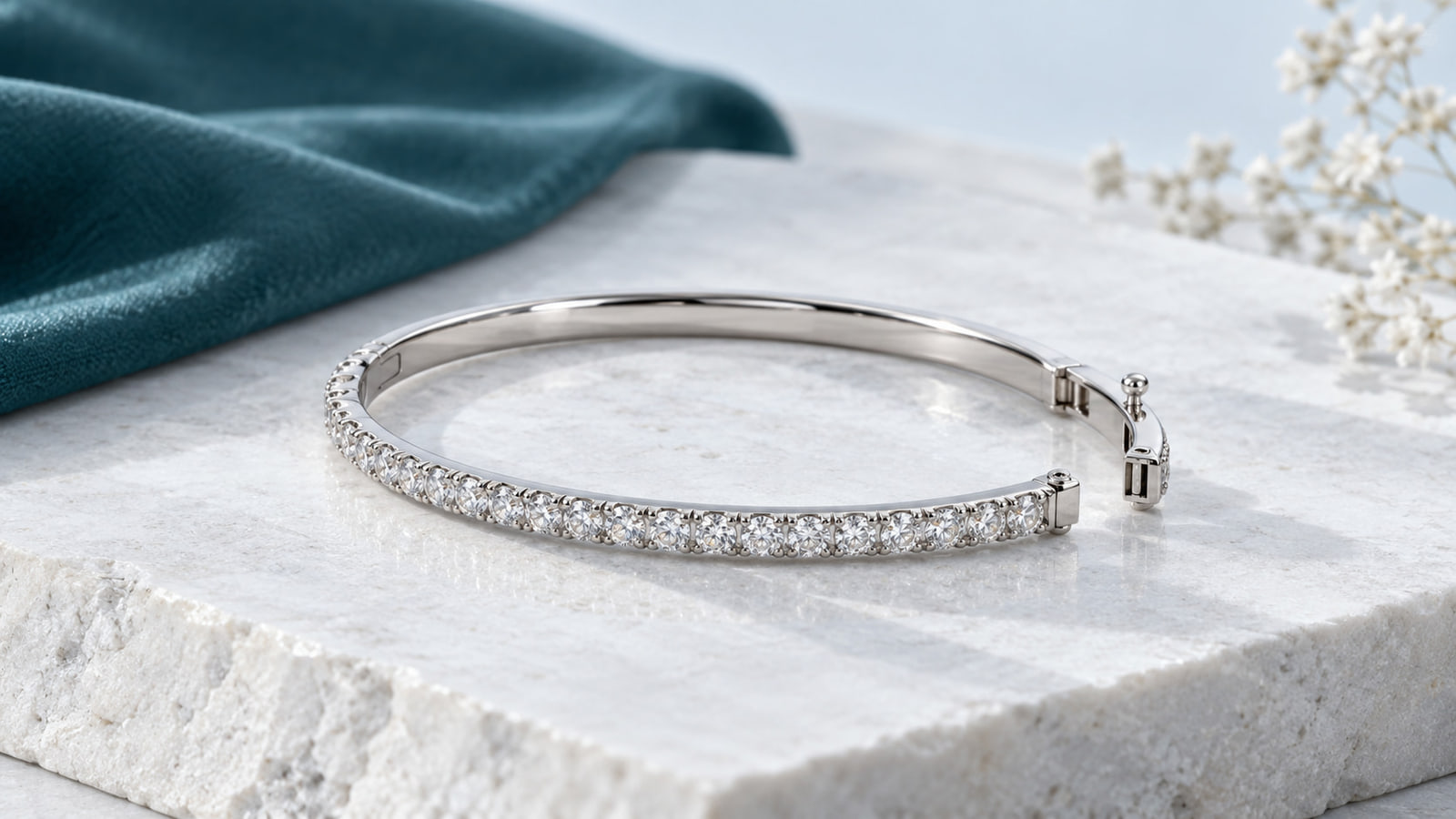
Buy a lab grown diamond bangle by its approved inner shape, opening method and stone-bearing arc. A rigid body does not articulate around the wrist like a flexible bracelet, so a bracelet length or total carat target cannot define its fit. Ask the jewelry maker to demonstrate the actual round or oval sample, its opening and closing operation, and the proposed stone positions along the curve. Select loose diamonds against the resulting seat schedule, with dimensions and appearance references for each row or section. Keep bangle-body validation with the finished-jewelry producer and loose-stone acceptance with the sourcing process. No universal opening clearance, hinge strength or comfort promise should be invented from a marketing photograph.
How Do Round and Oval Bangle Shapes Change the Brief?
Describe the inner opening using the maker's agreed measurement method. A round bangle needs a diameter reference; an oval needs both axes and a clear orientation. Those numbers do not alone establish fit because the body profile, opening method and intended wearing position also matter. Show the actual sample rather than translating a wrist circumference into an assumed universal bangle size.
For a closed rigid bangle, the wearer must pass the hand through the opening. A hinged design introduces an opening operation, while an open cuff has a defined gap. These are different product concepts and should be reviewed separately. Do not tell a supplier to make the item adjustable unless the producer has explicitly designed and approved that behavior.
Ask the maker to record the accepted sample's inner shape and finished profile. The buyer's fit review can include selected hand and wrist forms, photographs and practical observations, but it should not be described as a universal comfort certification. Where a collection uses several sizes, keep each body's dimensions and stone schedule linked to its own reference.
The jewelry application brief should identify this as a rigid-body project. A supplier familiar with flexible tennis bracelet parcels still needs the bangle's actual seat requirements before selecting suitable stones.
Rigid Bangle VS Flexible Bracelet: What Must Change?
| Buying decision | Rigid bangle | Flexible bracelet |
|---|---|---|
| Body geometry | Fixed inner curve and cross-section | Linked or otherwise articulated assembly |
| Fit reference | Inner dimensions and opening operation | Finished wearable length and closure allowance |
| Stone map | Positions tied to an arc on the body | Positions tied to repeated moving links |
| Size variant | May change curvature or stone-bearing span | May add or remove approved modules |
| Prototype focus | Wrist placement, opening and curve continuity | Articulation and drape around the wrist |
This comparison does not rank security or wear life. Those depend on the actual product and its verification. It prevents the buyer from transferring a familiar bracelet specification to a mechanically different item.
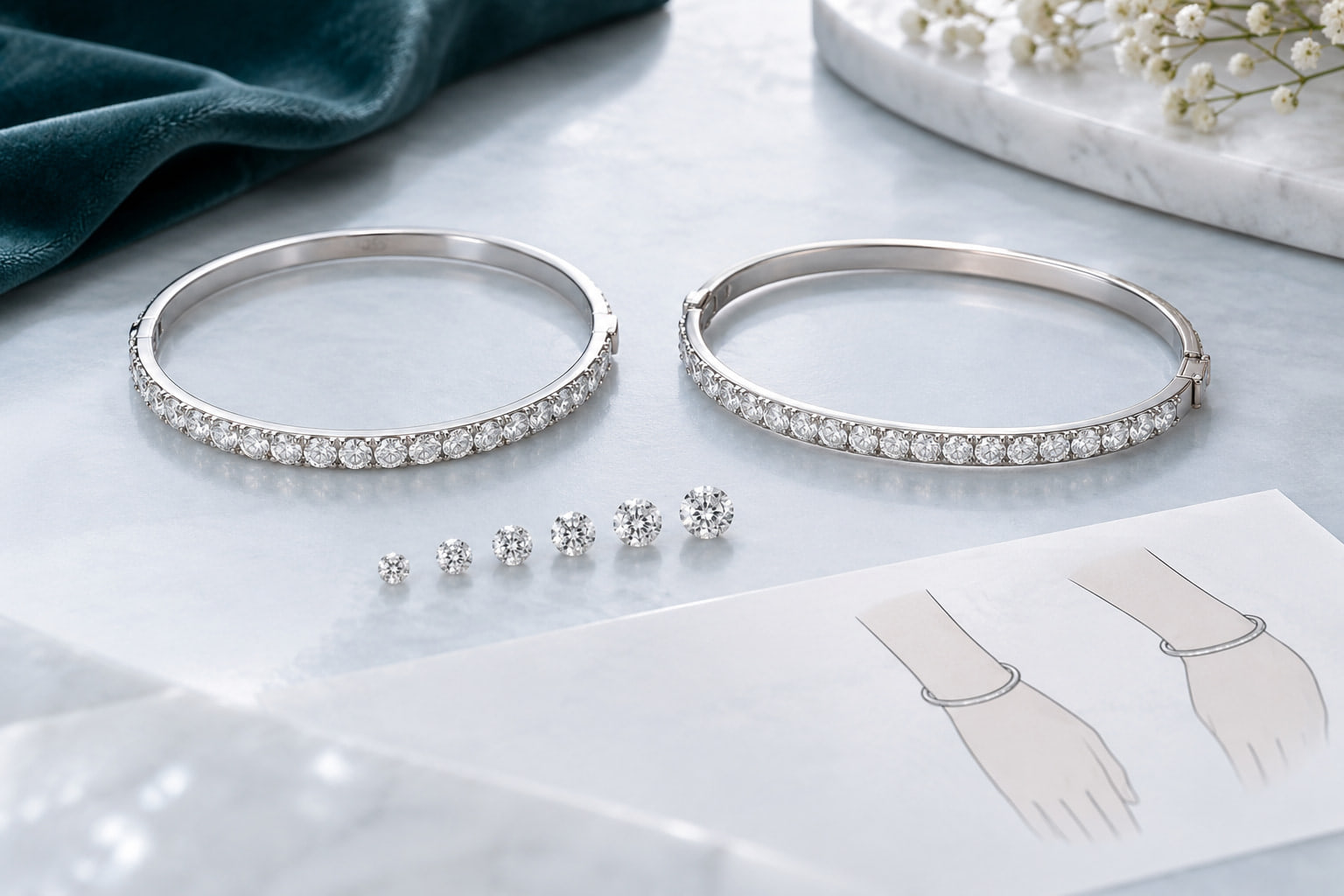
Within bangles, distinguish round and oval bodies as well. Two designs can share the same front stone count while placing those stones on different curves. That can change the apparent gaps and angle of the outer positions. Approve the full front arc in the intended viewing position, with side photographs showing where the diamond row ends.
How Should Diamond Positions Follow a Rigid Curve?
Identify the front axis and number positions outward to each side. State whether the stone row covers only the top, extends around the shoulders or continues farther around the body. Measure the stone-bearing span on the accepted drawing using a method the maker can reproduce. Do not substitute the bangle's inner circumference for that span, because they describe different surfaces.
For repeated rounds, give the accepted diameter and depth window for each seat family. Where the row graduates toward its ends, preserve the opposing positions as pairs. The maker should identify any seat changes required as curvature increases. A loose parcel that looks uniform on a flat tray may present differently when the outer stones tilt away from the viewer.
Review the metal between adjacent positions as well as the stones. The visible pattern includes rims, prongs, gaps and the exposed body surface. If the outer row appears crowded, ask the maker to compare seat placement and body curvature before narrowing the diamond window. A stone-only adjustment may not resolve the visual issue.
Use melee selection for repeated small stones and calibrated parcels where appropriate. These supply categories help organize the order, but they do not determine the final bangle curve or the producer's setting method.
The row schedule should also identify blank positions deliberately left near an opening, so receiving does not confuse an intentional endpoint with missing stones.
Hypothetical Example: Two Oval Sizes Sharing a Front Row
An invented collection plans 30 small oval bangles and 20 medium oval bangles. The initial concept gives both versions a 21-stone front row. That means 50 x 21 = 1,050 mounted stones, plus the buyer's chosen 30 loose reserves. The 1,080 purchased stones are a count plan, not a prediction of total carat weight or a recommendation for every bangle.
The small and medium bodies use different illustrative inner axes, but the maker proposes retaining the same front stone-bearing span. The buyer asks for both samples because a shared count does not establish identical seat orientation. On the medium sample, the outer two stones appear farther from the front when viewed on the wrist form. The team must decide whether that appearance is acceptable before freezing a common parcel.
One option is to keep the shared 21-position row and approve its different presentation. Another is to revise the medium body's stone-bearing arc, which may require different seat spacing or additional positions. If the medium version moves to 23 stones, the mounted requirement becomes 30 x 21 + 20 x 23 = 1,090, before reserves. The revised design adds forty mounted stones across the program.
The buyer approves the actual medium sample and then updates its component schedule. It does not quietly consume the repair reserve to cover the extra production positions. This separates a design change from a purchasing shortage and prevents the first delivery from exhausting the stock intended for future repairs.
Which Channel Can Support a Bangle-Specific Stone Schedule?
Supply location does not establish rigid-body expertise. Ask each channel which part of the bangle program it can document: loose stones, body components, assembly or final inspection. Compare the same approved arc and size schedule in every inquiry.
USA / Body reference before replacement
How Should a US Trade Buyer Handle Size-Specific Bangle Repairs?
Stuller provides a US loose lab-grown diamond offering. For a rigid bangle repair, a trade source still needs the actual seat reference. A general request for a bracelet stone does not explain the curve, position or dimensions involved.
Retain the bangle size and row position in the retailer's service record. If a stone is missing near the end of the arc, send the maker's seat information and photographs of adjacent positions. Confirm whether the replacement is selected loose for the bench or supplied as part of a separately quoted repair. Those are different service scopes.
For a new collection, ask the US commercial contact whether it can support the relevant dimension window across all approved body sizes. Do not treat a local selling address as evidence of growth origin or mechanical validation. The buyer should keep the bangle producer's sample and opening-operation records separate from the loose supplier's stone description, while linking both to the same style revision.
CHINA / Body sizes and stone families
What Should China-Facing Bangle Sourcing Keep Separate?
For a China-based coordination workflow, send separate body and diamond schedules. MEITUO's Qingdao team can coordinate the stone requirement, while the actual jewelry maker defines the rigid curve and opening. A supplier response should state which part of that scope it covers instead of using the broad word bangle for everything.
Show whether small and medium bodies share the same front positions. If the maker changes a size's arc after the first sample, update the diamond count before the coordinator allocates the parcel. Ask for production and reserve stones to be quoted separately so design additions cannot silently consume the repair allocation.
Where the order includes several stone families, request clear group labels and a packing record linked to body size. The receiving workshop should be able to tell whether an outer-row parcel belongs to the small or medium version without reinterpreting a marketing photograph. For repeat orders, confirm the body revision first; a previously accepted parcel may be unsuitable after the producer changes curvature or seat spacing.
INDIA / Flat sorting versus assembled appearance
How Should an Indian Parcel Seller Support a Curved Row?
Greenlab lists Surat manufacturing and Mumbai corporate contacts. When approaching an Indian parcel supplier, describe the planned rigid arc and provide the jewelry maker's actual dimension windows. A parcel sorted attractively on a flat tray still needs to fit the approved curved seats.
Ask whether the offered material can be separated into the required position groups and whether the quoted count is before or after that selection. If the design graduates toward the ends, request opposing groups together. Keep the acceptance reference specific to the bangle rather than borrowing a tennis bracelet sample merely because the stones have similar weights.
For export packing, preserve sublot labels until receiving inspection is complete. Agree how out-of-window stones and visibly mismatched row-end stones will be replaced. The seller should know whether a replacement must match a repeated central position or a unique outer position. That distinction reduces ambiguity when the loose selection team never handles the finished rigid body.
What Should a Bangle Sample and Receiving Check Include?
Approve the body sample before the main diamond allocation. Record inner axes or diameter, opening type, stone-bearing span and the orientation of the front. For hinged products, ask the producer to explain its opening, closure and connection verification. For open designs, record the intended gap and handling instructions. Do not create numerical safety thresholds without a legitimate engineering basis.
At loose-stone receiving, compare dimensions and condition against the seat schedule. Lay the front row in order so the intended visual progression is clear. For multiple sizes, identify which stones are common and which are version-specific. Bulk stock should not be combined until the receiving team knows that the relevant windows and references are compatible.
After setting, inspect the row at the front and at oblique angles. Look for an unintended step, a missing position or a conspicuous mismatch at the row ends. Ask the maker to complete the agreed retention and body checks. GIA distinguishes hardness from impact resistance; a rigid bangle still needs careful condition review and appropriate care instructions.
Retain one sample from each approved body size. A photograph of the smaller version is not enough to resolve a later complaint about the larger arc. Link the accepted samples to the repeat-order record, including any changes to the body or seat schedule.
Use a written observation sheet for the opening sample. Record whether the reviewer could identify the intended front, operate the closure as instructed and place the bangle in the proposed wearing position. Any uncertainty should be described as an observation for the maker to resolve, not converted into an invented pass-fail engineering threshold. Keep the body sample identity and photographs beside that sheet.
For oval bodies, add a photograph showing the long axis relative to the stone row. This prevents a later discussion from confusing a rotated display position with a changed curve. For round bodies, identify the front axis even though the inner opening is rotationally symmetric. The stone layout and opening mechanism can still create a distinct intended orientation.
If the producer proposes changing metal profile to reduce cost, repeat the relevant sample review before carrying over the old approval. A stone parcel can remain dimensionally suitable while the revised body presents the row differently. Ask the producer to identify which geometry changed and retain both versions until the commercial team understands the visible consequence. This keeps the purchasing decision connected to the actual object rather than a style code alone.
How Can MEITUO Coordinate Stones for a Rigid Bangle?
MEITUO is a sourcing and supply-chain coordination partner in Qingdao, Shandong, China. It serves jewelry brands, wholesalers, retailers and designers with loose centers, melee, side stones and matched sets. For a rigid bangle, the buyer should supply an approved body drawing and a position-based diamond schedule so sourcing can focus on the actual seats rather than a generic bracelet weight target.
MEITUO can support product selection, supplier coordination, quality-requirement confirmation and order follow-up. A useful inquiry separates common front-row stones from any size-specific or graduated positions, and separates production quantities from repair reserves. The jewelry maker should remain responsible for the agreed body, hinge, opening and completed-setting verification.
Contact [email protected] with the body revision, size mix and accepted visual reference. Confirm available stones, documents, MOQ, treatment information, lead time and shipping terms for the order. The melee buying guide can help organize stone fields, while the producer supplies the bangle-specific geometry.
What Belongs in a Lab Grown Diamond Bangle RFQ?
Identify the body as round, oval or another explicitly drawn shape. State the opening type and size mix, then attach the stone-bearing arc for each version. Include quantity by position family, actual dimensions, matching reference and reserve allocation. Ask suppliers to quote any proposed changes to the stone schedule as alternatives requiring approval.
Request separate commercial lines for loose stones and any body or assembly work. If the supplier cannot confirm that the accepted dimensions are available, resolve the stone-or-seat decision with the maker before production begins. Do not permit an unreviewed narrower body, larger gap or different row length as a routine cost adjustment.
The RFQ guide provides commercial structure. Add a sample milestone for each rigid-body size and identify who approves the completed bangle. A clear scope makes the loose diamond offer comparable without suggesting that the stone coordinator has validated the bangle mechanism.
Please quote loose laboratory-grown diamonds for [quantity by size] rigid [round or oval] bangles, body drawing [revision]. The attached position map defines [stone-bearing arc], opening type, dimension windows and visual references for each size. Separate common stones from size-specific row ends and quote [reserve quantities] outside production consumption. Confirm accepted count, actual weight, sorting responsibility, available documents, treatment information, MOQ, lead time and shipping terms. Require approval for changes to count or dimensions. Body fit, opening operation, hinge or closure checks and completed setting will be approved separately with the jewelry producer.
FAQ: Lab-Grown Diamond Bangles: Rigid Curves and Stone Layouts
Can a Tennis Bracelet Length Define a Bangle Size?
No. A rigid bangle needs its own inner dimensions, opening method and physical fit review. Flexible wearable length is not a direct substitute.
Are Oval and Round Bangles Interchangeable at the Same Stated Size?
No. Record the measurement method and actual axes or diameter. Body profile and opening operation also affect the accepted sample.
Should Every Bangle Size Use the Same Stone Count?
Only if the maker's approved designs do so. A size change may preserve the front row, change its spacing or require different positions. Update the bill of materials accordingly.
Can an Open Bangle Be Bent to Fit?
Do not assume that. The producer must define whether adjustment is part of the design and provide appropriate handling instructions for the actual product.
Why Inspect the Row Ends Separately?
Outer stones sit on a different part of the rigid curve and may appear differently from the front. Review their orientation, gaps and matching on the assembled sample.
Who Validates Hinges and Closures?
Assign that responsibility to the finished-jewelry producer through an explicit verification scope. A loose diamond quotation does not establish mechanical performance.