 English
 Español
 Português
 Deutsch
 Français
 Italiano
 Nederlands
 العربية
 日本語
 한국어
 ไทย
Quick Answer
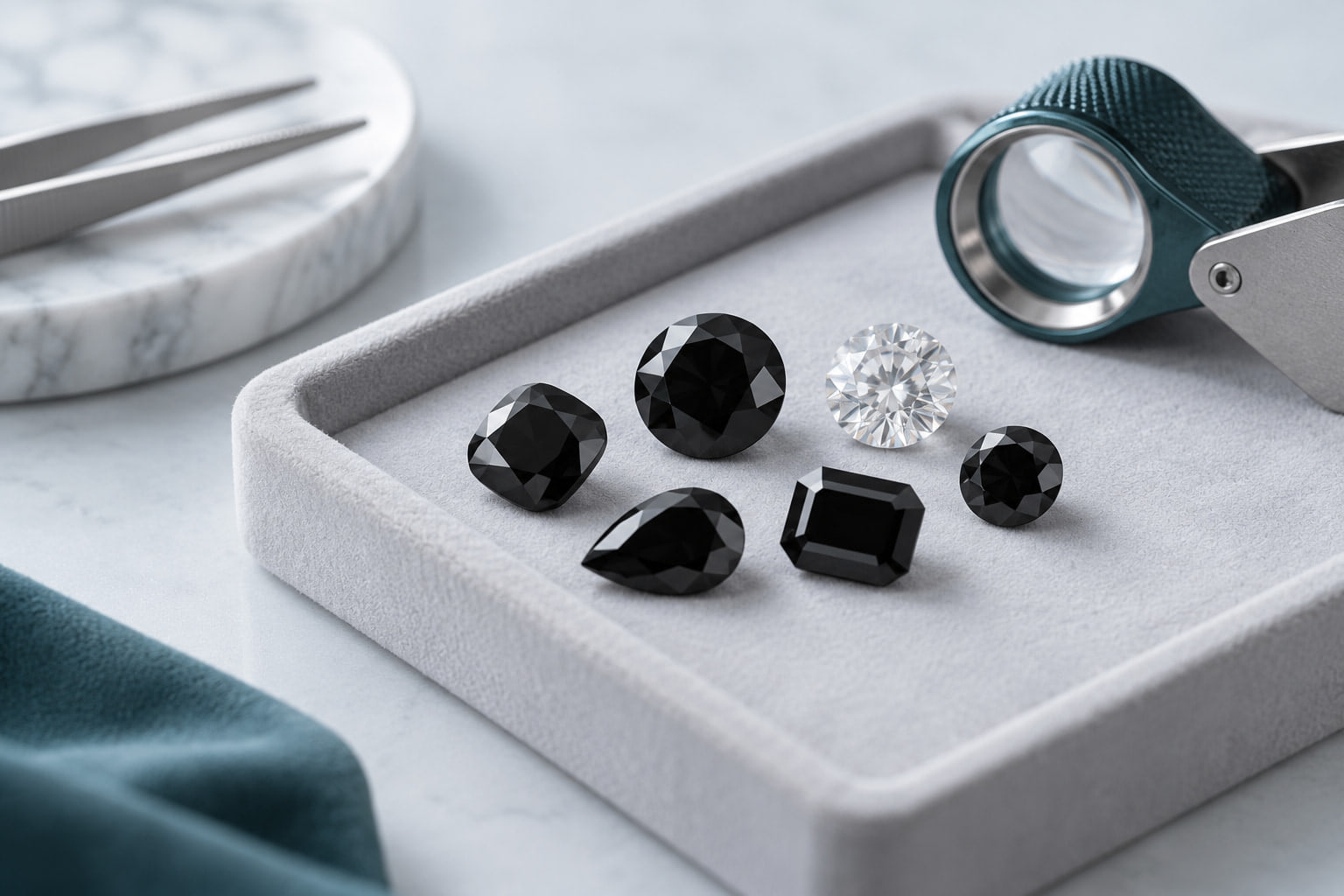
A black lab-grown diamond offer needs two separate answers: what the material is and how its black appearance was produced. Black color alone does not establish laboratory-grown origin. Before buying, obtain the seller's precise material description, natural or laboratory-grown origin statement, treatment information and a suitable verification route for the actual goods. Do not accept a black faceted stone as a laboratory-grown diamond because it looks dark or arrives with a generic diamond parcel. For an opaque-looking product, ordinary face-up photographs also cannot establish internal clarity. Treat an ambiguous offer as unresolved inventory until its identity and disclosure are clear. MEITUO's availability of black material must be confirmed; this guide is not a black-diamond stock announcement.
What Should the Words Black Lab-Grown Diamond Mean in an Offer?
The phrase combines an appearance claim and a material-origin claim. Each needs its own support. A seller may be describing a diamond that has been color treated, a natural diamond sold under imprecise wording, or a different black material. These possibilities are not interchangeable. Ask for the full description on the quotation and invoice before discussing a production quantity.
GIA explains that black appearance in diamonds can be associated with dark inclusions or color treatment. That general explanation is not a determination of any offered parcel's growth origin. It does not allow a buyer to infer that a black stone is laboratory-grown, untreated or natural-color. A supplier's photograph cannot resolve those questions.
Use three required fields: material, growth origin and treatment or color origin information. Keep unknown as an explicit status rather than silently filling it with the most commercially attractive answer. Ask what evidence applies to the exact item or lot, who issued it and what limitations remain. A generic laboratory-grown report for an unrelated colorless diamond cannot support the black parcel.
For a brand developing a dark-stone collection, first decide whether laboratory-grown diamond identity is mandatory or whether the design accepts another accurately described material. That is a product decision, not a reason to loosen the wording after an offer arrives. If the required identity cannot be established, the candidate should not inherit the collection's approved material claim. The fancy-color product category is a starting point for discussing confirmed options, not evidence of black availability.
How Can Buyers Investigate Identity and Treatment Without Overclaiming?
Ask the seller what testing has already been performed and whether it covers an individual stone or a parcel. Then agree an independent route appropriate to the material and quantity. Describe the question to the laboratory before submitting: the proposed material identity, the claimed growth origin, the black appearance and any known or suspected treatments. Confirm that the requested service can address those questions.
GIA requires disclosure of known or suspected treatment and synthesis when material is submitted. Follow that principle in your own handover: preserve the supplier's declarations, including uncertainty. Do not remove an ambiguous treatment note to obtain a cleaner-looking file. A laboratory cannot evaluate an undisclosed commercial promise that never reaches it.
Do not improvise a destructive test or use a household demonstration as a purchasing verdict. A surface photograph, a loupe inspection or one instrument response may answer a limited question while leaving growth origin unresolved. Record the scope of the actual test and the competent reviewer. If a parcel is sampled, keep the sampled items linked to the lot and define what the result can and cannot establish for untested stones.
Treatment information also affects the production conversation. Ask whether the proposed setting, cleaning and later service processes are compatible with the material as supplied, and have the responsible laboratory or workshop clarify limitations. Do not invent one care rule for every black stone. Retain the confirmed instructions with the product record so the finished item's service team knows what was actually purchased.
Claimed Lab-Grown VS Treated Natural VS Simulant: What Differs?
The following matrix is a terminology-control tool, not a visual identification chart. The alternatives can look similar in a photograph. Only an appropriate evidence route can determine the status of the actual offered item.
| Offer category | Material claim | Origin question | Buyer release condition |
|---|---|---|---|
| Claimed black laboratory-grown diamond | Diamond | Laboratory-grown origin must be supported separately from black color | Reconcile identity, origin and treatment evidence |
| Color-treated natural diamond | Diamond | Natural origin plus disclosed color treatment | Use accurate natural and treatment wording; do not call lab-grown |
| Natural-color black diamond claim | Diamond | Natural growth and natural color origin are distinct findings | Obtain evidence for the exact claimed scope |
| Black diamond simulant | A different material | Identify that material accurately | Do not place it under a laboratory-grown diamond SKU |
| Ambiguous black faceted stone | Unresolved | Unknown until investigated | Hold outside approved inventory |
Price cannot resolve the matrix. An inexpensive offer is not automatically a simulant, and an expensive offer does not prove natural color. Nor does the country of sale answer the material question. Compare quotations only after the descriptions are sufficiently complete to establish what is being compared.
Create different stock codes for materially different products. If a design deliberately accepts alternatives, preserve separate product copy and service instructions. A flexible design brief is useful; a flexible identity field is not. The buying team should be able to trace every finished item back to the material description approved for that version.
What Can an Opaque-Looking Stone’s Appearance Review Establish?
Once identity questions are being handled through the appropriate route, inspect the features that photography can usefully show. Review outline, dimensions, facet junctions, surface condition and consistency of the face-up dark appearance. Use diffuse light and a second ordinary viewing condition. Extremely bright reflections may conceal surface differences, while an underexposed picture can make unrelated materials appear uniformly black.
Inspect near edges and setting contact points under suitable magnification. Record visible pits, abrasions or damaged corners as observations without assigning an unsupported cause. A surface issue needs a documented acceptance decision even when the buyer wants a strongly textured or opaque appearance. The word black does not erase ordinary workmanship requirements.
Do not request a standard colorless-diamond clarity promise from a photograph that cannot reveal the interior. Ask the laboratory what assessment applies to this material and service. If a seller uses familiar clarity language, require an explanation of who assigned it and how it relates to the offered stone. Avoid translating an unknown opaque product into a conventional spreadsheet grade just because the buying system has a mandatory field.
For a repeated layout, compare stones side by side in the intended orientation. Surface reflections and outline consistency can affect the rhythm even when all stones look dark. Have the setter approve the actual dimensions and contact areas. Keep appearance, identity and setting fit as separate gates so passing one does not silently release the other two.
How Should an Ambiguous Black-Stone Pilot Be Separated?
Hypothetical example: a designer wants thirty pendants, each using one dark center stone, with six proposed reserves. The initial requirement is thirty-six pieces. Seller A offers thirty-six items described only as black diamonds. Seller B offers thirty-six described as treated natural diamonds. Seller C claims laboratory-grown diamond origin but has not yet supplied evidence connected to the parcel. These are invented offers, not a market survey.
The buyer cannot rank them as equivalent laboratory-grown options. A goes into identity clarification. B is materially described for a different origin category and may be considered only if the product brief allows it. C remains pending origin and treatment reconciliation. None should be released under the mandatory laboratory-grown stock code at this stage.
Suppose the design team decides it can accept a properly evidenced alternative for a separate product version. It opens a new stock code, revises the material description and obtains the setter's approval before ordering that version. It does not relabel the original brief after receiving goods. This preserves the distinction between a deliberate design choice and an undocumented substitution.
MEITUO can be approached with the unresolved requirement and asked which accurately described options, if any, are available for coordination. If black material is unavailable or unsuitable, the designer may consider confirmed blue or pink laboratory-grown options as a new design direction. Those are alternatives requiring fresh approval, not visual substitutes or proof of black stock.
How Should Black-Stone Questions Be Localized Across Supplier Markets?
Local search can help locate a commercial contact, but it cannot identify a black stone. Ask the same material questions in every country, then adapt the review and return route to the actual seller. The panels below describe diligence tasks and channels rather than a verified list of black laboratory-grown suppliers.
USA / Material disclosure
What Should a US Seller Substantiate Before a Black SKU Is Approved?
A US-facing brand needs the seller's actual material description before it can write a product page. FTC jewelry guidance distinguishes laboratory-created diamonds and simulants; a dark color does not remove the need for accurate identity wording. Ask a prospective seller to put growth origin and treatment information in the quotation, with the evidence applicable to the exact item or lot.
Stuller provides an example of a US laboratory-grown distribution channel, but that general channel reference does not establish black stock. A black-material search needs its own availability and evidence inquiry. Do not turn a broad supplier category into a verified recommendation for a niche product the source has not confirmed.
Agree who will arrange independent examination, which items will be submitted and what happens if the conclusion differs from the offer. Keep the return route and review window in writing. Product copy should remain on hold until the buyer can reconcile the offered material, supporting evidence and the identity promised to customers.
CHINA / Precise material descriptions
How Should a China Inquiry Keep Black Appearance Separate From Origin?
When contacting a China sourcing coordinator, send separate fields for material, growth origin and treatment. The MEITUO sourcing team in Qingdao can receive that brief, but its address does not establish the identity or availability of a black parcel. Ask the proposed seller to preserve the full upstream description rather than shortening it to black diamond during translation.
Request actual sample references and the proposed examination route. If several suppliers respond, keep each parcel separate until its declarations and evidence are reconciled. A shared dark appearance is not a reason to combine the lots. Require changes in the description to be explained and approved before packing or dispatch.
For a designer seeking a particular visual effect, make it clear whether the laboratory-grown requirement is mandatory. If the seller proposes another material or a treated natural diamond, it should appear as a separately described alternative. Confirm availability before scheduling the design launch. These steps create a useful China sourcing record without inventing a standardized black laboratory-grown product or assuming that every colored-diamond supplier carries it.
INDIA / Item-linked declarations
What Should Buyers Verify With an Indian Diamond Contact?
GreenLab lists Surat and Mumbai contacts, illustrating an Indian diamond channel's commercial locations. Those contacts do not establish black laboratory-grown inventory, and this article does not recommend the company as a verified source for that niche material. Ask any candidate seller for the exact material description and evidence before arranging a bulk purchase.
If the offered stones have been treated or processed by another business, request that role and the available treatment information in the file. Do not infer origin from a cutting-region address. Confirm whether a document belongs to the offered item, a sample from the same lot or unrelated promotional material; these are different scopes of evidence.
Agree how unresolved goods remain segregated while identification proceeds. If export is handled by a separate trading contact, preserve the same item references through that handover. A buyer should be able to explain which declarations came from the seller, which findings came from an independent examiner and which questions remain open. Release the material claim only after those records can be reconciled.
What Can MEITUO Confirm Before a Black-Material Inquiry Proceeds?
MEITUO works from Qingdao, Shandong, China as a sourcing and supply-chain coordination partner. Its confirmed product conversation covers loose centers, melee, side stones, matched pairs and sets, and fancy-color options. Black material availability is not established by this article and must be checked before any product or delivery promise is made.
For this inquiry, send the mandatory identity requirement, intended design and evidence questions first. The team can coordinate supplier responses, product-selection discussions, quality-requirement confirmation and order follow-up within the scope agreed for the actual order. It does not replace an independent identification laboratory or validate an ambiguous parcel by describing it in a quotation. Request confirmation of documents, MOQ, lead time, treatment information and shipping terms. The bespoke and statement application page provides a relevant design context. Contact [email protected] and ask what can be substantiated before requesting production quantities or publishing a black laboratory-grown product page.
What Wording Belongs in a Black Lab-Grown Diamond RFQ?
Make the identity requirement impossible to overlook. State whether another accurately described material is an acceptable alternative and require alternatives to be quoted separately. Ask for the proposed evidence route before committing to a large lot or a finished-jewelry launch. Keep any uncertainty visible in the response sheet.
For US-facing descriptions, the FTC distinguishes laboratory-created diamonds from simulants and requires clear material disclosure. Treat product copy as a separate approval following evidence reconciliation, not a way to complete missing supplier information. Use the supplier-selection guide to organize the commercial checks alongside this identity gate. The following brief prioritizes those unresolved questions.
We are evaluating [quantity and dimensions] of material described as black laboratory-grown diamond for [design]. Confirm the exact material, natural or laboratory-grown origin, known treatment and color-origin information, with item- or lot-linked evidence and its limitations. Propose an independent examination route and identify who arranges it. Do not substitute treated natural diamond or another material under the same stock code. Quote alternatives separately. Confirm actual availability, sample terms, documents, MOQ, lead time, packing, shipping and return conditions. Keep unresolved material segregated pending written identity, appearance and setting approval.
FAQ: Black Lab-Grown Diamonds: Identity Questions Before Buying
Does Black Color Prove Laboratory-Grown Origin?
No. Appearance is separate from growth origin. Obtain the actual material description, origin and treatment information and agree an appropriate evidence route. A dark photograph cannot establish any of those findings.
Are Treated Natural Black Diamonds Laboratory-Grown Diamonds?
No. Treatment and growth origin are separate concepts. A natural diamond that has been color treated remains a different origin category from a laboratory-grown diamond and needs accurate material and treatment wording.
Can a Standard Clarity Grade Be Inferred From an Opaque Photograph?
No. The image may show surface condition and outline while revealing little about the interior. Ask the responsible laboratory which assessment is applicable to the actual material and service instead of filling in a familiar grade without support.
Can a Supplier’s General Laboratory-Grown Certificate Cover a Black Parcel?
Only evidence connected to the relevant goods and findings can support the purchase. A document for an unrelated stone does not establish the parcel’s identity, growth origin or treatment. Verify references and scope before release.
Does MEITUO Have Black Laboratory-Grown Diamonds in Stock?
Availability is unconfirmed in this guide. Send the exact material and evidence requirements to MEITUO for an order-specific response. Confirm any proposed option before publishing a product claim or promising delivery.
What Is the Best First Step for a Dark-Stone Design?
Decide whether laboratory-grown diamond identity is mandatory or whether another accurately described material is acceptable as a separate version. Then obtain item-linked descriptions and an appropriate examination route before comparing bulk quotations.