 English
 Español
 Português
 Deutsch
 Français
 Italiano
 Nederlands
 العربية
 日本語
 한국어
 ไทย
Quick Answer
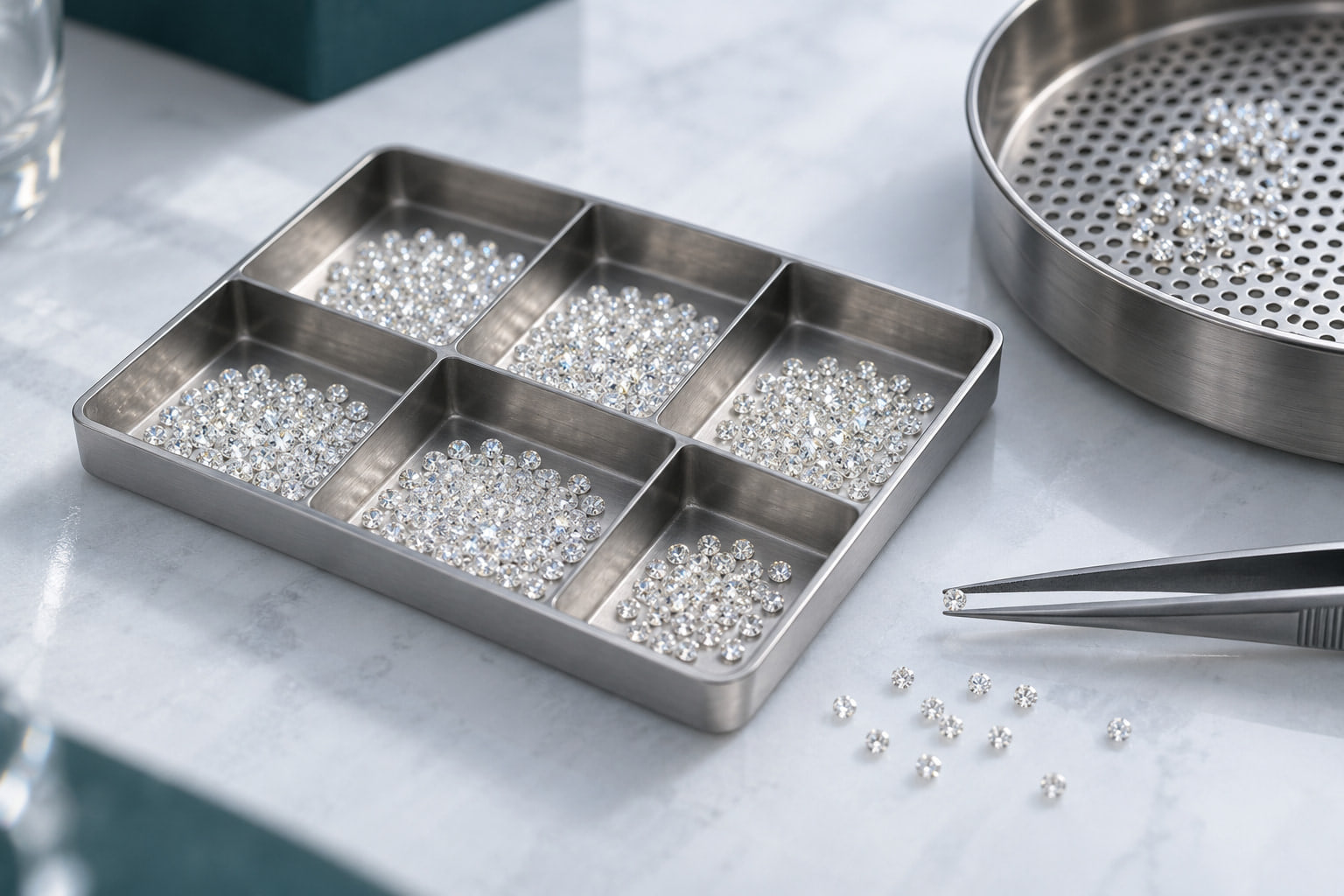
A 1.8 mm lab grown diamond order should specify measured diameter, agreed tolerance, depth limits, appearance range, screening basis and a countable lot structure. “1.8 mm” alone does not define how a parcel will fit a setting. Use the setter's validated seat dimensions to establish an acceptance window, then approve a representative sample and preserve it for reorders. Compare cost per accepted stone as well as per carat, because sorting losses and reserve quantities change production economics. Do not convert diameter into a guaranteed weight using a generic chart. A measured parcel may contain stones of different weights or depths. For repeat production, control the minimum and maximum dimensions rather than relying on the nominal label or a sieve description alone.
How Do You Define a Usable 1.8 Mm Melee Size Window?
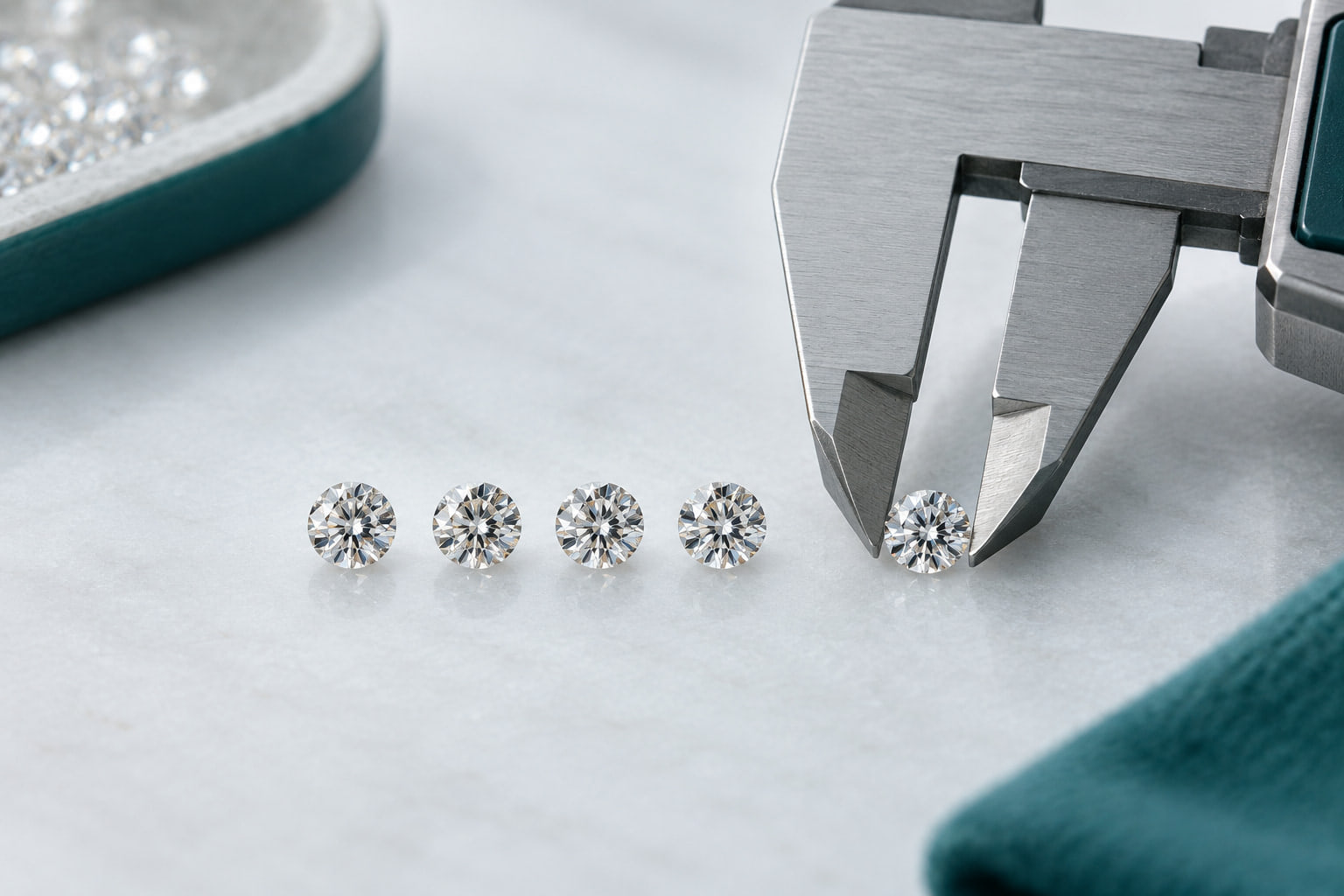
Ask the manufacturer which measurements control the seat: minimum diameter, maximum diameter, girdle condition and total depth. A round stone can be slightly out of round, so one convenient diameter reading is not enough. Record two perpendicular face-up readings and define whether the requirement applies to each reading or an average. This small distinction can decide whether an apparent match binds in a seat.
A sieve category is useful for sorting, but its commercial label should be translated into a written dimensional agreement. Confirm the sieve convention and the supplier's measurement method. Do not assume two sellers use the same boundary simply because both quote 1.8 mm. Ask how stones close to a boundary are handled and whether a mixed boundary parcel can be separated before dispatch.
For an exploratory sample, a buyer might request 1.78 to 1.82 mm in both measured directions, explicitly as a proposed project tolerance pending setter approval. That is an illustrative starting point, not an industry standard or a promise that every setting accepts it. If the setting trial shows that 1.82 mm stones consume too much metal, tighten the specification before ordering bulk.
Use our melee buying guide for the broader parcel framework. Here, the priority is turning one nominal size into a repeatable manufacturing input. Save the approved dimensional window with the CAD revision and the retained physical sample so later teams can understand why it was chosen.
Why Can Two 1.8 Mm Lab-Grown Diamonds Set Differently?
Face-up diameter does not describe the pavilion clearance underneath the stone or the metal needed around its girdle. A parcel with acceptable diameters can still contain depth variation that makes a row sit unevenly. Ask the setter to identify the limiting clearance and the preferred range instead of choosing depth from an unrelated online size chart.
Inspect girdles and damage under suitable magnification before the trial. Thin vulnerable edges, chips or an irregular outline can matter more to the setting process than an attractive color label. Keep those rejection reasons separate from optical preferences. The supplier should know whether a hold is caused by physical damage, an out-of-window dimension or merely a mismatch with the approved appearance sample.
Build a short test strip using the actual metal, seat and setting technique. A hand-held loose parcel cannot show the relationship between stone depth and finished row height. Photograph the strip from the top and side, record which stones were used, and have the setter identify unnecessary adjustments. Any correction should return to the stone specification or CAD, rather than remain an undocumented bench workaround.
For tightly repeated rows, examine cumulative spacing too. Ten stones at the upper end of a permitted diameter range may behave differently from ten at the lower end. You can request narrower sublots for demanding layouts, but price the extra sorting and verify whether it actually improves the bench result. Smaller tolerance numbers without a manufacturing purpose add cost without necessarily improving the jewelry.
Connect the trial to the actual jewelry application so the setter checks the intended seat and metal geometry.
How Should You Compare 1.8 Mm Lab-Grown Diamond Quotations?
Compare quotations using the same accepted specification and an explicit counting basis. A low per-carat number cannot be evaluated if the seller has not described the usable size distribution or the expected number of stones in the actual parcel. Ask for measured count and weight for a sample lot, then use that information to plan rather than promise a universal conversion.
| Buying issue | Per-carat offer | Counted-piece offer | Decision check |
|---|---|---|---|
| Production requirement | Weight must be converted into an estimated count | Count relates directly to seats | Request actual parcel count before release |
| Depth variation | Heavier stones can increase spend without filling more seats | Piece count does not control clearance | Apply depth and girdle acceptance in both cases |
| Sorting losses | Rejected weight changes accepted yield | Rejected pieces reduce usable count | Quote remedy and cost per accepted stone |
| Reserve stock | Extra weight may not give matching repair pieces | Specified reserve count is easy to identify | Keep reserve tied to the approved lot |
| Repeat quotation | Same weight can contain a different distribution | Same count can still have changed dimensions | Retain limits and comparison samples |
Hypothetical quote normalization: offer A costs 440 currency units for 1,000 stones and has a trial acceptance of 960. Its sample cost per accepted stone is 440 divided by 960, or about 0.458. Offer B costs 470 for 1,000 and yields 990 accepted, about 0.475 each. These invented figures illustrate arithmetic, not wholesale market prices. A may still be unsuitable if forty missing stones delay a production run or the trial is not representative.
Add any separately agreed sorting, freight and verification costs before making the final comparison. Keep the yield assumption visible and repeat the calculation using the actual incoming lot. See our wholesale quotation guide for separating offer scope from headline price.
How Many 1.8 Mm Stones Should a Production Order Contain?
Hypothetical project, the Twenty-Four Seat Band: a workshop plans eighty half-eternity bands, each with twenty-four seats. The direct requirement is 80 multiplied by 24, or 1,920 stones. The buyer proposes eighty matching reserve stones, making 2,000 accepted stones required. The reserve is a deliberate planning choice for this project, not a universal allowance.
If a pilot lot produces a 96 percent accepted yield, ordering 2,000 unselected stones would not reliably fill the target. Dividing 2,000 by 0.96 gives about 2,084 stones before rounding. Better still, ask whether the supplier can quote 2,000 accepted stones against the agreed window and retain responsibility for its own preshipment sorting. The quotation should state which basis applies.
Make the count plan auditable. Divide a bulk shipment into labeled sublots with counts and weights, and record the receiving recount method. Resolve shortages before the parcel is mixed with existing inventory. If a mechanical counting process is used, confirm the instrument is suitable for these stones and cross-check a defined sample manually. A scale reading alone cannot identify a misplaced stone of a different size.
MEITUO can coordinate a specification for round laboratory-grown melee and discuss a separate matching reserve. Request the accepted quantity, dimensional checks and replacement conditions explicitly. For demanding runs, our calibrated parcel page helps frame the difference between general size availability and a project-specific approved lot.
If the workshop changes seat count or metal design after approval, recalculate the order. A reserve chosen for eighty pieces should not quietly disappear into an expanded ninety-piece production schedule. Preserve the distinction between production consumption, inspection holds and repair stock.
Which Supplier Questions Matter for 1.8 Mm Melee in Each Market?
A useful source for calibrated melee is the channel that can answer the dimensional and lot questions, not simply the closest office or lowest visible offer. Establish whether sorting is performed by the seller, its producer or another service, and who owns the acceptance remedy.
USA / Replenishment and returns
Can a US Trade Channel Supply a Setter-Approved 1.8 Mm Range?
A domestic trade channel may be useful when a workshop needs small repeat parcels or a clear return process. Stuller's laboratory-grown diamond resource page confirms a US trade supplier offers loose laboratory-grown diamonds with and without reports. That describes its offering; it does not prove a quoted 1.8 mm parcel has your exact tolerance, or that the stones were grown in the United States.
Ask whether the advertised diameter is a nominal category or a measured acceptance window. Confirm that the seller can supply a separate matching reserve and identify the lot on future invoices. For an urgent repair, request an actual dimensional match rather than assuming any stone from the same catalog category will fit the original seat.
Discuss return eligibility before the setter opens production. Count discrepancies and dimensional holds should be reported while the parcel remains identifiable. A local shipping address may make that process easier, but the written terms still decide the remedy. Compare delivered accepted-piece cost and response time alongside the quoted stone price.
CHINA / Sorting responsibility
Who Controls Sorting When Buying Chinese 1.8 Mm Melee?
For a China-based procurement route, identify the business that performs final calibration and the entity that accepts responsibility for a failed size window. The growth supplier, sorting provider and exporter can be different parties. A quotation from a coordinator should explain those roles rather than imply that a single address performs every process.
With MEITUO in Qingdao, send the diameter and depth limits in a table that can be passed upstream without reinterpretation. Ask for the supplier's measurement convention, proposed sublot size and available preshipment evidence. A close-up photograph helps show appearance, but it does not establish dimensions or count across a bulk parcel.
Request that any wider commercial sieve category be sorted to the approved project window if that is needed for the setting. Agree who pays for that extra work and who owns rejected stones. When multiple sublots are consolidated for export, keep their original identities and counts visible on the packing record. Consolidation should improve shipping efficiency without erasing which material passed which inspection.
INDIA / Calibrated-lot continuity
How Should an Indian Melee Offer Connect Cutting, Sorting and Export?
An Indian supplier may quote through a commercial office while technical answers come from a different operation. Greenlab's official contact information lists Surat and Mumbai contacts, illustrating why the buyer should identify the right counterpart rather than address every question to a sales inbox. It does not establish availability of a particular 1.8 mm specification.
Ask who signs off the final measured distribution and whether the proposed parcel is already sorted or will be prepared after the order. Where a seller offers several producers' inventory, request a clear rule against replacing the approved source lot with an unreviewed alternative. Equal nominal diameter is insufficient if depth or face-up character changes across a long row.
For repeat bands or small earrings, negotiate the ability to reserve matching pieces or reproduce the acceptance window. Record whether a new run will use retained master samples, measurement records or only a catalog size name. Keep the export packing lot connected to the technical approval so receiving staff can locate the correct reference immediately.
How Do You Receive and Reorder a Calibrated 1.8 Mm Parcel?
Create an incoming card with purchase reference, sublot identifier, declared count, measured weight and inspection status. Preserve the original packaging until quantity and identity discrepancies are resolved. Do not pour several shipments into one drawer and attempt to reconstruct the lots after a setter finds a problem.
Agree screening documentation for laboratory-grown identity separately from dimensional inspection. The IGI laboratory-grown diamond service description concerns report services and notes growth and treatment comments upon request. It should not be read as proof that a bulk melee parcel carries an individual report for every stone. Ask what actual lot screening and documentation the seller supplies, who performed it and how it connects to the shipment.
Inspect dimensions across sublots using the same agreed method. Record minimums, maximums, outliers and the reason for any hold. For a tightly fitted product, use an agreed inspection plan or full sorting where justified; a handful of attractive stones from the top of a parcel cannot establish the whole distribution. Define the sample selection method before dispatch.
For reorders, send the original acceptance card and fresh photographs of the retained reference. Ask whether the new lot uses the same sorting boundary and depth range. A label reading 1.8 mm does not authorize a change to the approved range. Keep old and new lots separate through a short bench comparison before releasing them together.
How Can MEITUO Coordinate a 1.8 Mm Melee Requirement?
MEITUO supports laboratory-grown diamond sourcing and supply-chain coordination from Qingdao, Shandong, China. For a 1.8 mm melee project, its useful starting point is a written request describing the accepted diameter window, depth constraints, appearance reference, quantity and destination. The team can coordinate product selection, supplier questions, quality-requirement confirmation and order follow-up.
The broader product range includes loose centers, melee, side stones, matched pairs and sets, and fancy-color options. Availability of a particular calibrated 1.8 mm parcel, its documentation, MOQ and lead time must be confirmed for the order. MEITUO should not be described as the grower, cutter or independent grading laboratory merely because it coordinates the purchase.
Send the setter-approved limits to [email protected] and ask which fields can be verified before quotation. Our repeat-order planning guide can help turn the first accepted parcel into a replenishment specification. Keep the buyer's final sample approval and manufacturing trial attached to the order.
What Belongs in a Calibrated 1.8 Mm Melee RFQ?
Include two-dimensional diameter limits, permitted depth range, girdle and damage criteria, appearance band and the accepted reference sample. State whether quantity means delivered pieces, accepted pieces or estimated pieces within a weight purchase. Specify reserve stock as a separate line so it is not consumed unintentionally in production.
Ask for the proposed inspection method, lot identifiers, screening records and the treatment-information available. State the allowed remedy for short count, out-of-window stones or a parcel that fails the agreed bench trial. Define the return window before setting begins; altered or mounted stones can complicate a dispute.
Avoid requesting the cheapest 1.8 mm lab grown diamond price without these fields. A useful answer is a scoped quotation whose acceptance conditions can be tested. The copyable brief below makes the dimensional and counting basis clear enough for a first supplier response.
Please quote 1.8 mm laboratory-grown round melee for [application], requiring [accepted piece count] plus [reserve count]. Proposed diameter limits are [minimum] to [maximum] in both directions, with depth [range], subject to our setter-approved sample. State appearance range, girdle and damage criteria, screening basis and available treatment information. Provide actual count and weight, sublot identifiers, measurement method and preshipment inspection options. Distinguish accepted-piece pricing from weight-based pricing. Confirm sorting charges, MOQ, lead time, shipping terms and remedies for shortage or out-of-window stones. Do not substitute a wider sieve category without written approval.
FAQ: 1.8 Mm Lab-Grown Diamonds: Calibrating Melee Orders
Does 1.8 Mm Specify a Fixed Carat Weight?
No. Diameter alone does not fix weight because depth and proportions vary. Use actual measured parcel count and weight for purchasing calculations. A generic size chart can support rough planning but should not become an acceptance guarantee.
Is a Narrower Tolerance Always Better?
Only when the setting needs it and the supplier can verify it. A very narrow requested range can add sorting costs without improving the finished piece. Approve the window through a representative bench trial.
Should Melee Be Ordered by Weight or Count?
Either can work if the quotation states its basis. For a known number of seats, a counted accepted-piece offer is easier to reconcile. Weight-based buying requires a reliable actual count and an agreed approach to sorting losses.
Can One Report Represent Every Stone in a Parcel?
Not automatically. Ask what service was performed, which stones it covered and how the record links to the lot. A document for one sample cannot be silently extended to all stones in an unidentified parcel.
What Should Happen to Out-of-Window Stones?
Keep them separately labeled and record the count, weight and rejection reason. Follow the agreed return, replacement or re-sorting remedy. Mixing them into stock before resolution makes both production planning and supplier discussion harder.
How Should a Repair Reserve Be Stored?
Keep it connected to the accepted production lot with its dimensions and appearance reference. Record every withdrawal. A reserve has value because it matches the original work, not merely because the drawer contains enough nominally similar stones.