 English
 Español
 Português
 Deutsch
 Français
 Italiano
 Nederlands
 العربية
 日本語
 한국어
 ไทย
Quick Answer
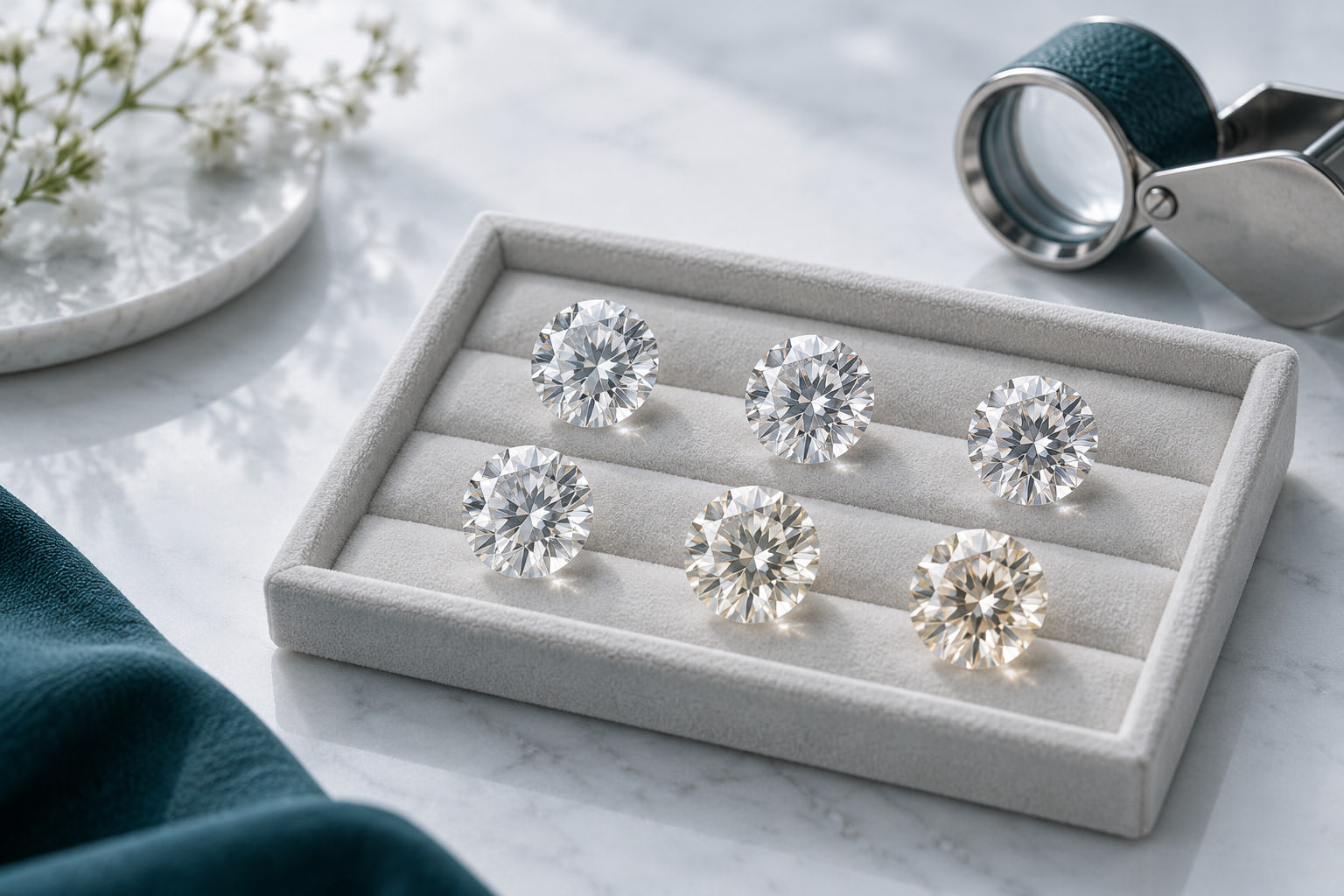
Use a lab grown diamond color and clarity chart as a selection matrix, not a universal ranking. Compare color and clarity together for the intended shape, size, metal and viewing distance. For a brilliant-cut center, a visually clean candidate with an appropriate color appearance may be preferable to a higher paper grade that adds little visible benefit. For a transparent step cut or matched set, inclusion placement and consistency may need more attention. Define a starting band, inspect actual stones and expand only when the sample shows a useful difference. Confirm the report system before comparing labels: current GIA eligible colorless-to-near-colorless loose laboratory-grown assessments use Premium or Standard, so a chart of traditional grades cannot be applied indiscriminately to every document.
Color Upgrade VS Clarity Upgrade: Which Should Your Chart Prioritize?
The matrix below is a buyer's trial plan, not a grading standard or a promise of eye-clean appearance. Traditional color and clarity terms are useful only when the supplier's report actually uses them. Within any trial band, inspect the individual stone and the finished design. Two stones with the same labels can behave differently because the labels do not describe every optical characteristic.
| Collection role | Illustrative starting trial | What the sample must establish | Upgrade only if |
|---|---|---|---|
| White-metal brilliant solitaire | Compare reported F-G with H; compare VS and selected SI candidates | Face-up color and visible inclusions at normal use distance | The difference is visible or needed for a clear range promise |
| Yellow-metal petite center | Compare reported G-H with selected I candidates; VS versus selected SI | Metal reflection and clean face-up appearance | A warmer option looks inconsistent with the intended style |
| Large step-cut center | Compare reported E-G and VS with VVS candidates | Central inclusion visibility and transparent facet appearance | Location or visibility of inclusions affects the design |
| Matched earrings | Same declared band, visually matched as a pair | Both stones appear consistent together | One stone distracts even though both fit the paper band |
| Melee rows | Agreed parcel appearance range and screening basis | The row reads consistently in the actual metal | Outliers remain noticeable in the finished row |
GIA's color education explains color evaluation, and its clarity education describes inclusion and blemish considerations. These concepts inform a trial; neither page sets the ideal procurement grade for your collection. The choice of trial bands above is editorial guidance for comparison, not a claim that GIA recommends those combinations.
Keep a separate column for the report issuer and service. Read the current GIA laboratory-grown service scope before mapping a supplier's documents into your buying spreadsheet. Do not convert Premium into an invented single traditional grade. If offers use different systems, compare the actual documented characteristics and appearance rather than forcing false label equivalence.
When Should You Spend on Color Rather Than Clarity?
Start by identifying the visible failure you are trying to prevent. If a center has no distracting inclusion in its intended setting but looks noticeably warmer than the side stones, a clarity upgrade will not solve the mismatch. If the face-up color already fits the range but a central dark feature is obvious, paying for a better color label may leave the real problem untouched.
Change one variable at a time during sample review. Compare two candidates of similar shape, dimensions and optical character while varying color appearance; then compare candidates with a similar color appearance while varying inclusion visibility. A side-by-side comparison of unrelated stones can make a size or facet-pattern difference look like a color-and-clarity conclusion.
Define viewing conditions that match the product. Use a neutral comparison setup first, then the intended metal or a representative mount. Record distance, lighting and whether magnification was used. An inclusion found under magnification is not automatically visible during wear, but a small visible feature should not be ignored merely because the report label sounds premium.
Do not let a budget ladder become a quality shortcut. A lower-cost candidate still needs acceptable dimensions, condition and appearance. Our loose laboratory-grown diamond range can help structure the request by shape and intended use, while the matrix tells the supplier which tradeoffs need to be demonstrated in actual options.
How Do Metal, Size and Neighboring Stones Change the Choice?
Metal belongs in the comparison because the customer sees a mounted object, not an isolated report. Test a representative stone against the actual white, yellow or rose metal finish. Avoid a blanket rule that warm metal makes every lower color acceptable. Reflections, openness and adjacent stones can still make a difference apparent.
Size changes the observation problem rather than dictating one mandatory clarity grade. A larger face-up area may make a particular central inclusion easier to notice; a different inclusion near a prong may be less distracting but still require condition review. Evaluate location, contrast and the intended mounting. Do not approve a candidate solely because a prong might hide a concern without the setter assessing it.
Neighboring stones often set the practical acceptance threshold. In a three-stone ring, a center that looks pleasing alone can appear different when placed between cooler sides. A halo can similarly make comparison easier. Ask for photographs and physical approval of the complete visual group, then keep the approved set together through production.
For matched pairs and sets, request consistency in face-up appearance in addition to a report band. For melee rows, use a parcel reference and finished strip. Neither individual center-stone reports nor a broad color band alone controls how many small stones read as one line.
How Can a Brand Test a Color-Clarity Budget Without Guessing?
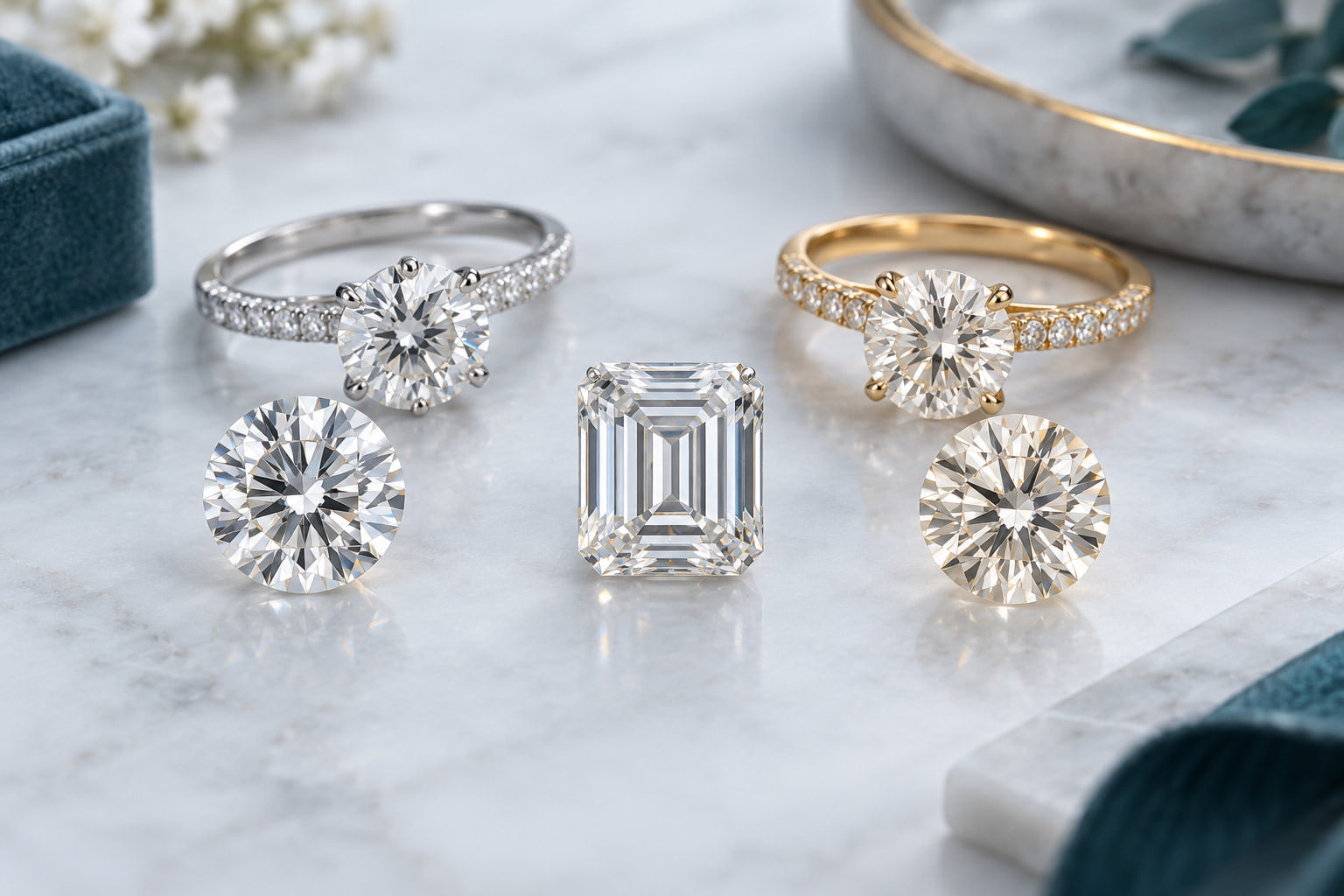
Hypothetical project, the Three-Tier Bridal Trial: a brand plans sixty solitaires in three equal design groups. Twenty use petite yellow-metal brilliant settings, twenty use white-metal brilliant settings and twenty use open step-cut settings. Rather than ordering sixty identical paper specifications, the team selects two candidate combinations for each group and requests four samples per combination. Three groups multiplied by two combinations and four samples produces twenty-four trial stones.
The team's invented quote budget is 12,000 currency units for the sixty centers. Option A allocates 140 per petite center, 180 per white-metal brilliant and 280 per step cut. The total is 2,800 plus 3,600 plus 5,600, exactly 12,000. These are hypothetical allocation figures, not market prices or suggested retail values.
After viewing samples, suppose the petite group shows no meaningful improvement from its proposed upgrade, while some step-cut candidates have distracting central features. The team tests moving 20 units from each petite center to each step-cut center. The revised allocations become 120, 180 and 300, with the same total. This arithmetic shows how a matrix can direct testing without increasing the budget. It does not prove the revised grades will be available at those figures.
MEITUO can coordinate candidate selection against that trial sheet, with actual availability and quotations confirmed separately. Ask for options that isolate the requested tradeoff rather than a random assortment of attractive stones. Use the jewelry-brand planning page to connect that request to collection roles.
Keep a record of rejected combinations and why they failed. If the limitation was mismatched appearance, do not describe it as a universal defect of a color or clarity grade. A sample trial produces a design-specific acceptance decision, not a new gemological law.
How Should Buyers Request Color-Clarity Options Across Markets?
Ask every supplier for the same matrix, report basis and comparison conditions. A country name is not a grade. The most useful channel is one that can show the requested combinations, disclose document scope and preserve the approved appearance in repeat orders.
USA / Comparison convenience
Can a US Trade Supplier Show Equivalent Visual Options?
US trade inventories can help a retailer compare options through an established account and return process. Stuller's loose laboratory-grown diamond information describes availability with and without grading reports. That makes document scope a necessary question: two offers should not be compared as though their paperwork provides identical information when one is unreported.
Send the supplier your collection-role matrix and request comparable stones in the required size window. Ask for options that vary color or clarity without making large simultaneous changes in dimensions and facet appearance. A US sales location does not show that the stones were grown domestically, and it does not determine which combination suits your customer.
For a retailer using a customer appointment to compare samples, define the hold period and return conditions before arranging the viewing. Record whether approved stones are reserved or remain available to other buyers. If a candidate sells before approval, repeat the comparison with the replacement rather than substituting another stone solely because its grade labels match.
CHINA / Candidate selection discipline
How Can a Chinese Coordinator Preserve a Comparison Matrix?
A coordinator can add value by translating a collection brief into a narrowly defined candidate search. With MEITUO in Qingdao, provide a table showing the intended setting, the report service accepted and the two combinations you want to compare. Avoid asking simply for best color and clarity, which invites a paper-grade escalation without identifying a visible benefit.
Ask whether candidate media are made with consistent backgrounds and movement, and whether the proposed stones can be reserved until review. When options come from different upstream sellers, document those routes separately. A matched report band from two sources may still produce noticeably different face-up character in one collection.
Request fresh approval if a candidate is replaced between quotation and dispatch. For melee accompanying centers, ask for a parcel appearance reference rather than assuming the center's reported color describes the surrounding row. Coordination is useful when it preserves these separate decisions through supplier communication. It should not be presented as independent grading, or as evidence that every available stone shares one production origin.
INDIA / Visual group matching
What Should an Indian Supplier Compare Before Offering a Grade Upgrade?
An Indian sales channel may be able to discuss both individual centers and complete matched sets, but the buyer should establish which operation selects and verifies them. Greenlab's official contacts distinguish Surat and Mumbai locations. Use that information to locate the relevant technical or commercial contact, not to infer a particular grade combination is in stock.
For a matrix-led request, ask the supplier to compare actual candidates together rather than send separate promotional videos. Step-cut centers need attention to transparent appearance and inclusion location, while brilliant-cut side stones need a coherent face-up relationship with the center. Those are different jobs even if all documents use similar color and clarity labels.
If the supplier proposes an upgrade, request the reason in terms of the intended product: a visible central feature, a mismatch between sides, or a clearly defined retail promise. Ask for both the original and revised option where possible. This keeps the buying decision tied to observed improvement rather than an automatic assumption that a higher grade always produces a better collection.
How Do You Turn a Chart Into a Repeatable Approval Record?
Create an approval card for each collection role. Include the allowed report system, trial bands, dimensions, normal-view appearance criteria, matched-set requirements and any excluded conditions. Add a retained reference or controlled comparison images. A short decision reason such as “central feature visible in open setting” is more useful than “not premium enough.”
Use videos with comparable backgrounds, exposure and movement. Overexposure can make color differences difficult to see, while selective lighting can hide or exaggerate features. Request a neutral sequence plus relevant close-ups, then use physical inspection where needed. Record the limits of remote approval rather than treating a compressed video as a substitute for every check.
At receiving, confirm the item matches its document and approved candidate. Then repeat the visual group comparison before setting. If the supplier replaces a stone with another of the same reported band, require fresh approval. The band narrows a search; it does not establish interchangeability.
For replenishment, compare new options against the retained acceptance card rather than a screenshot of last year's retail page. Our repeat-order guide explains why dimensions and appearance need their own history. Review the matrix when the metal, size range, setting openness or customer positioning changes.
How Can MEITUO Help Buyers Compare Grade Combinations?
MEITUO is a Qingdao, Shandong sourcing and supply-chain coordination partner for jewelry brands, wholesalers, retailers and designers. A color-and-clarity project benefits from sending the team a defined matrix: the product role, shape, dimensions, report basis, starting bands and the visual difference the buyer wants to investigate.
The team supports product selection, supplier coordination, confirmation of quality requirements and order follow-up. Its range of sourcing discussions includes loose centers, melee, side stones, matched pairs and sets, and fancy-color options. It does not issue independent grading reports or establish a stone's appearance through a generic chart.
Ask MEITUO to identify which candidate combinations and documents are available for the proposed order, and which points still require physical approval. MOQ, lead time, treatment information and shipping terms must be confirmed individually. Contact [email protected] with the trial matrix and expected replenishment needs so the response can address a meaningful tradeoff rather than a request for the highest grade in every column.
What Should a Color-and-Clarity Selection RFQ Specify?
State the collection role and the visual outcome first. Specify which reported combinations you want compared, but allow the supplier to flag unavailable combinations and suggest alternatives with reasons. Require separate confirmation of report issuer and service so labels do not become misleading shortcuts.
Include actual dimensions, intended metal, setting openness and any adjacent stones. Define the normal viewing conditions for visible-feature assessment and request consistent media. A phrase like eye clean should have an agreed meaning; it should not conceal an unstated inspection distance or lighting condition.
Ask for a trial quotation and a production quotation separately, with substitutions subject to approval. Keep the selected combination and the observed reason together in the acceptance file. The goal is a range your team can explain and replenish, not the largest number of high-grade labels on a spreadsheet.
Please propose laboratory-grown diamond options for [collection role] in [shape and dimension range], intended for [metal and setting]. Compare [color/clarity combination A] with [combination B] using [accepted report issuer and service]. Explain any unavailable fields without inventing equivalence between systems. Supply consistent face-up and side media, relevant inclusion close-ups and matched-group views where applicable. Our normal-view acceptance is [distance, lighting and criteria]. Quote trial quantities and production quantities separately, including [reserve]. Confirm reservation, substitution approval, document availability, treatment information, MOQ, lead time and shipping terms. Recommend upgrades only with a product-specific reason.
FAQ: Lab-Grown Diamond Color and Clarity Chart: How to Choose
What Is the Best Color and Clarity for Lab-Grown Diamonds?
There is no single combination for every shape, size and setting. Start with a role-specific comparison, inspect actual stones and pay for an upgrade when it improves the intended product or supports a defined range promise.
Can a Chart Guarantee an Eye-Clean Stone?
No. Visibility depends on the particular feature, its location, contrast and viewing conditions. Define what eye clean means for your purchase and assess the actual candidate rather than relying only on a clarity label.
Should a Large Center Always Have Higher Clarity?
Not automatically. A larger viewing area can make some features easier to notice, but the individual stone and setting determine the result. Compare location and visibility before choosing the paper grade.
Can Premium Be Converted Into a Single Traditional GIA Grade?
Do not create a one-to-one conversion that the service does not provide. Check the current GIA laboratory-grown service and read the actual document. Keep the assessment system visible when comparing offers.
Must Side Stones Have Exactly the Same Grade as the Center?
Matching labels can help narrow the search, but the finished visual relationship matters. Evaluate the center and sides as a group and keep the approved set together through production.
When Should a Brand Revise Its Matrix?
Revise it when the design, metal, size range, report service or customer positioning changes, or when receiving repeatedly reveals the same mismatch. Preserve the old matrix with its order history so the reason for the change remains clear.