 English
 Español
 Português
 Deutsch
 Français
 Italiano
 Nederlands
 العربية
 日本語
 한국어
 ไทย
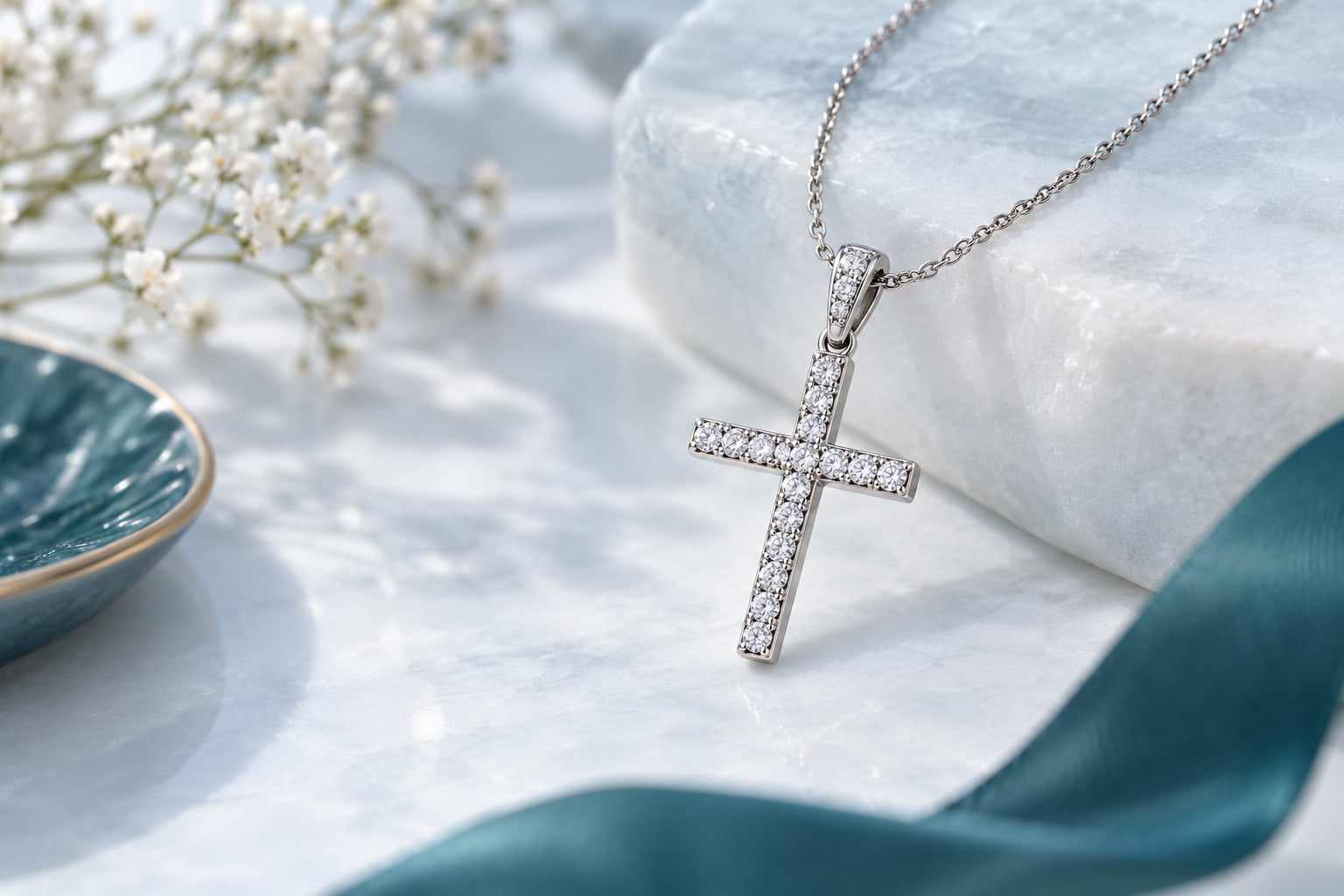
Quick Answer
For a lab grown diamond cross pendant, begin with the finished outline, center-junction design and chain attachment. Decide whether the arms use uniform or graduated stones, then specify each position's diameter, depth and appearance. Count the center only once when the vertical and horizontal rows intersect. Approve a full stone layout and a physical sample on the intended chain to check balance, rotation and bail clearance. Total weight does not determine those features. Source matching reserve stones by the actual size groups and keep the accepted layout for repairs. A sourcing coordinator can help select and follow the loose-diamond order; casting, setting, bail engineering and final jewelry inspection require their own confirmed maker and approval process.
How Should the Center of a Diamond Cross Pendant Be Planned?
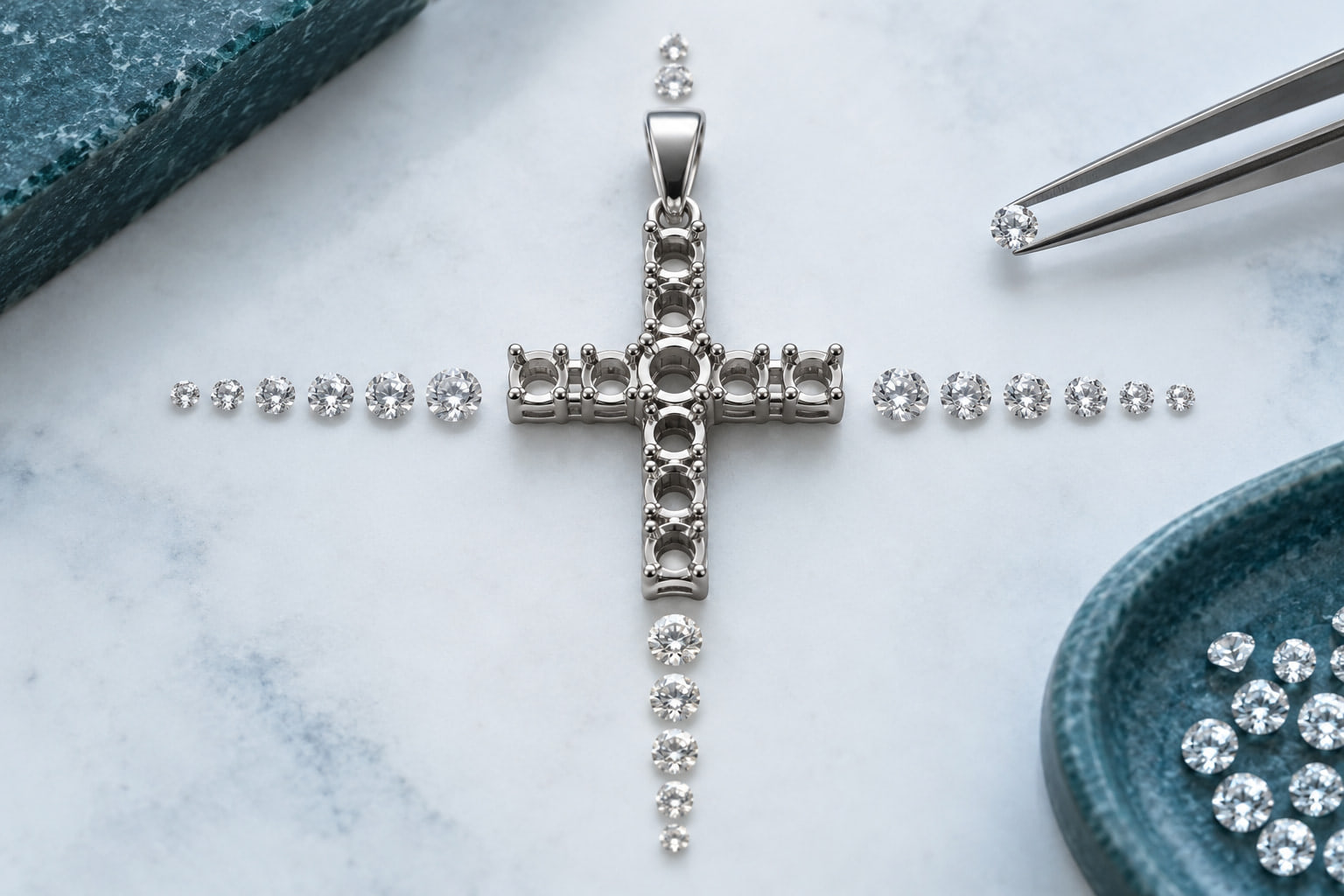
Choose whether one stone forms the intersection or several smaller stones create a central cluster. A single center can make the geometry legible, but it may need a different seat from the arm stones. A cluster can change the visual weight and metal structure. Draw the actual junction rather than leaving it to the setter to improvise from a rough cross outline.
Mark the centerline of each arm and the intended metal intervals. If the horizontal arms do not meet the vertical row cleanly, a small alignment error becomes a focal point. Review the layout at realistic size as well as enlarged. A drawing that looks balanced at screen scale may feel crowded in a petite pendant.
Control the center's depth and girdle relationship to neighboring stones. A deeper stone may lift the intersection or require a thicker back. Have the maker define the space available and the protective metal needed. Do not assume that equal face-up diameter makes two candidates interchangeable at the most constrained position.
Use our everyday jewelry application to frame the wearing context, then request round laboratory-grown melee by position. The supplier should receive the junction detail and the whole outline together so a local fit decision does not unintentionally change the pendant's overall proportions.
Uniform Arms VS Graduated Arms: Which Layout Should You Source?
Uniform and graduated layouts create different inventory and repair requirements. Neither is inherently better. Choose the one that supports the intended size, visual rhythm and production capability, then preserve its position map through the order.
| Decision | Uniform stone arms | Graduated stone arms | Procurement implication |
|---|---|---|---|
| Visual structure | Repeated stones emphasize a regular line | Changing sizes can emphasize the center or lower arm | Approve actual outline at realistic scale |
| Size groups | One main group, perhaps a distinct center | Several groups tied to position | Quote accepted counts for every group |
| Junction | Same diameter can simplify visual continuity | Larger center may need a special seat | Specify center depth separately |
| Pair symmetry | Horizontal arms use equal repeated counts | Mirrored arms need the same size sequence | Retain left-right position map |
| Repair stock | One group may cover many positions | Reserve must include each critical size | Keep production and reserves separate |
| Reorder | Repeat one calibrated window | Repeat the whole graduated progression | Use measured ranges, not total weight alone |
A graduated layout needs more than a bag containing the right total number of stones. Ask the supplier to pack the sizes separately and reference them to the drawing. If the maker receives mixed sizes without a map, it may recreate an approximate pattern that differs from the approved sample.
For uniform arms, still review size distribution across the parcel. A row that alternates near-minimum and near-maximum diameters can look uneven in a tightly repeated design. Use calibrated parcel selection to communicate the accepted window and identify how outliers will be handled.
Why Should the Pendant Be Tested on Its Intended Chain?
The bail connects the jewelry to its wearing behavior. Its opening must accommodate the intended chain and relevant end fittings, while the attachment position affects how the cross hangs. State the chain scope clearly: an illustration of a pendant on a chain does not establish that the chain is included in a loose-stone or pendant quotation.
Ask the maker to review the pendant's center of gravity and attachment geometry in the physical sample. A cross that rests well on a flat tray can rotate or tip when suspended. Record the chain used in the trial so a later change in chain thickness or construction does not silently alter the tested combination.
Inspect the back and junction for sharp transitions, exposed stone features or surfaces that may catch on fabric. Have the maker define suitable checks for the actual construction. This guide does not prescribe a universal load test or guarantee wearing performance from a drawing.
The GIA care guide explains that diamonds can chip and that loose stones can wear metal. That supports attention to secure seats and serviceability, not a promise that a particular pendant is indestructible. Ask how the center and arm stones can be inspected and replaced without unnecessary disturbance to the surrounding structure.
How Do You Count a Cross Layout Without Double-Counting the Center?
Hypothetical project, the Thirteen-Position Cross: the vertical row has nine stone positions, including the center. The horizontal row has five, also including the center. The unique count is nine plus five minus one, or thirteen stones. Counting both rows without subtracting the shared center would overstate the requirement.
For a graduated version, the designer uses one larger center and twelve smaller arm stones. A production run of seventy-five pendants requires seventy-five centers and 900 arm stones. The buyer selects a reserve of five centers and sixty arm stones, giving eighty centers and 960 arm stones in the accepted order. These reserves are project choices, not general recommended percentages.
If the layout instead uses three size groups, repeat the count by position rather than divide total weight among the groups. A shortage in one group can stop complete-pendant production even when the shipment's total count is correct. Keep the center and each arm group separately identified in the purchase schedule.
MEITUO can coordinate a request for loose centers and melee arm stones against the approved map. Ask for actual dimensions, available documentation and appearance consistency across the proposed groups. The order should identify whether the center is individually reported and what screening basis applies to the small stones.
Before volume release, set one complete cross and compare the junction, arm spacing and suspended profile with the approval drawing. If the bench changes the number of positions or the central seat, update the arithmetic and reserve schedule. Do not let a corrected prototype coexist with an unchanged bulk order.
How Should Cross-Pendant Stone Requests Differ Across Supply Channels?
The useful channel is one that can maintain the junction and arm schedule, not merely offer a cross-shaped product image. Confirm whether the offer is loose diamonds, a separately agreed finished pendant or another scope. Keep each provider's responsibility explicit.
USA / Position-specific replenishment
Can a US Trade Source Supply Center and Arm Groups Together?
A US trade channel may make small follow-up purchases convenient, but the request still needs a position map. Stuller's laboratory-grown resource page describes loose-stone offerings with and without reports. It does not establish that a particular cross-pendant assortment or exact calibrated arm size is available, nor that the stones were grown in the United States.
Ask whether the center and small-stone groups can be reserved and shipped under references that remain useful for reorders. If the center has an individual document, keep that reference separate from the arm parcel's screening or lot record. A single broad invoice description can make later replacement work unnecessarily difficult.
For a retailer using a domestic workshop, send actual measurements before the final seats are cut. Confirm return conditions before setting, and retain a small matching reserve where the design needs it. The channel's practical value is faster access to suitable replacements, not permission to ignore the center junction or replace an arm stone with any nominally similar round.
CHINA / Junction and group control
How Should a Chinese Coordinator Preserve the Cross Layout?
For MEITUO's Qingdao sourcing coordination, provide a numbered drawing and a table of unique positions. Mark the shared center explicitly. This prevents a supplier from treating the vertical and horizontal rows as independent orders or assuming the center uses the same depth window as every arm stone.
Ask who performs final sorting and whether the center and arm groups come from one or several upstream sources. Review appearance together where consistency matters. If a wider commercial melee category is offered, request project-specific selection or identify the limitation before the maker commits to tight seats.
Request separate reserve labels and keep the final packing schedule connected to the drawing revision. A change from uniform to graduated arms should trigger a new quotation by size group, even if the estimated total weight is similar. Coordination is useful when it preserves these distinctions; it does not substitute for the jewelry maker's bail, setting and suspended-balance approval.
INDIA / Layout and export identity
What Should an Indian Selection Channel Verify for Mirrored Cross Arms?
An Indian supplier search should identify both the selling entity and the contact responsible for selection. Greenlab's official contact page lists Surat and Mumbai contacts, illustrating why commercial and technical questions may follow different routes. That does not establish availability of a complete cross-pendant stone program.
For graduated arms, ask for matched size groups and consistent media showing their relationship to the center. Request the actual accepted count in every group, not only a total carat figure. A parcel can contain enough total stones and still be short of the specific size used at the horizontal ends.
Confirm that approved substitutions appear on the final schedule and that each export sublot keeps its identity through receiving. For a recurring range, discuss a matching reserve or a repeat-selection process using retained references. Do not assume a later stone with the same report band will fit the original junction or preserve the mirrored appearance of the arms.
How Do Buyers Approve a Cross Pendant for Repeat Production?
Approve three views: face-up geometry, side profile and suspended wearing position. The first reveals alignment and stone rhythm; the second reveals height and seat relationships; the third reveals balance and chain interaction. Use the actual approved stones where practical and document any substitute sample materials.
Review the horizontal arms as a matched pair. Check that counts, graduation and metal spacing mirror correctly. Inspect the lower arm for the intended length and visual weight. A symmetric top section does not guarantee that the full pendant reads as intended.
Prepare an accurate product description. The FTC laboratory-created diamond disclosure guidance emphasizes conspicuous origin disclosure near product descriptions. State total diamond weight clearly and identify whether the chain is included. Avoid implying a center weight when the number refers to the whole pendant.
For reorders and repairs, retain the numbered map, dimension limits, appearance reference and accepted sample photographs. Use our repeat-order planning guide to preserve the procurement history. A replacement should match its position and visual role rather than simply add back the missing total weight.
If the cross tips forward in the suspended trial, ask the maker to investigate the attachment and mass distribution before changing diamond grades. A visual balance issue is not corrected by a higher clarity label. If one horizontal arm appears shorter, compare stone counts, measured diameters and metal gaps independently; this distinguishes a stone-selection problem from an assembly problem.
For a damaged center junction, photograph and identify the surrounding stones before removal. Ask whether the repair changes the shared seat or adjacent arm spacing. Review the whole cross again after repair, because an acceptable isolated center can still alter the intersection. Keep the corrected drawing and service photographs with the original position map. Repair records should describe the actual final structure instead of merely stating that one stone was replaced.
What Can MEITUO Coordinate for a Cross-Pendant Program?
MEITUO is a sourcing and supply-chain coordination partner based in Qingdao, Shandong, China. It supports jewelry brands, wholesalers, retailers and designers with product selection, supplier coordination, confirmation of quality requirements and order follow-up. For a cross pendant, a numbered layout and separate center-and-arm schedule make the request actionable.
The sourcing range includes loose centers, melee, side stones, matched pairs and sets, and fancy-color options. Ask the team which combinations, dimensions and documents are available for the proposed order. A coordinated loose-stone request does not establish that MEITUO manufactures pendants, bails or chains, or validates a finished jewelry design.
Contact [email protected] with the approved stone map, production quantity and repair reserve. Confirm availability, MOQ, lead time, treatment information and shipping terms before final commitment. Keep casting, setting, chain fit and final pendant approval assigned to the responsible jewelry maker, while using the same stone specification across all supplier conversations.
What Should a Lab-Grown Diamond Cross Pendant RFQ Include?
Attach the complete outline and a detailed center-junction drawing. Number each position, identify size groups and state diameter, depth, condition and appearance requirements. Reconcile row counts to unique stone count so the shared center is not purchased twice or omitted.
Quote production and reserves separately. Request labels that connect the delivered groups to the drawing, together with actual counts, weights and available laboratory-grown documentation. Require written approval for substitution of a center or an entire arm group.
State the scope plainly. If you are requesting loose stones, say so; if you also need finished-jewelry support, ask for a separately confirmed offer and responsible maker. The following brief supports a stone procurement conversation without implying that a sourcing quotation covers the complete pendant or chain.
Please quote loose laboratory-grown diamonds for [cross-pendant design] in [production quantity]. The attached map has [unique position count], comprising [center specification] and [arm size groups with counts]. Apply [diameter, depth, condition and appearance limits], and quote [reserve by group] separately. Provide actual count and weight, available reports or screening records, treatment information and clear lot references. Identify sourcing constraints before proposing alternatives and obtain written approval for substitutions. Confirm MOQ, availability, lead time and shipping terms. Our jewelry maker will separately approve the center junction, setting, bail, chain fit and suspended balance; this request does not assume a finished-pendant supply scope.
FAQ: Lab-Grown Diamond Cross Pendants: Stone Layout and Sourcing
How Many Stones Are in a Diamond Cross Pendant?
The count depends on the layout. When rows share one center, add the row counts and subtract the duplicate center once. Use a numbered position map for more complex clusters or graduation.
Does Total Weight Determine the Pendant Size?
No. Stone count, dimensions, metal spacing, arm lengths and the bail determine the finished outline. Weight is one part of the specification and cannot replace the drawing.
Should the Center Match the Arm Stones Exactly?
That depends on the intended design. A distinct center may be intentional, but its appearance, dimensions and depth should be approved with the arms rather than selected in isolation.
Is the Chain Included in a Sourcing Quotation?
Only if the confirmed offer says so. A photograph showing a chain does not establish commercial scope. State loose stones, pendant and chain requirements separately.
What Makes a Useful Repair Reserve?
Keep matching pieces for each critical size group with the original dimensions and position map. A reserve containing only small arm stones cannot replace a distinct center or another graduated position.
Who Checks Whether the Pendant Hangs Correctly?
The finished-jewelry maker and buyer should approve the physical sample on the intended chain. The loose-diamond supplier can support the stone schedule but should not be assumed to validate balance or bail construction.