 English
 Español
 Português
 Deutsch
 Français
 Italiano
 Nederlands
 العربية
 日本語
 한국어
 ไทย
Quick Answer
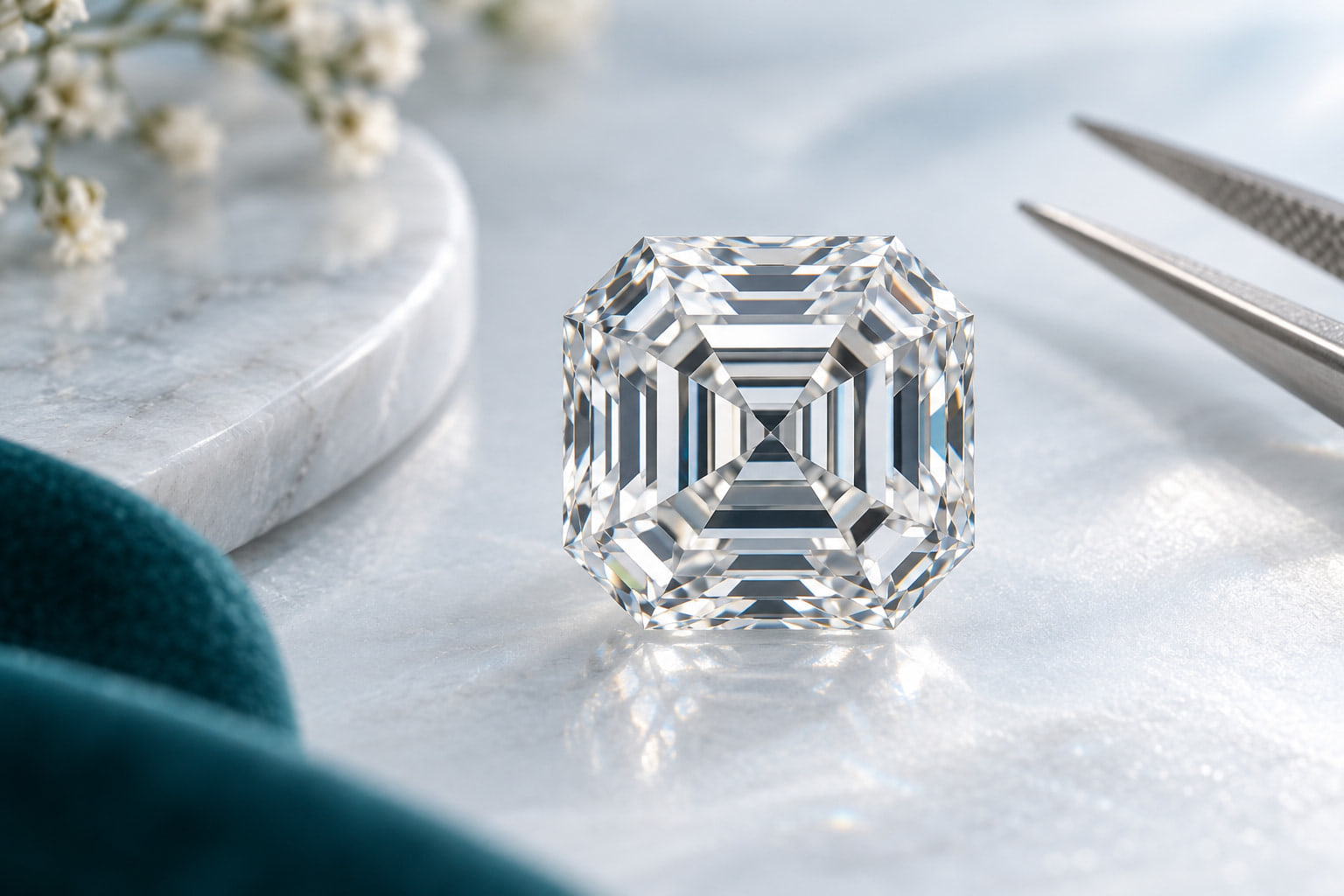
When buying an asscher cut lab grown diamond, first establish whether the seller means a generic clipped-corner square step cut or a documented branded product. Do not infer Royal Asscher identity, authorized origin or a proprietary facet arrangement from the word Asscher alone. For generic stock, inspect the concentric steps and diagonal pattern in motion, compare all four corner clips, and investigate persistent face-up transparency. Maximum length and width do not describe the full eight-sided outline or pavilion fit. Approve the actual stone against the head drawing, with magnified corner-condition images and verified identity documents. Keep an accepted visual reference so a replacement reproduces the square step-cut character rather than merely matching carat weight and a broad shape label.
What Does Asscher Mean in a Laboratory-Grown Sourcing Request?
In broad trade usage, an Asscher-style search often means a nearly square step cut with clipped corners. That generic description should be translated into the actual laboratory shape and cutting-style wording on the offered document. It should not be expanded into a claim that a stone comes from the Royal Asscher company or follows one of its proprietary designs.
Royal Asscher's own site describes its branded family and a 74-facet Royal Asscher Cut. The company's design discussion distinguishes its branded cuts from generically marketed Asscher variations. Those are primary brand descriptions, not evidence that MEITUO offers branded inventory. Any actual branded offer would need its own documented identity and authorization checks.
For a generic lab-grown project, use clear language such as square clipped-corner step cut, with the reference image and desired appearance attached. Ask the supplier to show the report's wording and actual facet evidence where relevant. Do not demand a proprietary branded cut while expecting an unrelated generic source to supply it by name alone.
This distinction also protects the finished product description. A brand can describe the visible square step-cut style accurately without implying an affiliation it has not established. Keep marketing copy, supplier invoices and laboratory documents aligned. If a seller makes a specific brand claim, resolve its evidence before reviewing price or appearance as though that claim were already proven.
How Should Buyers Inspect the Hall-of-Mirrors and Diagonal Pattern?
With the table approximately level, observe the concentric steps surrounding the center. Then follow the diagonal-looking elements toward the clipped corners. Buyers sometimes describe a windmill impression where these diagonal regions structure the face. Treat that phrase as a visual description, not a guarantee of one exact facet arrangement or grade.
Tilt slowly along two perpendicular axes and compare whether the broad reflections change coherently. A striking still photograph can hide an unappealing sequence of inactive areas. Conversely, a dark diagonal in one frame may be part of changing contrast. Judge the complete moving pattern at actual size before moving to close inspection.
Investigate suspected windows separately. GIA's cut-evaluation discussion describes windowing as a see-through effect. Repeat the observation using a neutral support with space beneath the pavilion. A colored holder or nearby metal can influence what appears through or reflected within the stone. Record viewing direction, support and persistence instead of labeling every dark or transparent area the same way.
The collection reference should specify the visual rhythm the brand values: broad orderly steps, a balanced diagonal impression and a central area it finds attractive. Do not assume the largest visible windmill is automatically the best choice. Compare several stones in the same setup, then retain accepted and rejected examples with their actual reasons. The square step-cut product category provides the relevant starting point.
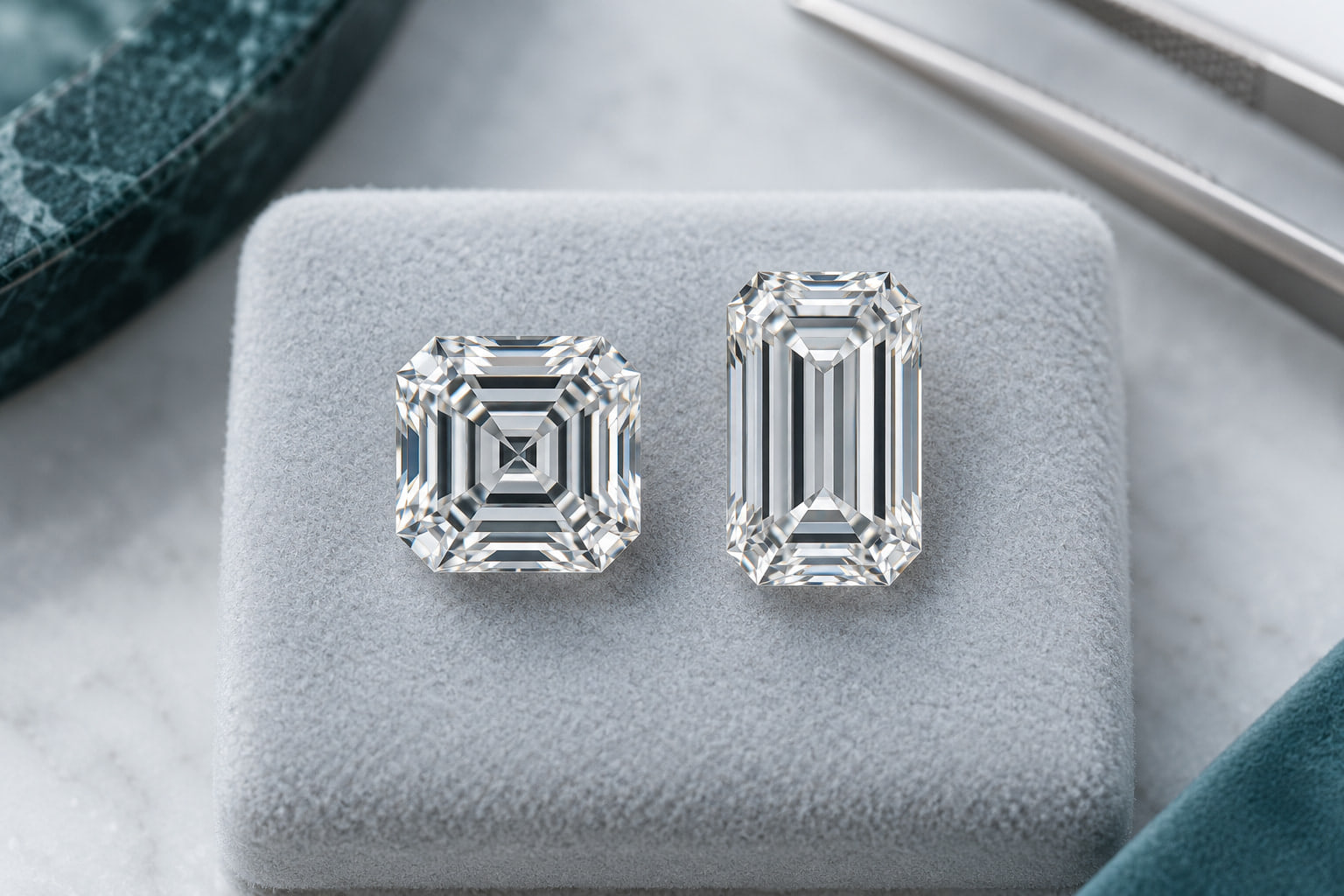
Square Step Cut VS Emerald Rectangle: What Changes in Buying?
| Selection issue | Square clipped-corner step cut | Rectangular emerald step cut |
|---|---|---|
| Visual organization | More equal-sided concentric and diagonal relationships | Long-axis bands and elongated central rectangle |
| Outline control | Compare all eight sides and apparent squareness | Compare elongation, parallel long sides and corner clips |
| Mounting concern | Large corner clips can change the apparent octagon | Long-edge support and corner contact need review |
| Pairing design | Check alignment with square or tapered accents | Check proportion of accents along an elongated center |
| Shared inspection | Review moving contrast, transparency, condition and actual pavilion fit | |
The comparison is between two generic step-cut directions, not between branded products. A square stone does not become a certified proprietary cut through resemblance, and an emerald rectangle is not a lesser version of it. Choose the style that serves the design, then approve its actual execution.
The emerald-cut category is useful when the design needs length. The shape guide helps compare those directions before the manufacturer builds a head around the wrong outline family.
Why Do Corner Clips Matter Even When Two Square Stones Measure Alike?
Hypothetical example: the Eight-Side Frame. Two generic square step-cut candidates each measure 7.0 by 7.0 mm. In a simplified face-up drawing, candidate A has straight-line corner cuts removing right triangles with 0.8 mm legs. Candidate B has corner cuts with 1.2 mm legs. The real stones must be inspected; this planar model only illustrates the geometry.
Each corner removal in A is 0.8 times 0.8 divided by two, or 0.32 square millimeters. Four remove 1.28 from the 49-square-millimeter bounding square, leaving 47.72. B removes 0.72 per corner, or 2.88 in total, leaving 46.12. The difference is 1.60 square millimeters, approximately 3.4% of A's simplified outline area. This is not a measured diamond spread or an optical rating.
The more important manufacturing consequence is where each diagonal edge meets the proposed prong. A head drawn for A may expose a different gap or bearing relationship around B. Equal maximum dimensions do not make those interfaces equivalent. Ask engineering to place both actual outlines into the design and review profiles, not to rely on the simplified area calculation as a fit test.
Now inspect their moving steps. If B has the preferred visual pattern, the buyer may consider a revised head. If the existing frame is fixed, A's geometry may be the more practical candidate, assuming all other checks pass. MEITUO can coordinate that alternative discussion with explicit exception notes. Preserve the final corner geometry and visual reference so a later replacement is not selected solely by seven-millimeter dimensions.
What Should a Square Step-Cut Receiving Record Contain?
Begin with exact item identity, document verification and inscription reconciliation where available. If branded identity was claimed, reconcile its separate evidence too. A laboratory-grown identity document does not by itself establish authorization to use a brand name. Keep generic geometry and branded provenance as distinct fields in the order system.
Read the current laboratory service. GIA currently uses Premium or Standard for its eligible loose colorless-to-near-colorless lab-grown quality assessment. Historical-style individual grade fields should not be promised on every current report. Obtain the actual report and relevant process information rather than copying a seller's summary.
At receiving, photograph the eight-sided outline at scale and inspect every clip and girdle edge under magnification. Note condition exceptions before setting. Repeat the agreed slow-tilt routine and compare the central steps and diagonal impression with the retained reference. A broad style match is not enough when a fixed head depends on specific corner geometry.
Have the setter approve the actual profile against the current mounting revision, then retain pre-setting and finished images. The repeat-order guide can connect the chosen octagonal outline, optical family and mounting version. If the design includes side stones, keep their layout alongside the center rather than as unrelated stock lines.
How Should Square Step-Cut Buyers Compare Supplier Channels?
Ask whether the channel can document generic geometry honestly and resolve any brand claim before selection. Exact corner images and controlled motion evidence matter more than a supplier's preferred merchandising label. Country alone establishes neither cut quality nor authorization.
For collection stock, retain a reference that another seller could understand without relying on the first seller's terminology. Include the actual laboratory description, contour image and permitted departures. This makes a future search more resilient if the original inventory contact or branded claim cannot be relied upon.
Build a shortlist matrix with three separate columns: naming evidence, visual fit and mounting fit. A generic candidate can pass the latter two while remaining unsuitable for a brief that specifically requires a documented branded product. Conversely, a documented branded offer can still be outside the intended dimensions or visual preference. Avoid compressing those results into a single quality score. The matrix should show which decision remains open and who has authority to close it.
For a fixed square frame, ask the supplier to preserve the accepted candidate while the setter reviews the clips. Confirm the reservation deadline and an alternative route if the review is delayed. If the original stone is sold before approval, restart the geometry and appearance checks with the replacement rather than inheriting the earlier decision. This is particularly important for a small collection whose visual identity depends on a specific broad-step rhythm. Keep any recut or repolish proposal separate from available-stock offers until the final stone, documents and profile can be reviewed.
US / Terminology at the counter
What Should US Retailers Clarify When a Client Requests Asscher?
A US retailer should determine whether the customer wants a generic square step-cut appearance or a particular branded product. Royal Asscher describes its own branded designs; resemblance alone does not establish that identity. Ask any seller making the branded claim for supporting evidence before using it in customer-facing copy.
For generic sourcing, a domestic trade distributor can be asked for exact corner images, profile and moving steps. Stuller's trade category illustrates that route without proving US growth or branded availability. Show the client the actual square-step reference and realistic mounting coverage. If the selected stone changes, review its corner geometry and visual family again. Keep the customer's style approval separate from the supplier's document verification and the setter's fit decision. Confirm actual reservation and return conditions rather than assuming a familiar shape label makes every offer interchangeable. Ask the distributor to retain the actual corner views while the setter reviews the head.
CN / Eight-sided geometry control
How Should China Sourcing Describe a Generic Square Step Cut?
For China sourcing, a perpendicular outline and the words square clipped-corner step cut are more useful than an ambiguous brand-adjacent request. GIA's production review supplies laboratory-grown industry context, not a guarantee of any seller's cutting style or branded authorization. Ask who controls the actual polished candidate and its documents.
A Qingdao coordination request should show how large the corner clips may be and which head version is fixed. Require exact-stone motion clips so the diagonal impression and central steps can be compared. If multiple suppliers use different inventory names, map them to the actual laboratory description rather than forcing every record into one marketing term. Keep proposed generic stock clearly described in quotations and packing lists. A more dramatic-looking pattern is not evidence of a proprietary design. Resolve identity or affiliation claims separately, then let the designer and manufacturer review appearance and fit on their own merits. Keep generic product naming consistent across the final dispatch record.
IN / Pattern and brand separation
What Should Indian Contacts Clarify About Square Step-Cut Offers?
An Indian polished-stock or cutting contact may use Asscher as a broad style label. Ask for the exact report description, actual facet evidence where relevant and any separate basis for a branded claim. GreenLab lists Surat and Mumbai contacts, illustrating possible contact points without identifying the cutter or brand status of a specific offered stone.
For a generic collection, request candidates grouped by corner size and moving step pattern. A custom-cut discussion should identify the buyer's visual reference without instructing an unrelated source to imitate a proprietary branded product. Confirm achievable dimensions, approval sample process and final documentation before committing. If a supplier proposes recutting to improve the square appearance or corner balance, obtain the projected weight, outline, timing and fit consequences. Keep a final exact-stone review after any work; a promising cutting discussion is not the same as an approved delivered center. Request a final eight-sided silhouette after any approved alteration.
How Can MEITUO Coordinate a Generic Square Step-Cut Inquiry?
MEITUO is a sourcing and supply-chain coordination partner based in Qingdao, Shandong, China. For a generic square step-cut program, it can help gather candidate information, communicate the preferred step pattern and corner geometry, and follow up on unresolved supplier questions. Its role includes product selection, supplier coordination, quality-requirement confirmation and order follow-up.
MEITUO's scope covers loose centers, melee, side stones, matched pairs and sets, and fancy-color options. That scope does not establish access to a proprietary branded cut or permission to make brand-affiliation claims. Any such offer would need separate evidence. For an ordinary generic inquiry, send the accepted eight-sided silhouette, profile limits and visual reference to [email protected]. Confirm actual availability, documents, MOQ, treatment information, lead time and shipping terms per order. The designer application page provides a useful context for coordinating this geometry-led selection while the designer, laboratory and manufacturer retain their own approval responsibilities.
What Should an Asscher-Style Diamond RFQ Clarify?
Say explicitly whether the request is for a generic square clipped-corner step cut. If a specific branded product is required, ask the seller for the relevant identity evidence and do not allow an unlabelled generic substitution. For generic stock, attach an outline reference and describe the preferred moving step pattern.
Include absolute dimensions, depth limits, corner views and the mounting revision. Ask for report wording rather than a shortened inventory label. Require exceptions to be listed individually before reservation. The RFQ guide can support the commercial terms once the shape and brand boundary is resolved. That sequence keeps quotation comparison focused on genuinely comparable offers.
Please quote [quantity] generic square clipped-corner step-cut laboratory-grown diamonds for [project], using visual reference [ID]. This request does not assume proprietary branded provenance. Provide actual laboratory shape wording, report references, scale images, all four corner views, profile and controlled motion clips. Target dimensions are [length/width] with depth limited to [limit] for head [revision]. State growth and treatment information and flag geometry or pattern departures individually. Confirm stock control, MOQ, lead time, shipping terms and review conditions. Any specific branded claim requires separate supporting evidence and approval by [buyer].
FAQ: Asscher-Cut Lab-Grown Diamonds: Evaluating Step Patterns
Does Asscher Automatically Mean Royal Asscher?
No. Establish whether the seller means a generic square clipped-corner step cut or a documented branded product. Do not imply Royal Asscher provenance or affiliation from resemblance or a broad inventory label.
Are All Square Step Cuts the Same Pattern?
No. Compare concentric steps, diagonal appearance and movement in the actual stones. A shared outline description cannot establish identical visual rhythm or preferred contrast.
Why Do Clipped Corners Matter in a Square Head?
They change the eight-sided perimeter and the local bearing relationship even when maximum length and width match. Have the manufacturer inspect the actual outline and profile before approving a substitution.
Is a Dark Diagonal Automatically a Defect?
No. It may be part of changing contrast. Observe controlled movement and compare with the accepted reference. Investigate persistent inactivity or see-through areas separately from a single dark frame.
Can a Laboratory Report Prove Brand Authorization?
A report should be read for its actual documented findings. Laboratory-grown identity and geometry do not automatically establish a seller’s authorization to claim a proprietary brand. Request separate evidence for any such claim.
What Should a Generic Square Step-Cut Reorder Preserve?
Retain the actual report wording, scaled eight-sided silhouette, corner views, motion clip and mounting revision. This allows the new candidate to be judged without relying on an ambiguous marketing name.