 English
 Español
 Português
 Deutsch
 Français
 Italiano
 Nederlands
 العربية
 日本語
 한국어
 ไทย
Quick Answer
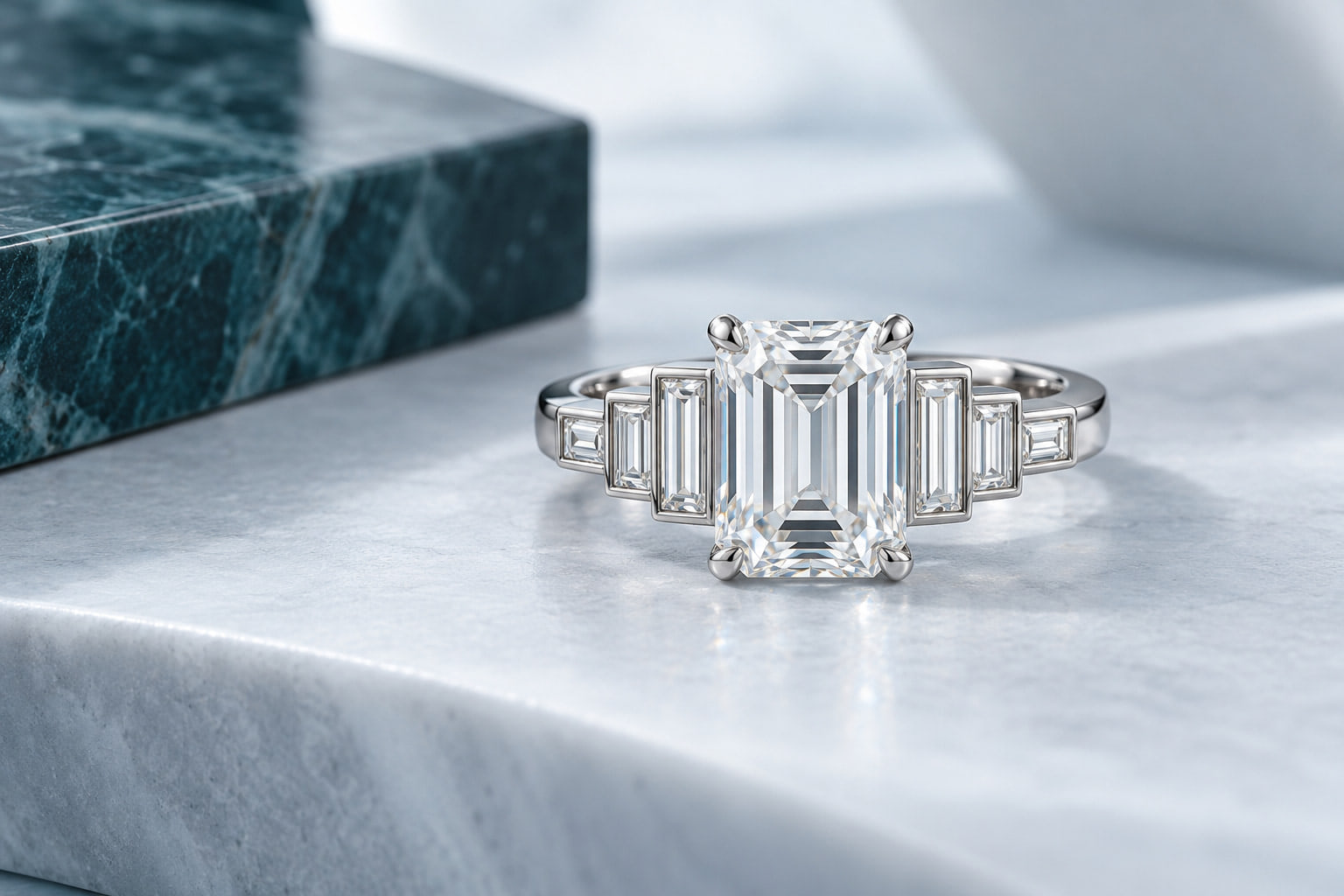
For an art deco lab grown diamond ring, choose the complete geometric composition before buying the center. Define center dimensions, side-stone outlines, channel alignment, metal borders and the finished height. Request matched side stones as an approved group and confirm their lengths, widths, depths and corner conditions against the CAD. Straight baguettes, tapered baguettes and other geometric sides create different shoulder lines; they are not interchangeable merely because their total weight matches. Approve a full stone layout and a manufacturing sample before volume production. Describe a newly made ring as Art Deco-inspired or contemporary, with clear laboratory-grown disclosure. Preserve the accepted layout and a matching repair strategy so later stones do not weaken the design's symmetry.
What Makes a Contemporary Art Deco-Inspired Ring Coherent?
The V&A account of Art Deco fashion and jewelry connects the style with strong geometry and abstract forms. For a modern buyer, that history is a design reference, not permission to claim historical provenance. A newly manufactured laboratory-grown ring should not be called an authentic period jewel unless a separate, truthful claim about the actual object supports that description.
Translate inspiration into a small number of controlled lines. A rectangular center may be framed by parallel baguettes, stepped shoulders or a contrasting geometric border. Choose which line leads the eye and which elements support it. When every edge competes, additional stones can make the composition less legible rather than more distinctive.
Create a face-up drawing and a profile drawing at realistic scale. Mark the center's visible outline, shoulder progression, metal widths and any intentional gaps. Specify whether the side stones should appear continuous with the center or form a separate stepped frame. Those intentions guide sourcing much more effectively than a mood-board image alone.
Our designer and studio sourcing page can help turn that concept into a coordinated request. Keep the style brief connected to bridal production requirements, including wearing height, ring size and the relationship to a wedding band. The visual language should survive normal use, not exist only in an overhead render.
Straight Baguette VS Tapered Baguette: Which Suits the Shoulder?
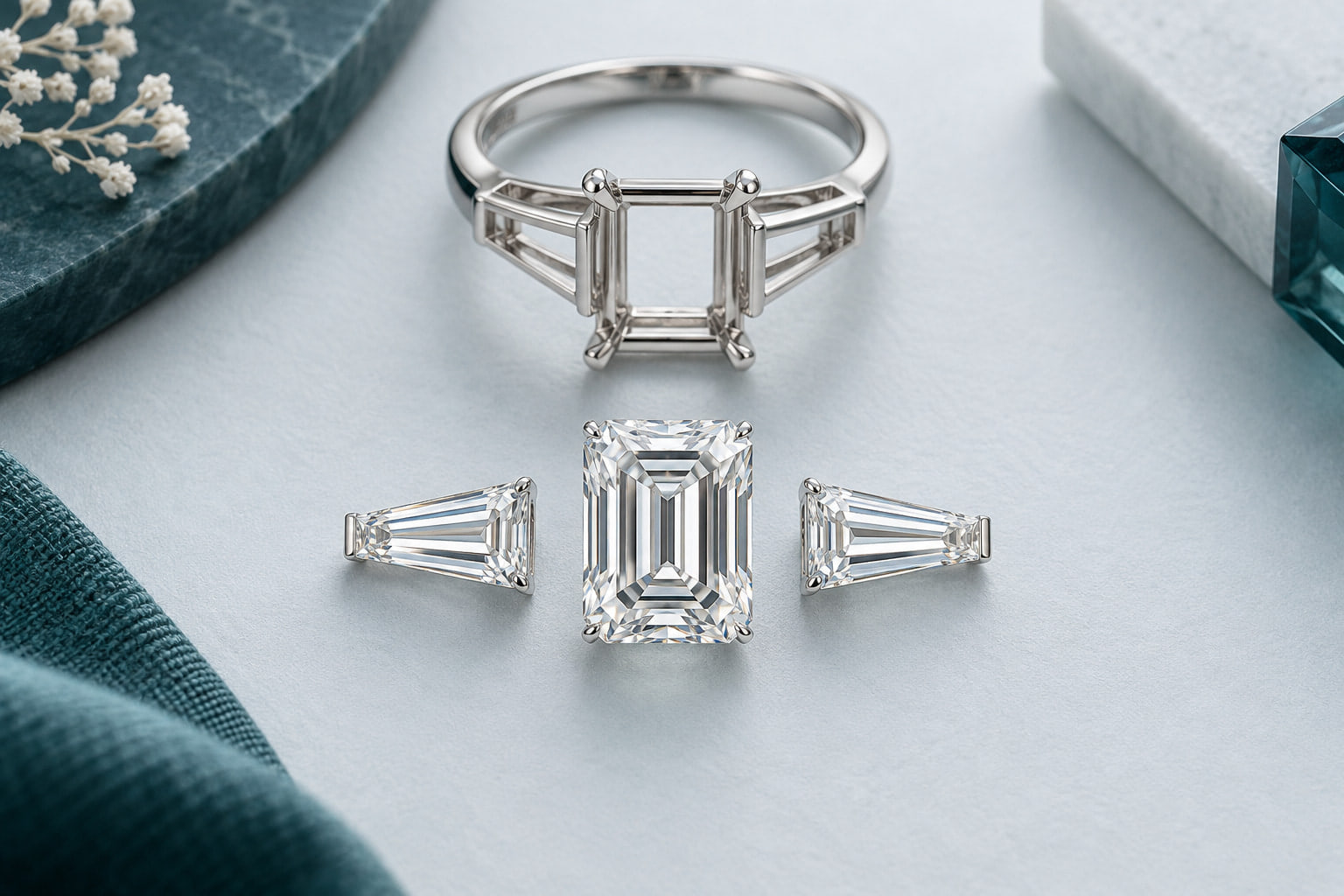
The GIA baguette guide distinguishes straight and tapered outlines. Use that difference deliberately: a straight edge can reinforce a parallel architectural frame, while a taper can transition toward a narrower shank. The following table is a design decision aid, not a universal preference for one shape.
| Layout question | Straight baguette sides | Tapered baguette sides | Approval evidence |
|---|---|---|---|
| Shoulder line | Parallel widths emphasize a linear frame | Changing widths create a narrowing transition | Full face-up layout with metal borders |
| Critical dimensions | Length, width, depth and parallel edges | Length, wide end, narrow end, depth and taper | Measured pair map rather than total weight alone |
| Pairing | Left and right should balance outline and appearance | Both sides must mirror taper direction and scale | Photograph pair in intended orientation |
| Channel fit | Parallel seats depend on consistent width | Seat geometry must follow the taper | Setter-approved CAD and trial |
| Replacement | Need the same calibrated outline | Need equivalent end widths and taper | Retained measurements and reserve strategy |
Do not choose sides only after the center arrives if the design depends on a precise shoulder progression. A difficult center width may require custom selection or a revised composition. Establish the acceptable center window first, then ask which side geometry can be sourced consistently within it.
For options, compare straight baguette side stones with tapered baguette side stones. Keep both shape and orientation on the approval record. A supplier's generic pair label cannot communicate which end faces the center or how the stones should sit in the finished ring.
Which Stone Details Can Break an Otherwise Strong Geometric Layout?
Long straight edges make alignment errors conspicuous. Inspect whether paired stones have comparable lengths, widths and end shapes before reviewing the total sparkle. A slight mismatch can create a visible step in a channel even when both stones meet a broad weight category. Request perpendicular photographs so perspective does not disguise the difference.
Inspect clipped corners and girdles for condition and seat compatibility. Diamond hardness does not make corners immune to damage. The GIA care guide distinguishes scratch resistance from resistance to chipping. Have the setter review vulnerable areas and protective metal before a design is approved.
Control depth as well as face-up geometry. If one side stone sits higher, a perfectly aligned overhead layout can still produce an uneven profile. Ask for sufficient dimensional information to evaluate seat depth and pavilion clearance. The setter should confirm where the ring can accommodate variation and where it cannot.
Review optical character across the group. A quiet step-cut side next to a brilliant center can be an intentional contrast, but mismatched transparency or an obvious distracting inclusion may weaken the symmetry. State whether the design seeks uniform facet character or a deliberate contrast. A generic high-clarity request does not answer that visual question.
How Should a Buyer Calculate a Geometric Ring Order?
Hypothetical project, the Stepped Rectangle Ring: a studio plans thirty rings, each with one rectangular center, two tapered baguette sides and eight round accent stones. The production requirement is thirty centers, sixty tapered sides and 240 accents. It requests three additional matched side pairs and twenty-four matching accents as a separate repair reserve, giving sixty-six sides and 264 accents. The reserve is a project choice, not a standard allowance.
For the design trial, the studio proposes a center measuring 8.0 by 6.0 mm and side stones whose wide ends visually align with its shoulders. Those dimensions are hypothetical design inputs, not a carat conversion. The CAD team must allow for metal and actual seat geometry rather than add stone widths as if they touch without setting structure.
The team asks for each side pair to be photographed facing inward, then outward, with the wide and narrow ends identified in the item schedule. It labels each set to its center so a later sorting step does not mix pairs. Approval covers the whole set, not three independent stones that happen to share a report band.
MEITUO can coordinate a matched fancy-shape pair request alongside the center and accent specification. Ask what sizes and pair consistency are available before committing to a drawing that requires an unusually exact outline. If selection cannot reproduce the design economically, revise the shoulder progression while the project is still at sample stage.
After setting the first article, compare the top view and profile against the approved layout. Record any bench changes, especially widened channels or altered metal borders. Those changes should update the production drawing and sourcing limits, so the next twenty-nine rings are not built from an obsolete brief.
Which Supplier Channels Suit a Geometric Art Deco-Inspired Ring?
A geometric design often needs a coordinated stone search rather than independent catalog purchases. Identify who can approve the center-and-side relationship, who controls calibration and whether a matched repair reserve can be held. Keep the historical style description separate from the contemporary supply route.
USA / Catalog options and set approval
Can a US Trade Channel Supply Complete Geometric Sets?
A US trade inventory may offer centers and geometric sides through convenient catalog channels. Stuller's laboratory-grown resource page confirms a loose-stone trade offering, but a buyer should separately confirm the exact baguette or tapered-side availability and whether complete sets can be held for review. Domestic distribution does not establish domestic growth origin.
For an Art Deco-inspired line, ask for both sides photographed with the intended center. Confirm whether a pair is matched by measured outline and appearance or merely grouped by a commercial size category. Establish return conditions before mounting, because setting can change the practical remedy for a mismatch.
If the retailer is coordinating a local bench, send the actual stone dimensions before finalizing the CAD. A familiar catalog name should not replace a measurement sheet. Keep the supplier's item references connected to the first-article approval, then request equivalent selection for reorders. The channel's convenience is valuable when it preserves the geometric relationship, not when it encourages a center-first purchase that leaves the sides unresolved.
CHINA / Layout-led selection
How Can a Chinese Coordinator Manage a Multi-Shape Ring Brief?
MEITUO's Qingdao coordination role can be relevant when a design combines centers, calibrated sides and small accents. Send one layout map but separate specifications for each stone group. Ask who performs selection and how the complete groups will remain identifiable if candidates come from different upstream suppliers.
For tapered baguettes, translate the drawing into length, wide-end width, narrow-end width and depth fields. Do not rely on an English shape name alone where a small interpretation difference can alter the shoulder line. Request orientation photographs and a measured pair schedule before approval.
Confirm whether repair pairs can be selected from the same run and whether a later reorder will use retained references. If the supplier proposes an alternative side shape, review the effect on CAD and the finished geometry before accepting it. Coordination can simplify communication, but it does not remove the need for the designer and setter to approve the actual stone-and-metal relationship.
INDIA / Pair symmetry and continuity
What Should Indian Side-Stone Selection Establish Before Export?
Indian channel research should identify the selection contact separately from the commercial counterparty. Greenlab's official contact page lists Surat and Mumbai locations, illustrating why technical and sales questions may follow different routes. It does not establish that every listed office supplies a specific geometric side-stone assortment.
Ask whether the proposed baguette pair has been selected as a mirrored group or assembled from separate inventory pieces. Request both end widths for tapered shapes, consistent side views and a record connecting each pair to its intended center. A total pair weight cannot reveal the shoulder alignment.
For a recurring Art Deco-inspired range, discuss the ability to reproduce the outline window rather than reserve a shape name alone. If exact replacements are difficult, plan matching reserve pairs before the first production order. Preserve the approved group identifiers in the export packing list so the receiving workshop does not mix sides across sets while checking counts or preparing the bench trays.
How Do You Approve the Design Without Overrelying on a Render?
Begin with a flat stone layout, then a CAD review, then a physical first article. Each stage answers a different question. The flat layout tests visual proportions; CAD tests the intended metal structure and clearances; the first article shows how the actual stones and bench work translate into the finished ring.
Use a checklist covering centered alignment, mirrored shoulder steps, consistent border widths, secure seats and comfortable profile. Assess the ring at normal viewing scale as well as under magnification. A design that looks dramatic in an enlarged image may lose its stepped rhythm when worn.
Check the relationship to the intended wedding band. A high side-stone gallery or projecting corner may prevent the desired stack, even when the face-up ring is attractive. If a gap is intentional, show it accurately in product images and sales samples rather than implying a flush fit.
For serial production, retain the accepted drawing, stone map, sample photographs and a written list of permitted variations. Ask for approval before a side shape or depth range changes. Use our matched-set buying guide to frame set continuity, and keep repair reserve withdrawals documented so the range remains serviceable.
When the first article fails symmetry review, identify the source before changing stones. Unequal metal borders with matched loose sides point toward layout or bench work; unequal side outlines visible before setting point toward selection. Photograph both conditions using the same orientation and retain the rejected pair separately. If the center is rotated slightly in its seat, correcting that alignment may resolve the apparent shoulder mismatch without replacing acceptable sides. Record the diagnosis and revised instruction so the next set is not rejected for a problem created elsewhere in the process.
How Can MEITUO Coordinate Geometric Center-and-Side Sets?
MEITUO is a sourcing and supply-chain coordination partner in Qingdao, Shandong, China. It supports jewelry brands, wholesalers, retailers and designers with product selection, supplier communication, confirmation of quality requirements and order follow-up. For an Art Deco-inspired ring, the most useful input is a measured layout with clear left-right orientation and a defined acceptance process.
The sourcing range includes loose centers, melee, side stones, matched pairs and sets, and fancy-color options. MEITUO can discuss candidate combinations and available documentation, but the buyer should confirm actual availability, calibration, MOQ and lead time for the proposed order. The team is not presented as a grower, cutter or finished-ring manufacturer through this sourcing role.
Send [email protected] the center window, side-stone dimensions, accent requirements and reserve plan. Ask which points can be confirmed before sampling and which need physical selection. Keep CAD approval, setting responsibility and final jewelry inspection with the appropriate project partners, while using one coordinated stone brief to reduce misunderstandings.
What Should an Art Deco-Inspired Ring Sourcing Brief Include?
Attach top and profile drawings with stone positions numbered. Specify actual center limits, side-stone end widths, lengths, depths and orientation. State whether optical contrast between center and sides is intentional and what the approved group should look like under neutral comparison.
Quote the complete set and the repair reserve separately. Ask whether each group can remain labeled together through selection, packing and receiving. Require a new approval if any side pair is replaced, even if the replacement has the same nominal weight.
Use contemporary style wording in the order and merchandising handover. A modern laboratory-grown ring can reference Art Deco geometry clearly and attractively without an unsupported antique claim. The sourcing brief should protect both the design and the accuracy of the finished product description.
Please quote complete laboratory-grown diamond sets for [contemporary Art Deco-inspired ring design]. Center limits are [length, width and depth]; side requirements are [shape, length, end widths, depth and orientation]. Include [accent count and size] per ring for [production quantity], plus [matching reserve]. Review the attached top and profile layout and identify any sourcing constraints before proposing alternatives. Provide paired neutral media, measured schedules, available reports and treatment information. Keep each approved set labeled together. Confirm substitution approval, MOQ, lead time, document availability and shipping terms. Final CAD, setting and finished-ring approval remain separate project stages.
FAQ: Art Deco Lab-Grown Diamond Rings: A Design Buying Guide
Is a New Laboratory-Grown Ring an Antique Art Deco Ring?
No. Describe a newly made design as contemporary or Art Deco-inspired unless a separate truthful provenance supports another description. Style references do not establish the age or origin of the object.
Can Straight and Tapered Baguettes Be Substituted?
Only after design and CAD review. Their outlines create different shoulder lines and seat requirements. Equal weight does not make them interchangeable in a geometric composition.
Should the Center Be Bought Before Selecting Sides?
For a tightly integrated design, establish the complete layout first. A center can be reserved within a suitable dimension window, but the side geometry and availability should be checked before final commitment.
Does High Hardness Protect Corners From Chipping?
No. Scratch resistance and toughness are different properties. Have the setter assess corner condition, seat design and protective metal, especially where the layout exposes vulnerable edges.
What Should a Repair Reserve Contain?
Use measured, visually compatible pieces or pairs tied to the approved layout. Keep them identified and record withdrawals. A random spare with the same shape name may not preserve the ring's geometry.
What Should Trigger a New First Article?
A changed center window, side outline, depth range, seat geometry or metal border can justify renewed approval. Record the change so the next order is built from the current specification rather than a previous render.