 English
 Español
 Português
 Deutsch
 Français
 Italiano
 Nederlands
 العربية
 日本語
 한국어
 ไทย
Quick Answer
CVD and HPHT describe ways of growing laboratory-grown diamonds. For a wholesale purchase, neither label replaces a clear product specification or a review of the offered stones. Decide whether the growth information is essential to your collection, request the supporting documentation you need and assess appearance, dimensions, matching and order cost separately. Keep growth method and any treatment information in distinct fields. A useful buying decision connects the specific diamond to your intended jewelry and customer promise, with the relevant information carried accurately from the sourcing record into the product presentation.
Understand What the Two Terms Actually Describe
The basic difference is a production process. GIA explains that HPHT growth uses high pressure and temperature around a carbon source and seed, while CVD growth deposits diamond material from carbon-containing gas onto a seed. These descriptions concern how the material is grown. They do not specify the complete appearance, dimensions or commercial suitability of a polished stone offered to your business. Read GIA’s explanation of the growth processes. For buying, use this background to ask better product questions rather than to create a universal winner between the two methods.
Begin by identifying why the distinction matters to your collection. Your customer may request a particular production description, your sourcing brief may require certain information, or your team may simply be comparing offers that use different labels. Those situations call for different next actions. A firm sourcing requirement needs supporting evidence for the item. A general comparison needs a consistent product basis. An internal knowledge question may be resolved by reading the technical source without imposing an unnecessary restriction on the purchase. Clarifying the purpose prevents a broad technical debate from delaying a straightforward selection decision.
Keep the terms in a product-information field that can be checked and maintained. If the offered item changes, confirm whether the information still applies. A collection description should not become more specific than the supporting records. This is particularly important when a retailer selects items over time rather than purchasing one fixed assortment. You can maintain a consistent customer experience while keeping accurate item-level information behind it. The useful distinction is between a stable brand promise and a product characteristic that needs to be confirmed for the particular selection you are presenting.
| Compare | CVD growth | HPHT growth |
|---|---|---|
| Basic growth route | Diamond material is deposited from carbon-containing gas onto a seed | Carbon grows onto a seed under high pressure and temperature |
| How the name is used | CVD identifies the stated growth process | HPHT can identify a growth process; read whether a separate reference concerns treatment |
| Treatment question | Ask separately what is stated about post-growth treatment | Ask separately what is stated about post-growth treatment |
| Buying evidence | Information applicable to the offered CVD-grown item | Information applicable to the offered HPHT-grown item |
| Product decision | Review the actual appearance, dimensions and agreed requirements | Review the actual appearance, dimensions and agreed requirements |
Separate Growth Method From Post-Growth Treatment
Use two separate questions when requesting information: how was the diamond grown, and what does the available documentation say about treatment? Combining them into one field invites misunderstanding. GIA’s research discusses CVD growth and subsequent HPHT treatment as distinct steps that can occur in the same material’s history. See GIA’s laboratory-grown diamond research overview. That distinction helps you recognize why a reference to HPHT should be read in context rather than assumed to identify the growth method in every sentence or document.
For your brief, state exactly which information you need and why. If your customer-facing proposition depends on a specific treatment disclosure, request a document or laboratory service that addresses it. If you are only trying to understand the offered item, ask the supplier to point to the relevant wording. Do not turn a broad comment into a more definite statement when writing your own listing. Where the available information leaves a question open, retain that question in the purchasing record and agree the action needed to resolve it before making a corresponding customer promise.
Treat changes in documentation as changes to the information basis of the offer. You might receive a different item, a different report product or an older document format. Review what has actually been supplied rather than carrying an assumption from a previous quotation. This does not mean every purchase requires a new technical investigation. It means the specificity of your claim should match the specificity of your evidence. Keeping growth and treatment in separate fields makes that relationship easier for purchasing, sales and your supplier to understand, especially when several people help maintain the collection.
Start Your Comparison With Equivalent Product Requirements
Two offers labeled CVD and HPHT can differ in several other ways. Before comparing them, align the stone role, shape, measurements, quantity unit and quality requirements relevant to your design. If you are buying a matched pair, both offers should address matching rather than simply supply two items. If you are selecting a center stone, compare the information available for those individual options. A different weight or service scope can be a legitimate alternative, but identify it as an alternative. Otherwise, the method label may receive credit or blame for a difference caused by another purchasing variable.
Use a short comparison sheet with a column for the required characteristic and a column for each offered option. Mark a requirement as confirmed only when the relevant information is available. Keep unresolved points visible instead of filling them from a supplier’s general catalog description. For example, if the quote identifies the growth method but provides no useful dimensions for the design, the next action is to request those measurements. That is more productive than making an early decision about which manufacturing process you prefer. Product equivalence gives the technical information a practical place in the comparison.
Once you have equivalent options, compare what changes for your business. You might prefer one specific stone’s appearance, a more useful information package or a purchasing arrangement that suits the collection. Explain the reason in the decision record. You do not need to claim that the selected process is inherently best for every buyer. The result can be narrower and more useful: this offered selection meets these requirements and supports this product plan. That conclusion is easier to defend internally and easier to revisit if a future order presents a different set of options.
| Purchasing field | Record before comparing methods | If it is missing |
|---|---|---|
| Intended use | Product, stone role and setting context | Clarify the design requirement |
| Physical specification | Shape and relevant measurements | Request item or selection details |
| Quality and appearance | Defined review criteria and available evidence | Arrange a relevant comparison |
| Information | Growth and treatment fields with their source | Ask for the applicable documentation |
| Commercial scope | Quantity unit, included services and charges | Normalize the quotation basis |

Review the Offered Appearance Without Using the Method as a Shortcut
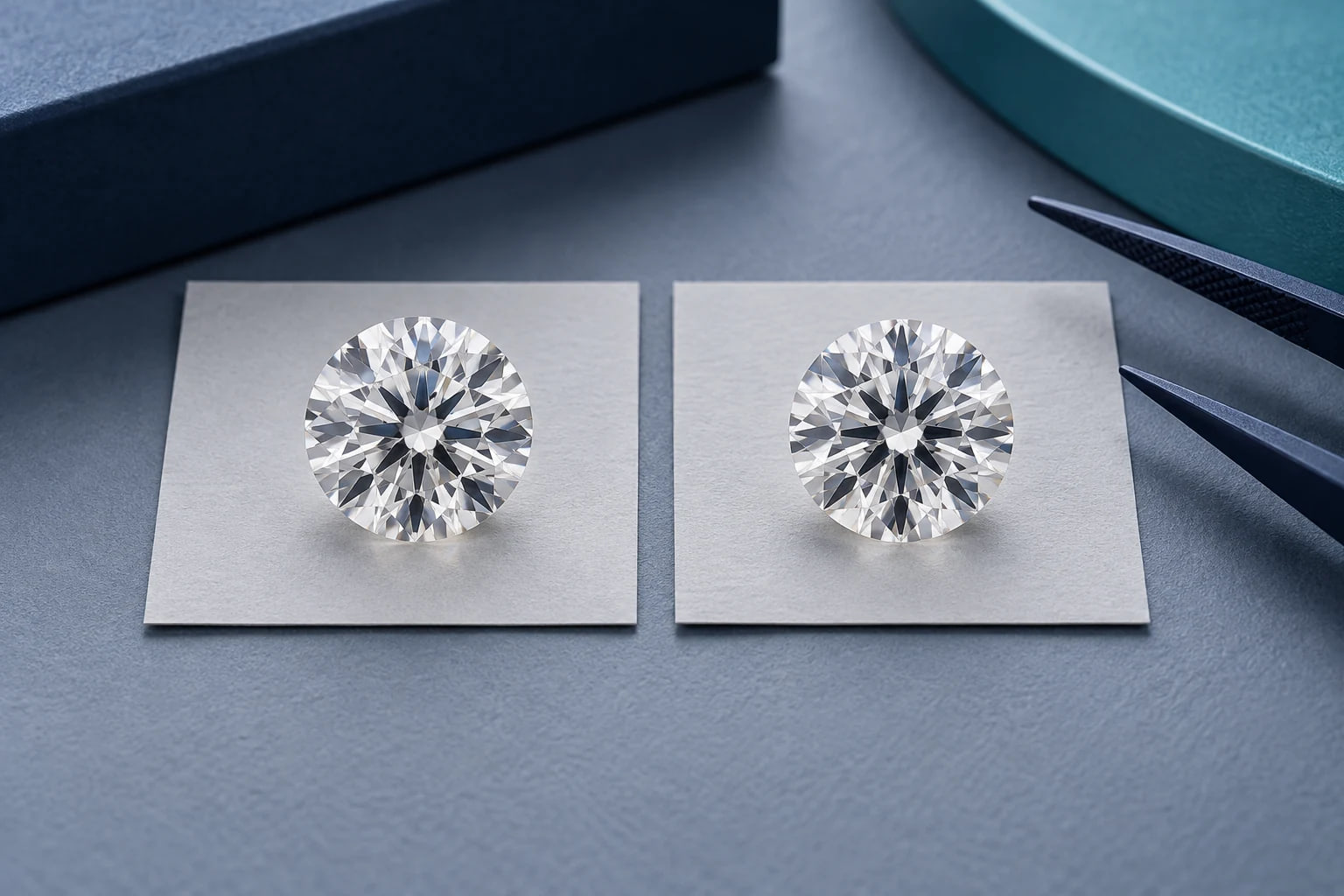
Your jewelry collection is ultimately presented through specific products. Review the offered stone or selection in that context, with attention to the appearance your customer will see and the way the design uses the diamond. Ask for relevant views of the actual item or a clearly described representative sample. If different suppliers use different lighting, backgrounds or image treatments, acknowledge that limitation in the comparison. A method label cannot correct an inconsistent viewing basis. Bring the discussion back to what your team needs to see before approving the product.
For a center stone, you may want to evaluate the outline and overall visual effect within the planned setting. For earrings, you may care more about the relationship between the two stones when viewed together. For a production assortment, the question may concern the consistency of the selection rather than a single striking image. State that task when requesting media or samples. The supplier can then prepare a response that helps you decide, rather than sending an impressive but unrelated photograph. Your own review should use the same task so that preferences do not shift halfway through the comparison.
Record the reason for an approval using language that relates to the design. A note such as “the pair’s outlines work together for this earring model” is more actionable than a general statement that one method looks better. If the approved option is later replaced, the supplier and your team can return to that recorded requirement. This makes appearance review useful for repeat purchasing. It also reduces the temptation to turn one sample experience into a broad claim about all diamonds produced by a particular process, which is far beyond what the sample exercise establishes.
Match the Documentation Request to Your Information Needs
Ask for the relevant document product, not only the laboratory’s name. The useful scope depends on the information you require and the service offered for the item. Review a sample format and the current service description, then identify which fields answer your question. For example, a request for production details should not be treated as fulfilled merely because an independent document exists. Confirm the actual wording and the item reference. This approach helps you avoid purchasing a document package that is more extensive in one area but does not address the question that matters to your collection.
Keep a distinction between the supplier’s statement, the laboratory’s statement and your own interpretation. Store each with its source rather than blending them into one simplified label. If your purchasing system only allows one short field, retain a linked note with the fuller wording. Your sales team can then use the approved description without reconstructing a technical conversation. This is especially helpful for a store that offers several stone choices, because a general collection statement may need to remain broader than the information available for a particular item.
When the document or item changes, check the fields relevant to your requirement again. Avoid assuming that a different report number means an identical information scope. If the detail you need is absent, ask what additional clarification or service would be appropriate. You can read our IGI and GIA report guide for the broader report-selection task. Here, the aim is narrower: make sure the growth and treatment information used in the buying decision is connected to the offered goods and is not stronger than the supporting description.
Compare Quotations Without Building a False Method Price Rule
Treat a quotation as an offer for a defined product and purchasing arrangement. It may reflect the item selection, quantity, documentation, matching and other services you request. If the CVD and HPHT offers differ in those areas, the price difference does not isolate the growth method. Ask suppliers to identify the scope clearly and distinguish requested options from alternatives. This lets you compare the proposed purchases without inventing a general market relationship from a small sample of offers. Your decision only needs to establish which available option works for the current collection.
Use complete order costs where the offers include different charges. Keep freight, packaging, documentation and other entered costs from being added twice when they are already included. Check the quantity units before calculating an allocated cost. A total for a pair should not be compared directly with a per-piece price or a parcel quoted by total weight. Once the basis is aligned, the comparison can show which purchasing option fits your budget and workflow. That result is a planning decision, not evidence that a particular growth process always commands a specific premium or discount.
If a supplier proposes an alternative that improves the budget, review the product implications before accepting it. The alternative might change the specific item, appearance, service package or documentation. Decide which changes you can accommodate and record the approved version. This gives price negotiation a useful boundary: the offer can evolve, but the product and information requirements remain visible. For a more detailed cost comparison, use our wholesale pricing guide. Keep the method discussion focused on the information it actually contributes rather than using it to explain every difference in the quotation.
Decide Whether the Method Belongs in Your Brand Proposition
Your customer proposition may be built around design, collection relevance, product appearance and service. Consider whether a specific growth-method claim adds a useful, supportable distinction for that audience. If the customer has not asked for it and it does not change the product decision, it may be better placed in the detailed product information than in the main collection message. This is an editorial choice for your business, not a suggestion to omit relevant information. The objective is to give customers a clear route from the offer to the supporting details they need.
If you choose to feature the method, plan how that statement will remain accurate across the range. Identify which products it applies to, where the supporting record sits and who updates the listing when an item changes. Do not copy an item-specific statement into a generic category template unless every relevant option meets the same requirement. The product team, buying contact and marketing team should share a usable reference. A concise internal instruction can be more effective than a long technical narrative that nobody maintains when the next batch of items is added.
Keep other claims independent. A description of the growth process does not establish your supplier’s facilities, environmental performance or customer results. If your brand wants to discuss those topics, obtain evidence for those specific claims rather than extending the method description beyond its scope. In the buying conversation, explain the product promise you intend to make and the evidence needed to support it. MEITUO can then connect your selection and information requirements to that promise, helping your team present the offered goods consistently without turning technical shorthand into unsupported brand messaging.
| Where the information appears | Appropriate focus | Record to maintain |
|---|---|---|
| Main collection message | The product value relevant to the audience | Approved collection proposition |
| Individual product details | Information applicable to the offered item | Item reference and supporting wording |
| Sales-team notes | How to answer the customer’s question accurately | Source and approved explanation |
| Repeat-order brief | Which requirements must continue | Current specification and change process |

Build Flexibility Into a Repeat Sourcing Requirement
Decide which parts of the selection are essential and which can be discussed on a future purchase. If a growth method is a firm requirement, state it clearly alongside the evidence you need. If the method is a preference, explain the product outcomes that have priority when an alternative is considered. This distinction gives the supplier a useful decision boundary. It also prevents an informal preference from becoming an unexamined restriction after the team member who made the first purchase has moved to another project or collection.
Retain the specific references used in the first decision. These may include the approved item or sample, relevant report information, images and the final order brief. A future request can then describe the intended continuity without claiming that a new item is identical in every characteristic. Where an alternative is proposed, compare it against the recorded requirements and identify what changes. The approval should concern the current offered goods. That keeps repeat purchasing practical while maintaining the information needed for your product presentation and customer conversations.
Review how the requirement interacts with your assortment plan. A narrow set of accepted options may be appropriate for a collection with a precise promise. A broader sourcing brief may suit a retailer whose customers choose among several documented items. Neither approach should be selected simply because it sounds more technical. Choose it because it supports your selling model and can be maintained by your team. When the next order is discussed, the supplier should be able to see what must stay fixed, what can be proposed separately and who is responsible for approving the difference.
Use a Worked Buying Situation to Organize the Decision
Consider an illustrative jewelry brand choosing an oval center stone for a new ring. Its comparison sheet has two separate fields. For Option A, the example entry reads “Growth method: CVD” and “Post-growth treatment: HPHT, as stated in the example information supplied.” For Option B, it reads “Growth method: HPHT” and “Treatment information: clarification requested.” These are invented teaching entries, not report extracts, MEITUO stock descriptions or laboratory conclusions. The important reading decision is that the HPHT reference under Option A describes a later treatment step rather than changing the CVD growth entry into an HPHT-grown product.
The buyer now has two concrete follow-up tasks. For Option A, retain the source of both entries and check that the customer description keeps growth and treatment distinct. For Option B, ask what the relevant documentation actually says before completing the treatment field; the growth entry does not answer that question. The designer still reviews each offered oval against the mounting and visual brief. If the brand requires a particular treatment statement, that requirement becomes an explicit approval condition for both options. If it simply needs accurate disclosure, the team uses the supported wording for whichever item is chosen.
This scenario is a planning example, not a claim about MEITUO customer results or the relative performance of two methods. Its value is the sequence: define the design, align the offers, resolve information gaps, review the product and record the decision. You can adapt that sequence to earrings, a pendant range or a trade assortment. Record your priorities so the next supplier conversation focuses on a purchase you can evaluate rather than an abstract debate with no agreed product at the center.
Prepare a Growth-Information Buying Brief
Write the requirement in a way another person can act on. Include the intended product, the information you need about growth and treatment, the source that should support it and the characteristics that decide product acceptance. If you are still exploring the collection, state the open question rather than inventing a firm method requirement. For example, you may want to compare two relevant items before deciding whether the distinction matters to the customer offer. That is a legitimate task for the sourcing conversation and can be recorded clearly.
Review the brief with the people who will use the information. Your designer may prioritize fit, purchasing may need an equivalent quote and marketing may need the approved wording for the product page. Keep those needs connected without asking one document field to solve all of them. If the question is laboratory-specific, use the current official source or appropriate service for clarification. If it is a commercial preference, discuss it as a preference. A better brief makes these distinctions visible so the supplier can respond with relevant options and the team can make the final choice coherently.
When you bring this brief to MEITUO, we can discuss the product selection, supporting information and purchasing approach together. The aim is not to force the collection into a preferred technical label. It is to help you source diamonds that fit the design and communicate the offered product accurately. Keep the agreed requirements with the final quotation and sample decision. That gives the growth-method discussion a useful outcome and creates a reference your team can return to when another item or repeat order is considered.
Connect the Requirement to MEITUO Sourcing Support
We help you turn the collection’s product and information requirements into a focused sourcing discussion. Share the intended jewelry, the specifications that matter and any growth or treatment information you need to retain. Our selection and supply-chain coordination support keeps these questions connected to the offered products, sample review and order follow-up. You can also discuss low-MOQ starting points, product materials, packaging, brand customization and logistics support as part of the same collection plan.
Our role is practical sourcing coordination. Technical statements in the guide are linked to their laboratory sources, while the final purchasing decision follows the specific goods and requirements you approve. Explore loose lab-grown diamonds or prepare an inquiry to connect the topic to a current collection rather than a general product label.
Share the details you know. Product quantities and project scope can be confirmed in conversation.
CVD and HPHT Buying Questions
Is CVD Always Better Than HPHT for a Jewelry Brand?
This guide does not rank one process as universally better. Evaluate the specific offered stone or selection against the design, appearance, information and commercial requirements of your collection. If a particular method is essential to your proposition, include it in the brief and request the supporting information. The purchasing decision should still explain why the selected goods work for the intended product.
Should I Ask About Growth Method and Treatment Separately?
Yes. Keeping them in separate fields helps your team understand the wording provided and maintain an accurate product record. Ask for the relevant supporting information rather than combining two different questions into a shortened label. If your customer proposition depends on a specific statement, confirm that the evidence addresses it before using that wording in your listing or sales materials.
Can I Compare Two Stones Fairly if Their Reports Differ?
You can compare the purchasing options, but first understand what information each document provides and which fields matter to your brief. Do not invent a direct conversion between different report products. Record any information gaps and review appearance or fit separately where needed. A clearer document comparison lets you decide which offered option supplies the evidence your business requires.
Do I Need to Advertise a Specific Growth Method?
Decide whether it is relevant to your customer proposition and whether you can maintain the statement accurately across the products concerned. The detailed product record should support the description you use. A collection can also be presented through design, appearance and service while keeping technical item information available for customers who need it. Coordinate the choice with the people responsible for buying and product content.
Why Do CVD and HPHT Quotations Sometimes Have Different Prices?
The offers may differ in the particular goods, quantities, matching requirements, documents or services included. Review those fields before attributing a difference to the method. This guide does not provide a market price rule. Use current equivalent quotations for your purchase and calculate the full entered order cost using the same product and delivery scope for both options.
Can I Infer a Stone’s Growth Method From a Product Photograph?
A product photograph is useful for the visual review it actually supports. Treat the stated growth information as a separate documentation question and request an appropriate source for the offered item. Do not turn an illustration or a general category image into evidence of production history.
What Should I Keep When Approving a Method-Specific Purchase?
Retain the current product brief, item or sample references, relevant documentation wording and the reason for approval. Identify which requirement should carry into a repeat purchase and which changes need review. That record helps your team update product information accurately if the offered item changes and gives the supplier a clear basis for discussing future selections or alternatives.
How Can MEITUO Help Me Choose Between the Available Options?
Share the intended jewelry and the specific product or information questions you want to resolve. We connect selection, supplier communication, quality requirements and order follow-up around that brief. You can compare relevant options and discuss supporting materials as the collection takes shape. The goal is an actionable purchase decision, with technical information connected to the goods rather than used as a substitute for reviewing them.
Sources and Editorial Notes
Growth-process background is drawn from the official GIA sources below. The purchasing framework and worked situation are MEITUO’s practical recommendations, not laboratory findings or market statistics.
- GIA: HPHT and CVD Growth Processes.
- GIA: Laboratory-Grown Diamond Research Overview.
- MEITUO Company Profile.
Reviewed October 27, 2026. No universal method-based quality or price claim is made.