 English
 Español
 Português
 Deutsch
 Français
 Italiano
 Nederlands
 العربية
 日本語
 한국어
 ไทย
Quick Answer
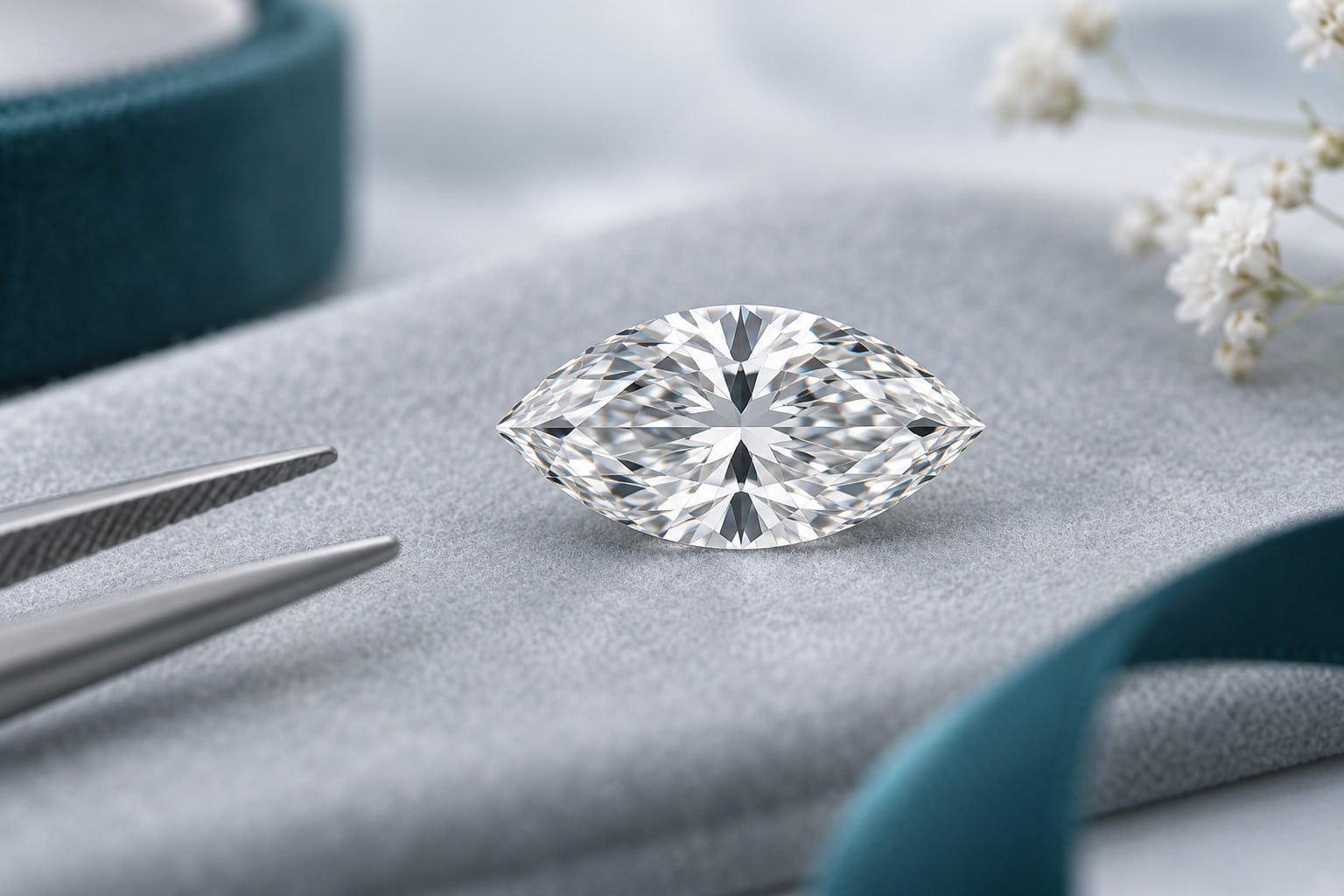
For a marquise cut lab grown diamond engagement ring, evaluate the navette outline, alignment of both points, changing central contrast and actual setting length before choosing by weight. The two sides should create the intended balanced silhouette, while the tips need condition inspection and a protective setting proposal. Observe a bow-tie area in motion and under more than one light source; a dark band in one photograph is not enough to reject the stone. For paired marquises, compare point angles, side fullness, width position and reflection texture together. Verify item identity and documents, then have the setter approve support and clearance at both ends. Treat the shape description separately from a laboratory's cut assessment or the buyer's own visual preference.
When Does Marquise Central Contrast Deserve Further Review?
The bow-tie description refers to an appearance across the central region, but buyers should record its behavior rather than treating the word as an automatic fault. Hold the cleaned stone in a consistent support and watch small movements along both axes. Does the central region change and interact with the rest of the face, or does a large dark zone dominate much of the routine viewing sequence?
Repeat under broad light and under smaller sources. Keep camera distance consistent because observer and camera obstruction can affect the image. A short glamorous clip may show only favorable angles, while a static close photograph may exaggerate one dark instant. Neither alone establishes the everyday appearance. Request an unedited sequence that includes the center and both ends throughout.
Compare candidates side by side at the size customers will see. It is possible to prefer a marquise with some changing central contrast over one that seems less distinct overall. The buyer's job is to establish an attractive reference family, not to promise a mathematically absent bow tie. GIA's marquise buying discussion provides relevant shape context; the acceptance routine here is an original procurement workflow.
If the result remains unclear, reserve the candidate subject to physical review under agreed terms. Do not convert uncertainty into approval merely to meet a production date. Ask for a replacement shortlist or a better-controlled clip, and document which observation remains unresolved so another reviewer can repeat the comparison.
North-South VS East-West Marquise Rings: What Changes?
| Procurement issue | North-south orientation | East-west orientation |
|---|---|---|
| Dominant dimension | Length extends along the finger | Length spans across the finger |
| Clearance review | Check gallery and wedding-band relationship | Check width across the intended ring size and shoulders |
| Point protection | Both ends need an approved protective design | Both ends still need protection despite different direction |
| Visual reference | Review hand-scale elongated silhouette | Review actual cross-finger footprint |
| Pairing accents | Confirm flank symmetry beside the long center | Confirm transition into shoulders without crowding tips |
Orientation is not only a styling choice added at the end. It changes which clearances matter most and how the ring appears on the intended finger size. Review a real-scale mock-up early. A long marquise that looks graceful in a loose-stone tray may require a different head and shoulder treatment when rotated.
GIA's chipping guidance identifies pointed shapes as needing attention. A protective prong or bezel concept must still fit the actual tip and supporting surfaces. The marquise product page starts the selection discussion, while the manufacturer should approve the completed head.
How Should Marquise Matching Work for a Coordinated Order?
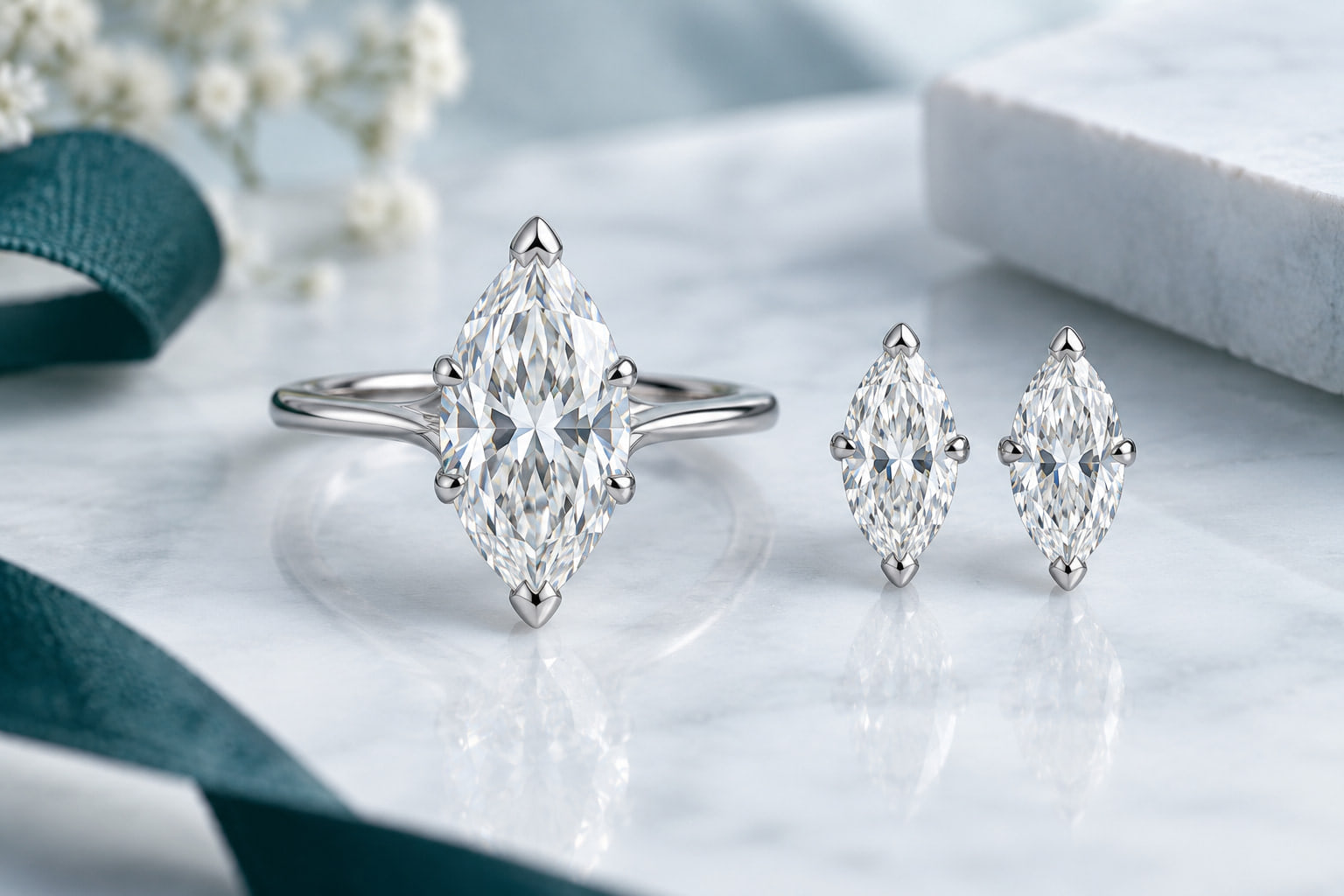
Hypothetical example: the Navette Pair and Center. A designer chooses a 12.0 by 6.0 mm marquise center and needs two 5.0 by 2.5 mm marquise accents. All have a ratio of 2.0, but that arithmetic alone cannot establish a coherent set. The small accents might have sharper ends and fuller centers than the larger stone, giving the design three unrelated silhouettes.
The buyer places equal-scale silhouettes in the intended layout, then views the actual small stones together. One candidate pair measures 5.00 by 2.50 mm and 5.08 by 2.48 mm. Their length difference is 0.08 mm, about 1.6% of the first stone's length. These invented measurements illustrate comparison, not a universal tolerance. The manufacturer decides whether that difference is acceptable in the specific side seats.
Now compare point alignment and reflection texture. If the left accent shows a conspicuous central dark region and the right accent does not under the same movement, equal dimensions do not make them visually matched. Rotate them into the exact mounting orientation and repeat the test. Optical pairing must be judged in the orientation the wearer will see.
Ask MEITUO to coordinate the center and accent group with individual identities, not to assemble a matched label from nominal dimensions. Use the fancy-shape pair category and matching guide to structure the request. If one accent fails, reserve the accepted center while the pair is reconsidered rather than changing the full set without approval.
What Should Marquise Receiving and Setting Handover Include?
Reconcile each stone to its inventory record and report reference, and verify the document through the issuer. Match any available inscription to the actual stone. Use the long-axis orientation consistently when capturing dimensions, point photographs and condition notes. A report reference does not record which end the setter will call the top unless the order file does.
Do not assume all current laboratory documents offer the same grading fields. GIA's current eligible colorless-to-near-colorless lab-grown service uses Premium or Standard assessments. Other services and historical documents differ. Ask for the actual report type and any needed growth or treatment information before purchase.
At receiving, inspect both ends, the girdle and any surface condition noted before dispatch. Repeat the agreed moving contrast test and compare the silhouette with the reference. Route tip concerns to technical review, outline mismatch to selection review and seat mismatch to engineering. Keeping those categories explicit prevents a favorable result in one area from closing an unrelated problem.
For setting handover, include profile views, intended orientation and the current head revision. The bridal application page provides relevant context, and the repeat-order guide helps preserve the navette family for future replacement. Photograph the protected ends after setting as part of the finished-piece record.
Which Market Questions Are Specific to Marquise Sourcing?
For marquises, the useful supplier is one that can show both points, preserve orientation and compare complete moving silhouettes. Ask how the actual stones are held and reviewed instead of treating the supplier's country as a proxy for shape quality.
Plan repair stock at the layout level. If a pair belongs to a distinctive navette family, an isolated replacement months later may be difficult to match visually even when the dimensions are available. The buyer can request a small approved reserve or retain a clear process for comparing a new pair. Neither option guarantees future stock. Record whether the collection permits replacement of one accent, both accents or the complete center-and-side group. This decision affects how much matching evidence should be retained and what the retailer can promise during after-sales service. Ask the setting team whether a replacement also requires a fresh head inspection, since the original seat may no longer have the same condition after removal.
US / Real-scale presentation
How Should US Retailers Review a Marquise Before a Client Appointment?
US retailers should obtain the actual marquise footprint before promising how it will sit across a finger. Stuller's trade category illustrates a domestic supply route, without proving US-grown origin. Ask the distributor whether the reserved candidate's media show both ends clearly and whether the intended head can be reviewed before the appointment.
For an east-west design, use a hand-scale mock-up on the intended ring size and discuss shoulder clearance. For a north-south design, show how the gallery relates to a companion band. Neither question can be resolved by carat weight alone. Keep the client's chosen outline and central-contrast reference in the order file, especially if a stock photograph was used at the first consultation. If the exact center changes, review the new media before presenting it as equivalent. Confirm written reservation, inspection and return terms with the actual seller, and make the setting handover include point-condition photographs. Keep the selected navette orientation visible on the appointment worksheet.
CN / Point-oriented coordination
How Should China Sourcing Describe a Marquise Group?
A China sourcing request should define the desired navette curvature and point relationship, rather than translate marquise into a shape word and stop there. GIA describes China's laboratory-grown production context, but production geography does not establish the outline or condition of a polished marquise. Ask who holds the actual center and any matching accents.
For coordinated sourcing through Qingdao, use fixed end labels and require photographs showing both points without prong-like holders covering them. A supplier should identify unresolved tip observations before consolidation. If marquise accents come from a different parcel than the center, request grouped media and separate identity records. Similar ratios across different sizes do not prove a matching silhouette. Clarify whether the buyer prioritizes a soft-sided navette or a narrower pointed form, and preserve that requirement when stock runs short. A proposed replacement should show its full outline and moving contrast, not only a higher report grade intended to compensate for a different shape.
IN / Outline and matched accents
What Should Buyers Ask Indian Marquise Cutting or Trading Contacts?
India sourcing can involve contacts close to cutting discussions as well as polished-stock trading. GreenLab's own contact page lists Surat and Mumbai, but a contact location does not tell the buyer who fashioned a particular navette. Ask who can answer questions about point angle, side fullness and the final profile of the offered stones.
For matched marquise accents, request a physically compared pair in the intended orientation, rather than two similarly described inventory rows. If a cutter proposes modifying a point or outline, obtain the consequences for final length, weight, symmetry, documentation and timing. The small area of a tip does not make alteration trivial to a matched set. For repeat collections, ask whether the supplier can maintain a controlled outline family from available stock. Keep the buyer's preference and the setter's fixed constraints distinct so an alternative can be considered honestly without being called an automatic match. Retain both end views with the final purchase record.
How Can MEITUO Coordinate a Marquise Center and Pair?
MEITUO works from Qingdao, Shandong, China, as a sourcing and supply-chain coordination partner. For marquise orders, buyers can ask it to keep center and accent identities linked, request comparable motion media and carry point-protection questions to the relevant supplier. Its support includes product selection, supplier coordination, quality-requirement confirmation and order follow-up.
Its range includes loose center stones, melee, side stones, matched pairs and sets, and fancy-color options. A coordinated marquise project can therefore begin with the whole layout rather than isolated stock lines. MEITUO should not be described as the grower, cutter or independent grader of the selected stones. Confirm availability, documents, MOQ, lead time, treatment information and shipping terms for the actual order. Email [email protected] with the navette reference, intended orientation, pair layout and head drawing. Include any fixed replacement constraints so the shortlist can flag them before reservation. The buyer and setter retain the final appearance and fit decisions.
What Should a Marquise RFQ Say About Points and Pairing?
State the orientation, target dimensions and chosen outline family before the report specification. Request both point views and a consistent movement sequence. For matched accents, provide their intended positions and ask for a grouped clip in that arrangement. A pair that looks alike in separate images may look different when mounted in opposing orientations.
Identify who reviews tip condition and engineering exceptions. Ask for stock-control confirmation and the time allowed to evaluate the actual stones. If a substitute is proposed, it needs its own silhouette and point evidence rather than a blanket equivalent label. The RFQ guide can provide commercial fields once the navette-specific approval routine is agreed.
Please quote [quantity] marquise laboratory-grown centers and [pair quantity] accents for [design]. Use navette reference [ID], target dimensions [ranges] and orientation [north-south or east-west]. Provide perpendicular scale images, A/B point views, profiles and unedited moving clips under consistent lighting. Show paired accents together in their intended positions. Include document references, inscription details where available, and growth or treatment information. Identify tip-condition concerns, outline departures and head-clearance exceptions before reservation. Confirm MOQ, stock control, lead time, shipping terms and inspection arrangements. Substitutions require approval from [buyer and technical reviewer].
FAQ: Marquise Lab-Grown Diamonds: Point Protection and Pairing
Is a Marquise Shape Itself a Cut Grade?
No. The shape describes the outline and must be distinguished from a laboratory assessment or the buyer’s visual approval. Read the actual report service and inspect the moving appearance of the specific stone.
Should Every Bow Tie Lead to Rejection?
No. Record how the central contrast behaves through ordinary movement and under controlled lighting. A single dark image can be misleading. Reject or review according to the agreed visual reference and the persistence of the observed effect.
Do Equal Ratios Guarantee Matched Marquise Accents?
No. Point angles, side fullness, absolute dimensions and reflection texture may differ. Inspect the pair together in its intended orientation and have the manufacturer approve the actual seats.
Can Marquises Be Set East-West?
Yes, as a design choice subject to proper engineering. Check the cross-finger footprint, shoulders and point protection at actual scale. Rotating the stone changes practical clearances and should be part of the original brief.
How Should the Two Points Be Documented?
Use fixed A and B labels on a reference image and retain close views before setting. Link observations to those labels and send unresolved features to a qualified reviewer. Repeat the photographs after setting for the finished-piece record.
What if One Accent in a Matched Pair Fails Inspection?
Keep the accepted items identified and request a new pair comparison. A replacement accent needs both dimensional and visual review beside its partner. Do not assume matching report fields alone restore the set.