 English
 Español
 Português
 Deutsch
 Français
 Italiano
 Nederlands
 العربية
 日本語
 한국어
 ไทย
Quick Answer
Moissanite vs lab grown diamond compares silicon carbide with diamond, which is crystalline carbon. Moissanite is not a laboratory-grown diamond even when it is manufactured for jewelry. Both can be attractive and durable in suitable designs, but their optical properties and identification requirements differ. Choose according to the customer’s material preference, visual taste, intended application and complete product budget. Do not use a thermal tester alone as a universal material or origin conclusion, and do not assume similar dimensions mean equal carat weight. Request complete material names, actual measurements and an appropriate verification workflow. For retail presentation, explain each option positively while preserving the distinction on the product card, invoice and customer receipt.
What Is the Difference Between Moissanite and Lab-Grown Diamond?
The material distinction comes first. Laboratory-grown diamond is diamond material produced by a controlled growth process. Jewelry moissanite is generally synthetic silicon carbide. A shared manufactured origin does not make the materials interchangeable, just as laboratory production does not make every manufactured gemstone a diamond.
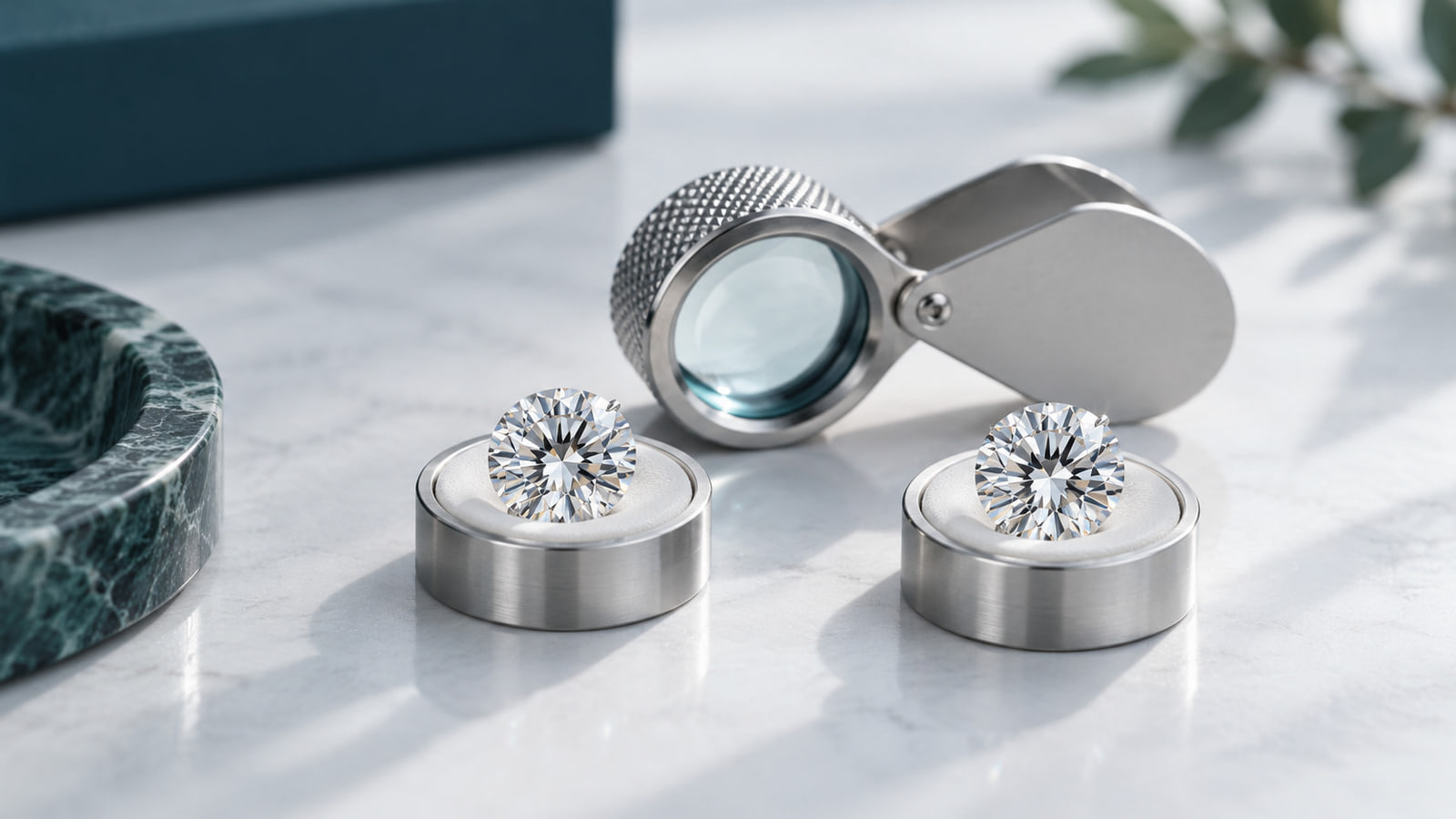
GIA’s imitation-gem guide describes moissanite’s strong fire and double refraction. These properties contribute to its visual character. A customer may enjoy that appearance or prefer the visual balance of a selected diamond. Neither preference needs to be framed as ignorance; the retailer should help the customer compare actual samples accurately.
Show samples under more than one ordinary viewing condition. High-intensity spotlights can emphasize colored flashes, while diffuse light reveals a different impression. Keep the setting and sample dimensions comparable when the purpose is visual comparison. If the shapes differ, explain that faceting and outline also influence what the customer sees.
Avoid claiming that every person can identify moissanite by eye or that every specimen looks identical. A trained professional can select appropriate observations and tests. A consumer-facing photograph, especially an edited one, should support design selection rather than serve as the proof of material identity.
Moissanite Versus Laboratory-Grown Diamond: Which Tradeoffs Matter?
The better choice is the material that fits the disclosed product promise. A retailer can offer both categories if staff, inventory and product data keep them distinct. The comparison should include the actual article and service terms, because an isolated stone characteristic does not answer every buying question.
Use the table as a selection framework, not a universal ranking or a price list.
| Criterion | Laboratory-grown diamond | Moissanite |
|---|---|---|
| Composition | Crystalline carbon | Silicon carbide |
| Product category | Diamond with laboratory-grown origin | Distinct gemstone and diamond simulant |
| Optical discussion | Evaluate the individual diamond’s cut and appearance | Expect a different fire and refraction character |
| Hardness context | Diamond has Mohs hardness 10 | GIA lists moissanite at 9.25 |
| Design-fit comparison | Measure length, width and depth | Use millimeters rather than assuming equal-weight equivalence |
| Verification | Establish diamond identity and laboratory-grown origin appropriately | Establish moissanite identity; do not relabel it diamond |
| Retail disclosure | State laboratory-grown diamond clearly | State moissanite clearly |
| Collection role | For customers seeking diamond material | For customers choosing moissanite’s attributes and proposition |
Hardness concerns scratching rather than complete resistance to damage. The setting, condition and use remain relevant for either material. Do not infer an unlimited lifetime or universal cleaning method from the hardness comparison.
How Should a Retailer Sample Diamond and Moissanite Designs?
Consider a hypothetical 40-pair earring collection using an 8.0 by 6.0 mm oval outline. The buyer develops two clearly separated options: laboratory-grown diamond and moissanite. The setting workshop receives each sample’s actual depth and outline, because matching the nominal length and width does not guarantee identical seat geometry.
Use separate approval sheets and bills of materials. Record material, dimensions, acceptable variation, pair matching and visual reference. If one option uses a different facet pattern, show the customer that difference instead of presenting the sample as an identical substitute. Keep actual stone weight separate from any commercial diamond-equivalent terminology a seller uses.
For the diamond route, review matched laboratory-grown options. Ask whether members are approved together and what happens if one needs replacement. For the moissanite route, require the same clarity of material and dimensional specification without assuming that a diamond report workflow is the appropriate documentation route.
Price both complete options with their actual scope. Metal, assembly, inspection, packaging and service can differ by supplier and design. The buyer should not declare a finished-product saving from the loose-stone line alone. MEITUO can coordinate supplier questions for the laboratory-grown diamond selection while the retailer keeps the two material programs clearly separated.
Why Is a Diamond Tester Result Not the Whole Answer?
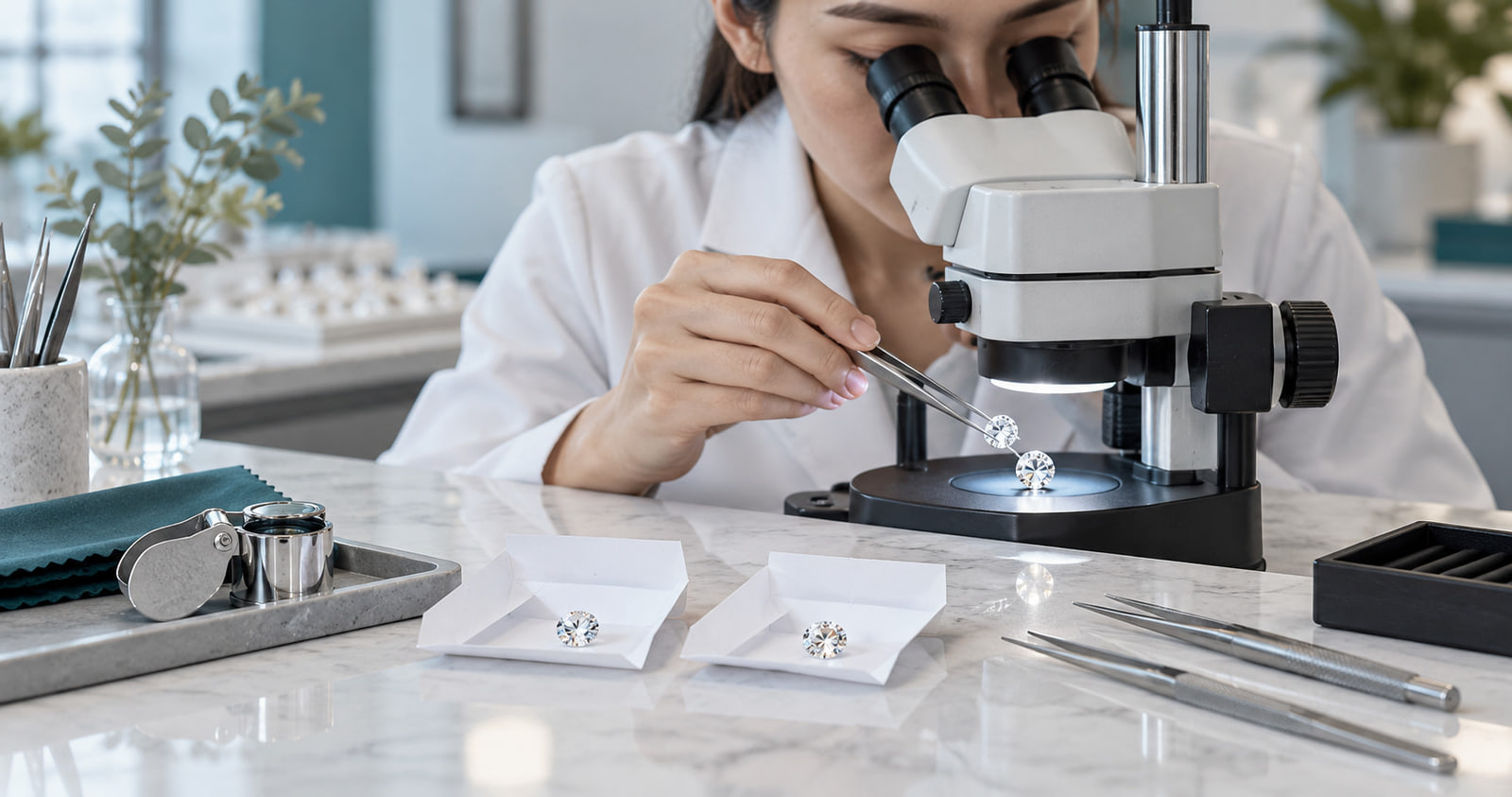
Some properties of moissanite are close enough to diamond to create screening pitfalls. GIA’s published moissanite identification case explains the relevance of thermal conductivity and microscopic double refraction. The lesson is to choose a suitable identification workflow, rather than treating a basic thermal response as proof of diamond.
Material identification and diamond growth-origin identification are also different tasks. Even after a stone is established as diamond, further suitable examination may be needed to distinguish natural from laboratory-grown origin. A single green light or a generic pass statement should not be expanded into all the facts a retailer wants to advertise.
For a hypothetical mixed supplier sample tray containing 12 stones, keep each item labeled and obtain the appropriate verification before merging any samples into stock. Record the test or service used, its scope and unresolved results. If a result is inconsistent with the invoice, isolate the affected goods and clarify the scope of the discrepancy.
A report reference or inscription should be connected to the physical stone and not treated as a standalone guarantee. The same GIA case illustrates why an apparent number can require scrutiny. Review the diamond report guide for the diamond portion of the program and keep simulant identification distinct from the report service purchased for diamond.
How Should Staff Explain Which Material Is Better for a Customer?
Ask what the customer wants the stone to be. If diamond material is central to the purchase, moissanite is a different option rather than another type of laboratory-grown diamond. If the customer values moissanite’s visual character and proposition, present it accurately instead of describing it only as a substitute for something else.
Use a consistent sample comparison. State material and origin, show the actual size and design, and explain service terms. Avoid unsupported claims that either material is an investment, universally greener or impossible to damage. Those statements do not follow from the basic material comparison.
For bridal designs, identity may carry strong personal meaning. For fashion applications, a different combination of style and budget may guide the decision. Let the customer’s priorities determine which tradeoffs matter rather than assuming the most expensive option is always best.
Keep the product data consistent after the conversation. The material name should appear in the listing, receipt and service record. If a design is offered in both materials, use separate SKUs and sample references. Review loose diamond center options with the same discipline: a clear product promise begins with an accurate category, then adds the individual stone’s specification and the final design.
How Should Buyers Qualify Suppliers in the USA, China and India?
Diamond and moissanite programs require separate material records even when a design is shared. Ask suppliers how samples remain identified, which verification route is used and how paired goods are approved. These market questions concern the actual seller and workflow, rather than assumptions about a country’s gemstone categories.
USA / SCREENING SCOPE
What Should US Retailers Ask a Distributor About Material Screening?
A US retailer buying both moissanite and laboratory-grown diamond should ask how the distributor labels and separates the categories. Request the full material name on the quote, invoice and parcel labels, plus a clear explanation of the verification route used for the goods. Do not assume that a generic tested statement establishes every material and origin fact.
For sample trays, keep individual references through customer demonstrations and return handling. A sample that moves between display, photography and the bench can lose its identity if the only label is on an outer envelope. Establish a procedure for unresolved or conflicting results before the first production order.
Ask whether product-data feeds preserve the distinction when a listing is shortened. A title that says only lab-created gemstone can confuse customers if the detailed material is hidden below. The distributor’s trade status is useful channel information, but the retailer still needs actual item evidence and accurate customer wording for the specific diamond or moissanite offer being sold.
Stuller documents a trade-only US channel. Qualify the particular offer independently.
CHINA / SAMPLE SEPARATION
How Should China-Based Sourcing Keep Diamond and Moissanite Options Distinct?
For a China-based sourcing program, issue separate material specifications even when the jewelry design is shared. A photograph of a colorless oval does not tell the counterparty which material the buyer intends. Repeat the complete name on the sample request, approval sheet and production order, and require written approval for any change.
If several workshops contribute to the article, identify who supplies the stones and who performs setting and final inspection. The buyer should know where material verification occurs and how the accepted goods remain separated through assembly. A shared design code should not erase the gemstone category.
MEITUO coordinates laboratory-grown diamond sourcing from Qingdao, Shandong, with product options including centers, melee, side stones and matched sets. Confirm its actual scope for the proposed order rather than assuming it supplies every moissanite option. Request diamond-specific availability, documents and treatment information, while keeping the alternative material program under its own supplier and approval records.
GIA’s 2024 review documents Chinese HPHT melee production. This industry context does not verify a specific seller.
INDIA / PAIR APPROVAL
What Should an India-Based Seller Clarify About Paired Gemstone Options?
With an India-based seller, clarify whether the company offers diamond, moissanite or both, and which business supplies each category. Ask how the selected goods will be identified and kept separate through any cutting, matching or export handoff. A single sales contact can coordinate multiple sources without being the producer of every material.
For earrings, require pair-level approval of actual dimensions and appearance. An equal-weight statement cannot establish matching across different materials or guarantee that the two members fit the intended settings. Retain a labeled pair layout and a record of any accepted variation.
Agree how the seller will respond to a material discrepancy or an unmatched replacement. The buyer should know whether the remedy involves retesting, return inspection or reselection, and who approves the next step. Avoid relying on a country reputation or a report logo as a substitute for a documented workflow. The useful comparison concerns the identified goods and the actual evidence supporting their material description.
GreenLab lists Surat manufacturing and a Mumbai office. Distinguish those roles in any supplier comparison.
How Can MEITUO Support This Sourcing Decision?
MEITUO is a sourcing and supply-chain coordination partner in Qingdao, Shandong, China, serving jewelry brands, wholesalers, retailers and designers. In a moissanite-versus-diamond comparison, its relevant role is helping the buyer define and source the laboratory-grown diamond option with clear dimensions, appearance and matching requirements.
Its product range includes loose center stones, melee, side stones, matched pairs and sets, and fancy-color options. MEITUO supports product selection, supplier coordination, quality-requirement confirmation and order follow-up. A buyer can use those services to request a diamond assortment that fits the intended design, without treating moissanite as another name for the same material.
Availability, documents, MOQ, lead time, treatment information and shipping terms must be confirmed per order. Contact [email protected] with the actual application and approval criteria. MEITUO does not issue independent grading reports, and its diamond sourcing role should not be assumed to include every simulant category. The retailer should preserve separate product records and customer wording for each material offered.
What Should Your Purchasing Brief and Acceptance Record Contain?
Put the material name before the design description in the brief. Define actual dimensions, pair or set requirements and the verification evidence needed for release. If the seller uses a diamond-equivalent size description, request the actual material weight and millimeter measurements as separate fields.
At receiving, keep the goods under their original references until identity, quantity and appearance checks are complete. Resolve conflicting results before the stones enter production or display. Maintain separate SKUs and service records if the design is sold in two materials. The following brief supports a clear diamond selection without asking a supplier to blur the difference between diamond and moissanite.
Please quote laboratory-grown diamond for [design, quantity and application], with dimensions [ranges], depth limits [details] and matching criteria [details]. State actual material and origin on each quotation line, sample label and invoice. Provide item references, actual weights, available verification or report scope, treatment information and receiving-discrepancy procedures. Any moissanite alternative must be quoted separately with its own material, measurements and approval reference. Confirm MOQ, availability, lead time, shipping terms and replacement matching options. No change of material or substitution is authorized without written approval and revised product information.
FAQ: Lab-Grown Diamonds vs Moissanite: A Retailer’s Comparison
Is Moissanite a Lab-Grown Diamond?
No. Moissanite is silicon carbide, while diamond is crystalline carbon. A manufactured origin does not make them the same material. State moissanite and laboratory-grown diamond as separate product categories in quotations, listings and customer conversations.
Which Material Has More Fire?
Moissanite has a different optical character and strong colored flashes, as described by GIA. The customer should compare actual samples under consistent lighting. A material-level difference does not mean every cut or specimen will produce the same visual impression.
Can a Basic Diamond Tester Confuse the Materials?
A thermal-only result is not a universal conclusion because some moissanite properties can create screening pitfalls. Use an appropriate identification workflow and interpret the instrument’s scope. Diamond material identity and natural-versus-laboratory-grown origin are separate questions.
Should Equal Carat Weights Fit the Same Setting?
Do not assume so across materials. Request actual length, width and depth and have the setting geometry checked. Even matching nominal face-up dimensions may leave different depth or outline details that matter to the workshop.
Is Diamond Always the Better Retail Choice?
No universal choice fits every customer. Diamond material may be essential to one buyer, while another deliberately prefers moissanite’s attributes and proposition. Explain both accurately and compare the actual article, visual preference, service terms and budget.
Can One Product Page Offer Both Materials?
It can, but the selected material must remain explicit through the product title, option selector, cart and receipt. Separate SKUs and approval references help prevent mistakes. Do not let a shared design photograph imply that the two options are chemically identical.