 English
 Español
 Português
 Deutsch
 Français
 Italiano
 Nederlands
 العربية
 日本語
 한국어
 ไทย

Quick Answer
A lab grown diamond color chart helps organize D-to-Z color grades, but a screen chart cannot reproduce subtle physical differences reliably. Read the grade in the actual document, then compare face-up appearance under controlled lighting and alongside the intended metal and companion stones. Color grade, visible hue and fancy-color terminology answer different questions and should not be merged. The most reliable buying decision combines the correct document scope with observations of the actual item and a written acceptance rule. Keep unresolved points visible before payment or setting. A supplier’s confident description is useful context, but the purchase record should distinguish confirmed facts from information that still needs verification.
How Should Buyers Read a Lab Grown Diamond Color Chart?
The D-to-Z framework concerns the degree of color in its defined range. It is not a color photograph of every stone assigned a letter. A grade alone may not resolve whether the designer sees an unwanted warm, gray or blue nuance in the finished look. Large stones, different facet arrangements, surrounding metal and neighboring stones can change the visual impression a buyer needs to evaluate.
GIA’s color explanation describes the D-to-Z grading framework and controlled comparison. That framework should not be confused with fancy-color evaluation. See GIA: Diamond color.
Color Chart Filtering Versus Controlled Physical Comparison
Use the chart to interpret broad language, then use controlled physical comparison to choose actual stock. Grade filtering and face-up approval are complementary. A buyer should not reject a conforming grade merely because an edited photograph looks different, or accept an unsuitable layout because every line carries a familiar letter.
| Decision | Grade-based shortlist | Face-up collection approval |
|---|---|---|
| D to F | Conventionally described as colorless | Still compare actual hue and appearance |
| G to J | Conventionally described as near-colorless | Check size, shape and surrounding metal |
| K to Z | Increasing color within the D-to-Z range | Use actual stone review against the design intention |
| Fancy color | A separate evaluation context | Do not infer fancy color from a D-to-Z letter |
Which Color Checks Belong in the Buying Brief?
The following selection checks connect the topic to an actual purchase decision. Record the requirement, evidence and unresolved question against the same stock identifier so the supplier and receiving team review the same candidate.
Source of grade. Confirm which laboratory and document supplies the color wording. Request original fields linked to the offered stone. The document must supply the letter you intend to record; do not infer it from broad categories.
Viewing control. Confirm light source, background and camera consistency. Request a repeatable comparison rather than color-corrected marketing imagery. Keep background and white balance consistent when reviewing supplier video.
Face-up nuance. Confirm whether the actual hue suits the design. Request a cleaned stone beside an approved physical reference. Specify unwanted appearance with a usable reference rather than a sweeping growth-method rule.
Collection match. Confirm center-to-side-stone and pair consistency. Request an identified layout inspected together. Check centers and companions together; isolated approvals do not establish a coherent layout.
Apply the relevant checks to individual loose centers or matched pairs and sets according to the actual order. Preserve the approved reference and flag substitutions for review before they enter the packing list.
For design studios, MEITUO can help align supplier color questions with the intended metal and companion layout. Send the accepted reference and document policy together, so visual preference and reported grade remain distinct.
The familiar D-to-Z groups are useful shorthand, but adjacent letters should not be illustrated as guaranteed screen colors. A buyer cannot infer a subtle physical distinction from a colored rectangle viewed on an unknown monitor. Use the chart to understand terminology, then rely on the original document and actual candidate comparison for the purchase decision.
Face-up appearance includes the cutting style and the way light travels through the stone. Larger or deeper-looking areas may draw attention differently from smaller bright facets. This is a reason to inspect the actual shape and size, not to invent a formula translating grade into visible warmth. Keep the observer’s note descriptive and separate from the laboratory’s result.
Metal samples can help evaluate the intended finished look, but they should not contaminate the neutral comparison. First examine the stones under the agreed reference conditions, then review the design context. This lets the team distinguish a stone-to-stone difference from the impression created by the setting. It also makes later disputes more reproducible.
For an earring pair, review both stones together in the same orientation and light. For a three-stone ring, include the center-to-side relationship. An isolated approval made on Monday and another made on Thursday may not establish that the final combination is coherent. Preserve the final layout and reopen it when a supplier substitutes a candidate.
If the buyer needs a precise letter, require an accepted document that supplies it. If the policy allows an overall category plus physical approval, record that policy honestly. Do not insert an inferred letter merely to satisfy a website filter. Product data should preserve the precision of the evidence, while the design approval preserves the chosen appearance.
How Does Color Review Work in a Real Ordering Sequence?
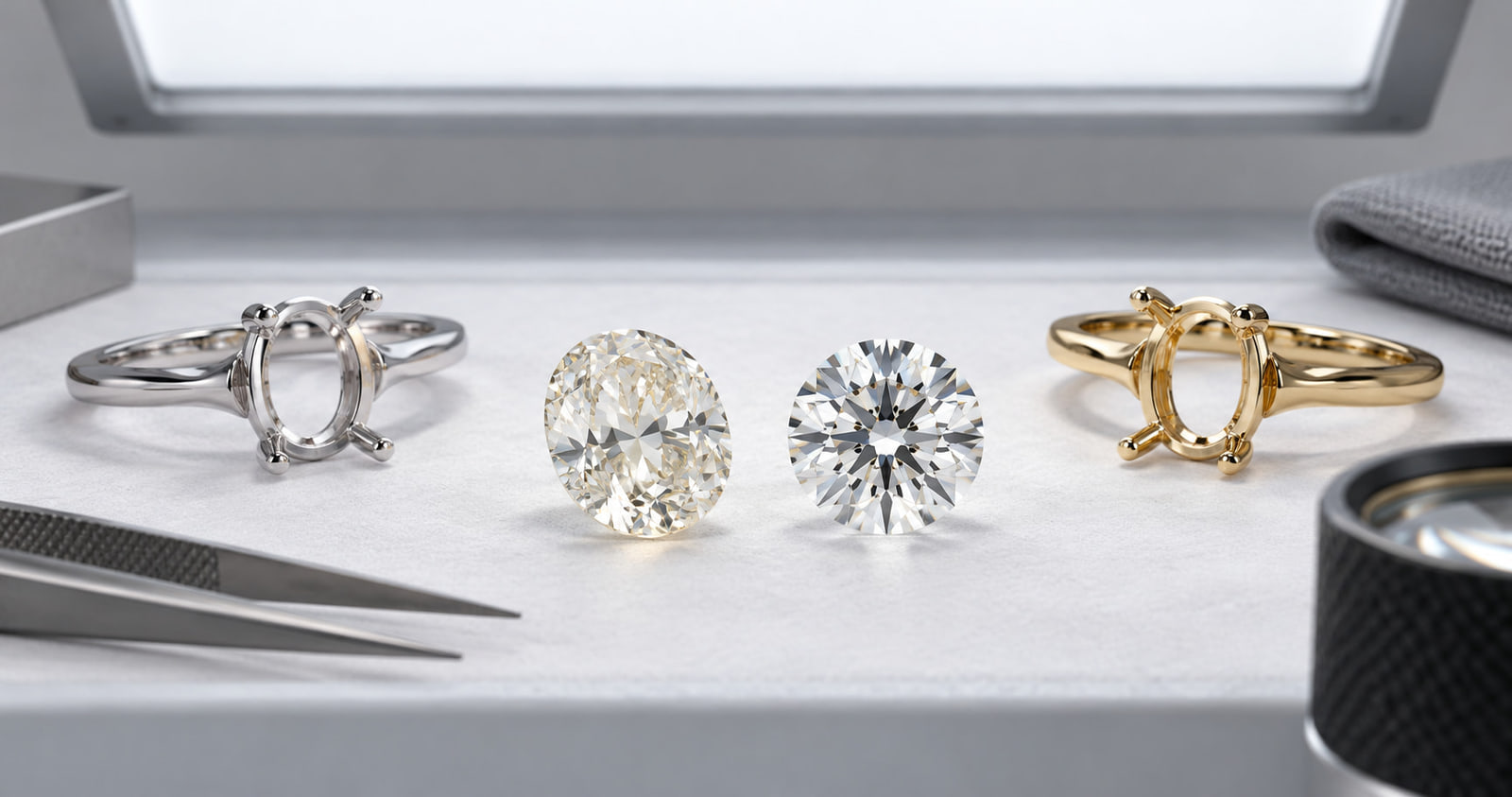
Hypothetical worked B2B example. A hypothetical brand compares two near-colorless ovals for a yellow-metal ring and a white-metal pendant. Staff do not assume that the same color choice must win in both products. They review the candidates with the intended surroundings and the relevant side stones, retain the approved references, and specify the actual acceptable appearance for each collection.
The white-metal pendant and yellow-metal ring should each have an accepted visual reference if their appearance goals differ. The brand can choose a sensible grade band for sourcing and still require final layout approval. It should not ask the supplier to reproduce a marketing photograph whose lighting and editing settings are unknown and therefore cannot be recreated reliably.
For later replenishment, preserve the reference identity and normal-light comparison method. If a new batch appears different, the same procedure helps determine whether the issue is the stone, surrounding metal, camera or lighting. This is more actionable than claiming that a grade letter is always invisible in one metal and always visible in another.
Carry the accepted decision into repeat-order planning; where the product depends on several stones, retain the pair or set approval with the candidate schedule.
How Should Buyers Resolve a Color Mismatch?
Confirm the color wording from the actual document and retain its original field. Do not enter a guessed letter for a current GIA overall assessment. Keep laboratory terminology separate from the visual note recorded by the buyer. If the purchase requires a precise grade, choose an acceptable service that actually supplies it and resolve any missing detail before shipment.
Compare clean stones under one agreed light and neutral surroundings, then review them in the intended jewelry context. Use a reference stone rather than comparing isolated photographs made on different devices. Automatic white balance, exposure and surrounding colors can change a screen impression. A subtle physical difference cannot be conclusively negotiated through mismatched screenshots from several phones.
For pairs and three-stone designs, approve the whole layout. A center can be individually acceptable while the combination looks uneven. Record whether the issue is visible warmth, another nuance or inconsistency between companions. If a replacement is proposed, repeat the layout review. Avoid extending a D-to-Z judgment into an unsupported fancy-color description or treating a letter as a complete visual specification.
For the ordering record, connect the findings to the RFQ fields and preserve the relevant side-stone specification when companion stones are included.
The current document scope is set out in GIA’s laboratory-grown services.
What Should Buyers Ask Color Suppliers in the USA, China and India?
Supplier geography can change communication and handling, but it does not settle color. Use these localized questions to understand the seller’s role, where the actual stock sits and who can supply the evidence required for this particular order.
USA / trade channels and handoff
Can a US Seller Provide Consistent Actual-Stone Color Comparisons for Online Selection?
For US remote selection, ask whether the supplier’s color imagery uses a consistent setup across candidates. Separate videos made under different white balance can exaggerate or conceal subtle differences. A seller should identify the actual stock and provide a useful comparison, not promise that a phone screen reproduces a laboratory grade precisely.
If the retailer sells coordinated sets, supply the companion-stone requirement before selecting the center. A center that looks acceptable alone may not create the intended layout. Keep the accepted reference available to the distributor when replacement candidates are proposed, especially if the original pair or set cannot be repeated from stock.
For product copy, retain the actual document’s terminology. An overall assessment should not become a guessed color letter in the website filter. If a precise grade is mandatory, establish an acceptable document service supplying it. The US sales channel can simplify communication, but the physical color decision still needs controlled observation and a clearly defined evidence source.
Stuller’s trade resources illustrate a US supply channel; ask your seller for actual candidate comparison conditions.
CHINA / sourcing coordination
Can a Chinese Coordinator Keep Center and Side-Stone Color References Aligned?
For China sourcing, share the color brief across center, side-stone and melee selection rather than treating each component as an unrelated grade filter. The designer’s intended metal and visual reference help suppliers understand the finished look. Ask for the final identified layout where consistency matters, not just separate photographs that cannot be compared reliably.
MEITUO in Qingdao can coordinate those component questions and follow up when supplier terminology differs. It should keep reported grade and buyer-observed nuance in separate fields. A supplier’s statement that a stone is white does not automatically answer a precise color-document requirement or an exclusion for a particular visible tint.
Before export, review substitutions in the same setup as the original candidates. Resolve fine appearance questions while reselection remains practical, and use physical approval if screen comparison is insufficient. Confirm available documents and order terms individually. A generic digital color chart should explain language, not become the physical standard by which the final assortment is accepted.
For its stated business role and Qingdao base, see MEITUO’s company introduction.
INDIA / manufacturing and export handoff
Can an Indian Seller Sort the Final Polished Layout by Visible Appearance as Well as Report Grade?
For Indian polished-stone offers, give the seller the actual size, shape and intended setting context when discussing color. A broad grade request may shortlist stock, but it does not fully describe the appearance goal for a large oval or an open-facet center. Ask for the final polished candidate, not a representative image of the grade band.
When several stones form a layout, require their identifiers to remain visible through sorting and approval. If one candidate changes, compare the replacement with its companions instead of accepting its letter grade alone. Distinguish a reported color result from a sales observation about face-up warmth or another nuance.
For repeat supply, retain an approved reference and the viewing protocol. This gives the seller a stable target and helps both parties investigate apparent differences caused by lighting or camera changes. Keep fancy-color requests separate from D-to-Z selection so neither side assumes that the same chart or terminology answers both evaluation tasks.
One role example is GreenLab’s Surat manufacturing and Mumbai office listing; preserve final stock identity through the handoff.
How Does MEITUO Support Color Grade Comparison?
MEITUO is a sourcing and supply-chain coordination partner in Qingdao, Shandong, China, serving jewelry brands, wholesalers, retailers and designers. For color grade comparison, its useful role is to turn the buyer’s collection requirement into an actionable supplier request: confirm which laboratory and document supplies the color wording, organize available evidence and follow up on unresolved selection questions.
Its sourcing scope includes loose center stones, melee, side stones, matched pairs and sets, and fancy-color options. For color-sensitive designs, ask MEITUO to request consistent actual-stone comparisons and preserve the intended metal, companion layout and accepted document wording in the supplier brief. The final acceptance criteria should remain with the buyer’s approved brief and the evidence supplied for the actual order.
MEITUO does not replace an independent grading or identification laboratory. Available stock, documents, treatment information, MOQ, lead time and shipping terms need confirmation per order. Send the intended application and color requirements to [email protected] so selection and order follow-up can start from specific questions.
What Should a Color RFQ Specify?
Specify the accepted color document and any grade band, then describe the actual design context. Include stone size, shape, intended metal and companion-stone relationship. If unwanted nuance is a concern, state the physical reference and approval conditions rather than relying on a digital color chart. Identify which requirements are mandatory and which can be reviewed with alternative candidates.
Ask for actual-stone or identified-layout imagery under the agreed setup, with any limitation disclosed. Make clear that image editing cannot substitute for meeting the physical appearance brief. Where a physical sample is necessary, agree how approval will be recorded and how replacement stones will be compared. Keep D-to-Z stock separate from any fancy-color sourcing request with a different evaluation purpose.
Please quote laboratory-grown diamonds for [jewelry application] in [shape and quantity], with [weight range] and [dimensions or tolerance]. Our priority is accepted color documentation, unwanted hue exclusions, neutral viewing conditions, metal context and center-to-side-stone matching. Supply available evidence linked to each stock line or clearly identified parcel. State [accepted document service], current stock location, proposed substitutions and any information you cannot confirm. Please separate product and service inclusions, confirm MOQ and lead time for this order, and provide [shipping destination and terms]. We require written approval before substitution or dispatch and a mutually agreed process for discrepancies identified at receiving.
FAQ: How Should Buyers Read a Lab Grown Diamond Color Chart
Can a Digital Color Chart Identify a Diamond’s Grade?
No. Screen and lighting differences prevent a generic chart from establishing a physical stone’s grade. Use the original document for reported terminology and controlled actual-stone comparison for selection. The chart is educational, not an independent examination of the offered candidate.
Does D Color Guarantee the Best Choice for Every Design?
It may meet a particular grade policy, but the buying decision still depends on actual appearance, size, shape, matching and priorities. Do not assume the highest letter requirement resolves setting fit or consistency. Evaluate the final candidate in the intended jewelry context.
Can a Near-Colorless Grade Describe Every Visible Hue Detail?
A grade is not a complete photograph of face-up appearance. If unwanted nuance matters, define a reference and viewing conditions. Keep the buyer’s observation separate from the original reported field and use appropriate review when the distinction affects acceptance.
Should Yellow Metal Eliminate the Need for Color Review?
No. Review the actual design and candidate rather than applying a universal rule about metal. Surrounding color can influence impression, but it does not replace the agreed grade or matching requirement. Record the chosen reference for that particular product.
Does GIA Standard Mean One Specific Color Letter?
No. Do not reverse-map an overall category into a precise letter. Read the current service scope and request an accepted document supplying individual color detail when required. Preserve the broad category as its own field in inventory and product data.
How Should a Buyer Compare Center and Side-Stone Color?
View the identified stones together under consistent conditions and against the intended reference. Approvals made separately on different screens may not establish a coherent layout. Repeat the comparison after a substitution and retain the final stock mapping with the approved arrangement.