 English
 Español
 Português
 Deutsch
 Français
 Italiano
 Nederlands
 العربية
 日本語
 한국어
 ไทย
Quick Answer
A lab grown floating diamond necklace does not necessarily contain a drilled diamond. Floating is a commercial description of an apparently light or discreet suspension, and the actual product may use a small bezel, unobtrusive prongs or another disclosed construction. Request a front, side and back drawing that identifies what retains the stone and where the chain passes. Approve the intended movement on a physical sample before buying a production parcel. Do not infer a hole, adhesive, hidden wire or particular repair method from the name alone. For procurement, separate the desired appearance from the mounting specification, and identify whether the offer includes a loose diamond, a setting component, a chain or a completed necklace.
What Does Floating Mean on a Supplier Product Page?
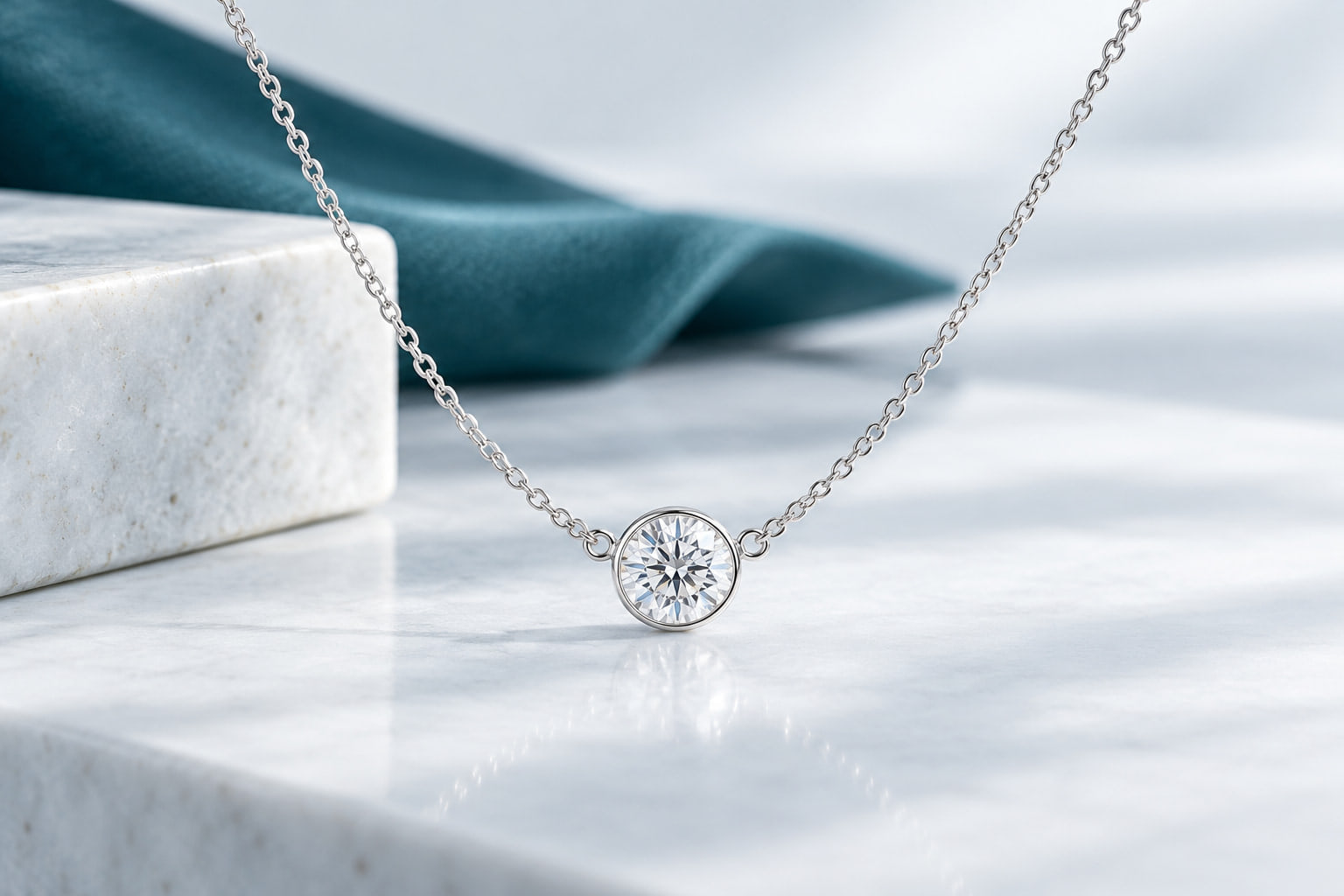
Use a named example to test the assumption. Brilliant Earth's Floating Solitaire Pendant describes bead prongs. That particular seller's construction shows why the word floating cannot establish that a diamond is drilled. It does not define every floating necklace, and the illustrated concept on this page uses a discreet bezel rather than reproducing that named product.
Convert the supplier's description into separate data fields: stone material, shape, dimensions, retention method, chain path and component scope. A title can remain expressive for customers while the purchase specification remains literal. If the seller cannot explain what retains the stone, the buyer does not yet have enough information to approve it.
For an offer described as drilled, request a drawing and actual close views showing the opening, its location and the connection. Do not substitute a generic internet explanation for product evidence. Drilling for suspension is also a different question from laser drilling used in a clarity treatment, so avoid ambiguous invoice wording. If that construction is not required for the collection, exclude it explicitly instead of allowing an unreviewed substitution.
The loose-versus-finished scope guide is relevant because a loose stone offer alone supplies none of the chain or retention evidence. Keep those component responsibilities visible in the commercial comparison.
Discreet Bezel VS Minimal Prongs: What Changes for Buying?
| Buying question | Discreet bezel concept | Minimal-prong concept |
|---|---|---|
| Visible structure | Continuous or specified partial rim around the outline | Separate metal contacts at defined positions |
| Required stone information | Actual outline, depth and rim-related fit | Actual outline, depth and contact locations |
| Sample review | Rim consistency and chain path through or beside the mount | Contact symmetry and chain clearance beside the head |
| Repair discussion | Ask how the maker opens or replaces the mounting | Ask how the maker accesses and inspects the contacts |
| Floating claim | Appearance must be demonstrated at final scale | Appearance must be demonstrated at final scale |
Neither column is a performance ranking. The maker must validate its own construction. A tiny rim may still look visually heavy around a small stone, while prongs that disappear in a large render may become prominent in an actual sample. Compare both at the same stone dimensions, finished chain and viewing distance.
Ask the design team which feature creates the desired impression: very little visible metal, a chain that seems to run behind the stone, or a stationary stone between chain ends. Those are different briefs. A buyer who approves only the word floating may receive a technically different mounting even though the supplier considers the marketing description accurate.
How Should Chain Movement Be Specified?
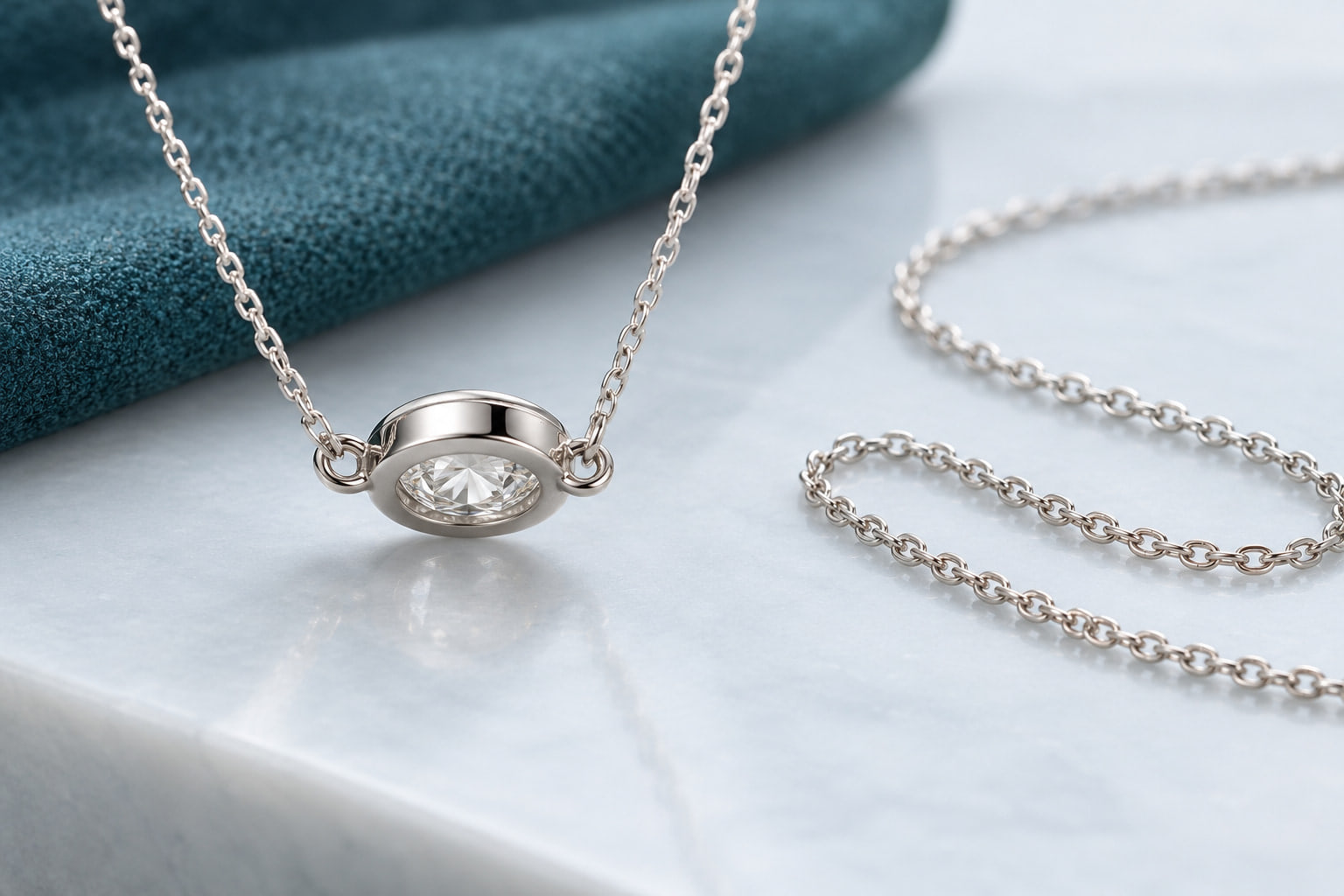
Decide whether the stone is intended to slide along the chain or remain fixed between two chain segments. For a sliding design, identify the usable chain section and ask whether the clasp or end fitting can pass through the mounting. A mounting that travels over the chain body may still be trapped by a larger end component. For a fixed design, show the left and right attachments and their orientation on the drawing.
Test the proposed chain with the actual mount. Observe whether the stone settles facing forward, whether the chain catches at an attachment and whether the head travels to an unintended location. Record the sample chain's specification so a later substitution does not silently change the approved behavior. These observations are project checks, not certified load or wear tests.
Photograph the back on the same scale as the front. This often makes the chain tunnel or attachment easier to understand than an enlarged face view. Require the maker to explain how the chain will be installed and serviced. If the chain cannot be removed without opening the mounting, note that in the repair instructions before the buyer approves packaging copy.
Our everyday jewelry application page can frame the use case, but intended everyday use does not establish that any proposed mounting is suitable. The completed sample and its maker's verification remain necessary.
Hypothetical Example: Two Floating Concepts for One Launch
An invented buying team plans 80 necklaces and compares a sliding bezel concept with a fixed minimal-prong concept. Both use one diamond per necklace. The stone requirement is therefore 80 accepted centers, plus the buyer's chosen four loose reserves. It is not 84 completed necklaces, and the reserve count does not appear in the mounted weight statement.
The sliding prototype has a chain body measuring 1.0 mm across and an end fitting measuring 2.4 mm at its widest point. The supplier's proposed 1.8 mm passage might accept the chain body but cannot be assumed to pass the end fitting. Those illustrative measurements are not recommended clearances. The maker must resolve the actual assembly sequence, component shape and required tolerances before the design is approved.
The fixed prototype has no sliding passage. Its open question is the alignment of the two chain attachments. On the buyer's sample, the right side sits higher in a front photograph. The maker checks whether the attachment geometry, chain length or assembly caused that observation. Buying a higher-grade diamond would not resolve the documented imbalance.
The team chooses the bezel direction only after a revised prototype shows the required movement and assembly access. It freezes the actual accepted stone dimensions, requests four like-for-like reserves and records the compatible chain reference. If a later chain offer changes the end fitting, the old passage approval is reopened rather than treated as permanent permission for all chains.
Which Supplier Channel Can Document the Mounting?
Send the same visual brief and literal construction questions to each channel. Compare how clearly the seller separates loose-stone selection from completed mounting responsibility. Country location alone does not answer whether the chain interface has been reviewed.
USA / Name-to-construction consistency
What Should a US Floating-Necklace Listing Prove?
A US retail product page can help identify a design direction, but it should not become an unexamined technical specification. The named bead-prong example discussed above demonstrates that floating terminology spans actual mounting choices. Ask the seller for the construction of the exact product variant being quoted, including whether its chain is removable.
When a retailer works with a separate local bench, confirm what arrives: a loose center, an empty mounting, a partly assembled necklace or finished jewelry. Give the bench the chain reference and actual stone dimensions before it agrees to use the components. A product return allowance is not automatically permission to set or modify the item and then return it.
For after-sales planning, identify which party can inspect the retention and which party can supply a replacement chain. Keep customer-facing origin language and construction descriptions aligned with the accepted item. A clear handover helps the retail team answer whether the stone slides without improvising an explanation based on the product name.
CHINA / Drawings before substitutions
How Should a Chinese Coordinator Compare Floating Proposals?
For a China-facing sourcing exercise, circulate one annotated construction drawing rather than asking several suppliers for a floating necklace in general. A visual reference may lead different workshops to quote different solutions. MEITUO in Qingdao can coordinate the loose-stone requirement once the buyer identifies which concept has actually been approved.
Ask each responding party to mark the chain route and stone-retention method on its own drawing. Record exclusions, such as no stone drilling or no change to the accepted bezel outline. If a supplier proposes an alternative, compare it as a distinct sample with a new revision identifier. Do not let a translated style name stand in for a component specification.
Before dispatch, request a packing schedule that distinguishes diamonds from findings and chains where those are supplied by different businesses. Confirm which workshop assembles the combination and who handles rejected components. This is especially useful when a diamond supplier can satisfy the center dimensions but has never seen the final chain hardware used by the maker.
INDIA / Stone scope versus necklace scope
What Should an Indian Loose-Center Quotation Leave Explicit?
Greenlab lists Surat manufacturing and Mumbai corporate contacts. When approaching an Indian loose-stone seller through such channels, specify that floating describes the planned jewelry appearance. It does not authorize the seller to infer a mounting construction or modify a stone.
Provide the actual dimension window accepted by the jewelry maker and ask for evidence of the offered stones' outlines and condition. If the supplier also offers a completed component, request a separate scope identifying who performs that work. A cutter's capacity to deliver a center does not by itself show that the chain passage or attachments have been validated.
Preserve each approved center's identity through export packing, particularly when larger individually documented stones are involved. At the receiving workshop, compare the delivered dimensions with the mount before assembly. Any proposal to alter a stone or substitute a different center must return to the buyer for review rather than being treated as routine fulfillment of the same floating style.
What Evidence Should Precede a Floating-Necklace Order?
Approve a sample dossier containing an actual front view, side view, back view and chain-path drawing. Label the stone dimensions and the construction revision. Add a short movement record, showing the sample being placed and allowed to settle. A dramatic product photograph is useful for merchandising, but it should not be the only evidence in the buying file.
For loose stones, inspect outline and condition before setting. Agree who reconciles each center with its receiving record. For mounted samples, ask the maker to inspect retention and chain connections using its stated process. GIA notes that diamonds can chip under impact; hardness is not a substitute for appropriate handling or a validated mounting.
Keep commercial descriptions consistent with the accepted construction. Avoid wording that promises an invisible structure if the rim is plainly visible on the actual product. In the US, the FTC guidance requires clear laboratory-grown origin disclosure. That is separate from explaining the visual floating effect and does not validate the mounting.
At repeat order, compare the mount and chain as a combination. If the stone dimensions, rim design or attachments change, determine whether the existing sample remains representative. A change log should say what was reapproved and by whom, so the workshop does not unknowingly mix incompatible component revisions.
Agree a simple defect vocabulary before the production review. A visible rim-width difference, restricted sliding movement, front-to-back rotation and a mismatched chain attachment are separate observations requiring different remedies. Mark the location on a photograph and describe when the issue appears. Avoid summarizing all four as a bad floating effect, since that tells the maker little about what needs to change.
Retain the rejected prototype beside the accepted revision until the first production run is reviewed. Its purpose is to preserve the decision history: the team can see which feature was corrected and avoid approving the old component again when a similar sample arrives from another source.
How Can MEITUO Help Clarify a Floating-Necklace Inquiry?
MEITUO is a Qingdao, Shandong sourcing and supply-chain coordination partner serving jewelry brands, wholesalers, retailers and designers. In a floating-necklace project, it can help turn the accepted loose-stone requirement into a selection inquiry and coordinate supplier responses. Its product scope includes loose center stones, melee, side stones and matched sets; an expressive necklace name should not be mistaken for a confirmed finished-product offering.
Send the chosen mounting concept, actual center dimensions and sample revision so the sourcing discussion focuses on suitable diamonds. MEITUO can support product selection, confirmation of quality requirements and order follow-up while the jewelry producer remains responsible for the agreed mounting and chain verification. Any additional service must be discussed explicitly.
Contact [email protected] with quantity, matching reference and documentation needs. Confirm availability, MOQ, lead time, treatment information and shipping terms per order. The loose diamond range and jewelry applications pages provide starting points for that discussion, rather than a promise of a particular floating construction.
How Do You Write a Floating Diamond Necklace RFQ?
Put the literal mounting description next to the visual name. State whether the stone is sliding or fixed, identify the intended chain and attach images of the approved sample. If drilling is excluded, say so. If any supplier proposes a different retention method, require a separate drawing and quotation rather than accepting it as an equivalent under the floating label.
List loose diamonds, mounts, chains, assembly and final inspection as separate scope lines, even when one seller quotes all of them. Define where the buyer's acceptance occurs and what changes reopen sample approval. This prevents a stone-only quote from appearing cheaper than a completed-necklace quote simply because major components are omitted.
Use the RFQ preparation guide for commercial fields and add the construction questions above. Require actual product evidence for unusual proposals. The next useful step is a complete and reviewable sample brief, not a general assurance that the stone will seem to float.
Please quote [quantity] loose laboratory-grown centers for a [sliding or fixed] floating necklace, using mounting drawing [revision] and chain reference [code]. The approved construction is [literal retention method]; [excluded modifications] require separate written approval. Provide actual dimensions, condition images, available documents and treatment information against our accepted sample. Separate any mount, chain, assembly and inspection charges from loose-stone supply. Confirm [reserve quantity], MOQ, lead time, packing identities and shipping terms. Require approval before changing the chain interface or stone geometry. The finished-jewelry maker will verify retention, chain movement and service access on the completed sample.
FAQ: Floating Lab-Grown Diamond Necklaces: Setting Clarity
Does Floating Always Mean a Hole Through the Diamond?
No. The term can describe discreet mounting approaches, including the verified bead-prong example discussed here. Ask for the actual construction drawing; never infer drilling from the title.
Is the Bezel Concept Pictured the Named Retailer Product?
No. The illustration shows a discreet bezel concept. The cited retailer example uses bead prongs and is included to demonstrate that the floating label does not define one construction.
Can Every Floating Pendant Slide on Its Chain?
No. Some concepts slide, while others attach between chain segments. Identify the chain route and review the actual sample before writing customer instructions.
Why Does the Chain End Fitting Matter?
Its width may exceed the chain body. A passage that accepts the chain itself may not allow assembly or replacement through the end fitting. The maker must confirm the complete interface.
Can One Diamond Fit Any Discreet Mount of the Same Carat Weight?
No. Actual outline, dimensions and depth must match the chosen mounting. Carat weight alone does not establish rim fit, contact location or assembly clearance.
What Changes Require Another Sample Review?
Reconsider approval when the retention method, chain hardware, stone dimensions or attachment geometry changes. Document which previous observations remain valid and which need repeating on the revised combination.